
On the edge of the Avoca river, where it widens towards the Irish Sea, a pair of pale green forms sit against the horizon, low and sculpted, their surfaces serrated with angled louvres that catch the light. Without decorative cladding to soften their purpose, they stand deliberately in plain sight.
What, then, is this architectural pleasure? Surprisingly, it’s a wastewater treatment plant.
In Ireland, like most places, we are not accustomed to encountering sewage infrastructure as an architecturally-designed object. These are exactly the buildings we squirrel away in industrial estates, hidden by as much distance as a planning application can manage. However in Arklow, Co Wicklow, the plant occupies a prominent waterfront site without apology, announcing itself as something unfamiliar: a new form of internationally celebrated, state-backed civic architecture.
That in itself is surprising, yes. But the deeper surprise to those who are unfamiliar with Arklow is what it replaced, which is to say, absolutely nothing; for decades, Arklow famously had no wastewater treatment at all. As such, the town became shorthand for infrastructural failure, cited in European Commission proceedings and fined for noncompliance with minimum regulatory standards.
READ MORE


In 2016, after decades of high profile failed attempts to resolve this issue, Uisce Éireann finally selected the Ferrybank site and started the project from scratch on a contaminated former munitions factory. Against the backdrop of more than 30 years of legal snakes and ladders, what finally emerged from Ireland’s most stubborn case study in infrastructural failure is now an international reference point for design.
All of which begs an obvious question: why bother designing a sewage plant at all? In most places, these facilities are hidden behind fencing and stripped of any civic expression. But the plant occupies a prominent promontory on the north quay, visible from across the river, and so invisibility was never really an option. What could have been an apology became instead an assertion – that even the management of waste is part of a town’s public identity.
And yet, Ireland does have a tradition of building with care for public places. The Office of Public Works (OPW) has been charged with leading the care and maintenance of civic buildings and landscapes since 1831. It manages over 2,500 state properties and 780 national monuments, among them the Brú na Bóinne Visitor Centre, which the OPW submitted to the Venice Biennale last year, where it was exhibited as an exemplary piece of site-specific architecture. Granted, not all of the OPW’s work is beautiful, and much of it goes unremarked at best, while serving as an inconvenience for modern affairs at worst. But overall it acknowledges a long institutional memory of Irish life through architecture, pointing at the fact that a building does more than just serve a function for today.

Which makes it all the more jarring that the infrastructure now most visibly reshaping Ireland has abandoned the idea of civic meaning entirely: data centres. Across the country, windowless sheds rise on the edges of towns, with their architectural anonymity optimised for server racks, cooling systems and grid connections. Data centres shape national debates about energy capacity and land use, and they are central to Ireland’s economic model. They are, by any measure, among the most consequential buildings in the country. And yet they express nothing about where they are geographically, or who we are as a people.
Contemplating Arklow’s wastewater plant beside any of the 128 data centres in the country and the contrast is revealing, and infuriating. Why does the state design sewage beautifully, yet allow the infrastructure of global capital to remain so mute?
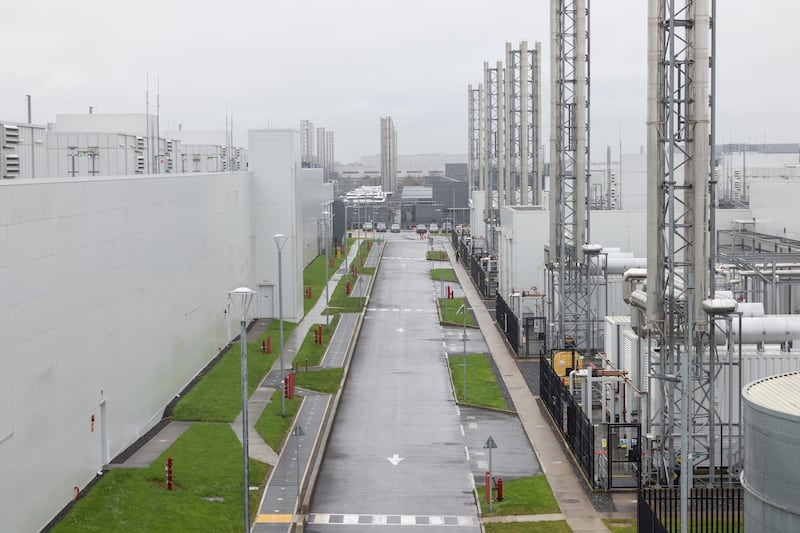
This distinction between civic infrastructure and extractive infrastructure says a great deal about Ireland’s economic development path. The neoliberal era brought glass-fronted tech headquarters to the Docklands, logistics hubs along motorways, and tax-optimised industrial sheds for data storage; in doing so prioritising competitiveness, efficiency and capital mobility to the benefit of those outside of Ireland. So much of what was built was functional, profitable and importantly, architecturally placeless. The State’s role in this regard was to facilitate and enable such “progress”.
However, Arklow ambitiously suggests something different has become possible: that a project delivered by the Irish State could be functional while also being architecturally considered. And while we frequently debate missed housing targets, grid bottlenecks and a lack of planning reform, here is a wastewater plant that was actually delivered, is actually operational – and is actually architecturally ambitious.
So if the State’s capacity to deliver groundbreaking work is not entirely absent, perhaps the question may instead be one of priority and purpose. Is it choosing to care for its communities or global shareholders?
If we are capable of designing wastewater systems with care, why not the rest of our infrastructure? Data centres dominate our energy debates, shape regional development and draw heavily on the national grid, but they are built as if Ireland were merely a convenient socket.
[ Why is Ireland so lacking in architectural ambition?Opens in new window ]
The architectural structures on the edge of the Avoca are beautiful, practical, and highly engineered forms performing an unglamorous task. Yet, in their deliberate presence, they register something larger and too important to fail to discuss; a record of intention.
If even the management of waste can be intentionally designed in a way that creates a statement about who we are today, are we willing to demand the same of everything else we build? Otherwise Arklow will remain a beautiful exception in a landscape of boring indifference.
Sinéad O’Sullivan is a business economist, formerly at Harvard Business School where she served as the head of strategy of the HBS Institute for Strategy


