
You’d expect the home team to put in a good showing at a German motor show. You’d expect the likes of Volkswagen, Audi, BMW, Opel, and Mercedes to step up to the challenge of putting on a memorable modern-age motor show.
And it’s true - the Germans have given us a cracking show so far, with lots of new model debuts and even an announcement that a famous model, though doomed, is going to survive into the electric era.
Volkswagen Group, as a whole, had a darned good go at dominating Munich, right on BMW’s doorstep with not one, not two, but a massive five reveals of seriously important new models.
Fair enough, four of those cars are effectively the same under the skin, with the Skoda Epiq, Volkswagen ID.Polo, ID.Cross, and Cupra Raval all being part of the so-called Electric Urban Car Family (EUCF) and so built on the same underpinning platform.
READ MORE


That means that all four will have a range of around 425km, and a front-wheel drive single-motor layout with 210hp to start with, rising to 225hp for the gorgeous little ID.Polo GTI, which, as with the standard ID.Polo, is also being shown in lightly disguised form in Munich.
This marks the first coming together of the Volkswagen ID lineup and its pre-electric models, and not coincidentally it’s happening during the Polo’s 50th birthday.

The ID.2all concept car we saw two years ago has thus become the new Polo — the harlequin-like camouflage wrap of which is clearly a nod to the multi-coloured Polos of old — cementing one of VW’s most long-serving model names for the future, and laying the ground for the likes of an ID.Golf and ID.Tiguan, maybe even an ID.Passat to follow.
Wicklow resident Thomas Schäfer, chief executive of the Volkswagen brand said: “Our model names are firmly anchored in people’s minds. They stand for a strong brand and embody characteristics such as quality, timeless design and technologies for all. That’s why we’re moving our well-known names into the future. The ID.Polo is just the beginning.”
Not so much a hint as a blatant reveal of what’s to come next is the ID.Cross, a slightly taller crossover built on the same MEB Entry platform, and - rather obviously - set to become an electric answer to the current T-Cross. The car in Munich is a concept model, but aside from the polished surfaces and humungous alloy wheels, you can clearly see the production car beneath.
Sitting above the ID.Cross in the lineup is a new VW T-Roc, which is longer and roomier than the current model, steals a bit of the ID.4’s styling, and, crucially for Irish buyers, now comes with a ‘full’ hybrid version to rival the Toyota C-HR and Corolla Cross.

Across Munich, both Cupra and Skoda were showing off their takes on the ID Cross’ idea. The Skoda Epiq, just 4.1-metres long but with a whopping 475 litre boot, is set to be the most practical of this new compact electric family, but it looks smart too in its production-ready bodywork, with a mixture of family-hatchback upper surfaces and chunky SUV lower body.
Cupra was keeping its Raval under slightly more wrapping than the Epiq - literally. The car was wrapped in a vinyl overcoat with an urban map print, emphasising its city-friendly nature. You can clearly see the more aggressively sporty front end, though, in contrast to the bluffer shapes of the VW and Skoda. The sporty Spanish brand also had a far-out concept car called the Tindaya.
Speaking of sporty, Audi came to Munich to remind us all that there’s a life beyond electric SUVs, with a strikingly minimalistic concept car called the Concept C, which everyone at Audi is straining at the leash to not call a new TT, but that’s basically what it is.

The show car even has much of the same ‘Bauhaus’ cleanliness of line so perfectly used by the original 1998 TT, both inside and out, and the good news is that it will head to production soon — Audi boss Gernot Dollner reminded us that the brand is not in the business of making pie-in-the-sky concepts anymore.
The Concept C or TT or Neue TT or whatever it will be called gets a neat electric retracting roof, rather like a Porsche Targa roof, which is appropriate as underneath, the Concept C shares its chassis and batteries with the imminent new Porsche Boxster. Will the slim, upright grille — reminiscent of Audi’s 1930s Auto Union Grand Prix cars — make it to production? Don’t bet against it. Equally, the production Concept C could be one of the first Audis to use software co-designed with American EV startup Rivian. Such software has been confirmed for on-road use by 2028.
VW’s most important car? That might just be the new Skoda Octavia, which is previewed by the Vision O concept car shown in Munich. This is a preview of the all-electric Octavia; hybrid and plug-in hybrid Octavias will remain on sale alongside this new electric model, which is due to hit dealerships in 2028 alongside a similarly all-electric Volkswagen ID.Golf. Both will use VW’s new SSP platform, which is significant.
Significant, why? Because the SSP platform — which has been hugely delayed — is far more sophisticated, adaptable, and more closely-integrated with its software (and it’s the software which has caused the delays) than the current MEB platform, which underpins the likes of the Skoda Enyaq and Elroq, and the VW ID.3 and ID.4.
SSP will allow faster charging speeds, its remotely-updatable software will mean that the car might actually get better as it ages, including how much range you can squeeze from a battery, it’s compatible with next-generation solid-state batteries, and - critically for VW - it will be cheaper to make than the current MEB platform.
That cost calculation is especially important, as VW Group has just announced how hard it’s been hit by the Trump Tariffs, citing a 29 per cent tumble in second-quarter profits, a €1.3 billion hit in the first half of the year, and a fall in profit margin from as much as 6.5 per cent, down to as low as 4.0 per cent. Skoda’s profit margin last year? A robust 8.5 per cent...
Also trying to upset BMW’s home-team applecart was Mercedes, which brought along its all-new electric GLC SUV, which will sell alongside the existing combustion-and-hybrid version for a bit, but which for now was making its debut with an ultra-long-range electric version, capable of a massive 701km range on one charge.
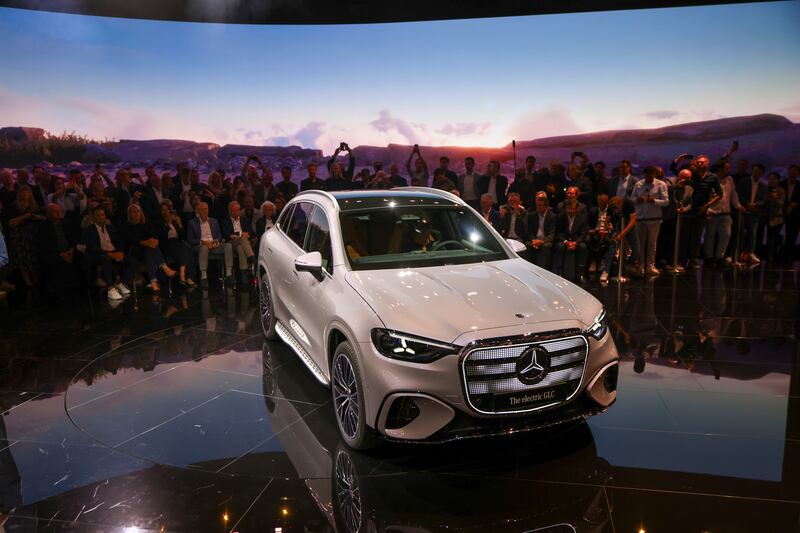
Speaking of massive, there’s the grille - Mercedes is moving way from the blobby, formless shapes of the current electric EQ lineup (indeed, the EQE SUV and saloon will be replaced by this GLC and the new electric C-Class in short order) and is looking back as far as its classic 1950s ‘Ponton’ models for inspiration for tall, upright grilles. As VW’s Mindt inferred, Europe’s brands have heritage as the one weapon which can’t be deployed by their Chinese rivals, so better make the most of it, eh?
Inside, the GLC gets the biggest screen ever offered by a European car maker as an option — the latest Hyperscreen is a full metre in width, and essentially encompasses all of the dashboard bar the air vents.

The massive surface contains 1,000 LEDs and is dimmable in separate sections, something that Mercedes is taking out a patent upon. You can get penalty points for looking at your phone while driving, but a metre-width touchscreen? That’s fine, apparently…
Well, the pretenders on the Munich pitch had their moments, but then BMW itself swung into action.
A 701km range for the Merc GLC? That’s cute, says the new BMW iX3, a completely new car based on the company’s brand-new ‘Neue Klasse’ electric car platform, promising a range of up to 805km for the four-wheel drive model that will arrive first, in early 2026.

Better batteries with a 400kW charging speed, a clever new electronic management system, which includes a driving module called ‘The Heart Of Joy’ and a new coast-to-coast instrument screen that runs along the base of the windscreen all add up to make the iX3 potentially interesting, but the biggest news is the nose, which sees the return of a 1980s-style horizontal grille look, with small inset ‘kidney grilles’ instead of the vast nostrils of the current iX model. It’s a look that’s far more handsome.
If the iX3 has our curiosity, then the i3 has our attention. BMW isn’t quite ready to fully reveal its new all-electric 3 Series saloon, but the car did make a Munich appearance in a camouflage wrap, showing that it has kept the dramatic sharp-edged styling of the Neue Klasse concept. The new saloon will go on sale in late 2026, and given that it uses the same electric architecture as the iX3, it could be pushing towards a range of almost 900km when it arrives. Plus there will be Touring estate and ultra-fast, four-motor i3M versions by 2028.
According to BMW’s chairman, Oliver Zipse: “For the past 50 years across multiple model generations, no other model has been as tied to the BMW brand as the 3 Series. It represents sheer driving pleasure at its finest. The iX3 and i3 are powerful symbols of the broad spectrum the Neue Klasse models will cover.
Opel and Mini traded electric car hot hatch blows, with the wild 800hp rally-car-of-your-dreams Corsa GSE concept teasing a humbler hatchback due to arrive in 2026, but you can download this concept version if you’ve got a PlayStation and the Gran Turismo video game. Mini’s effort was a little more tame, working with lifestyle label Deus Ex Machina to create special versions of the Cooper S Works in both petrol and electric forms.
Elsewhere, newly-arrived Chinese brand Leapmotor - which is actually part-owned by the European Stellantis Group (Peugeot, Opel, Fiat etc etc) — showed of not a new SUV but a family-sized five-door hatch, called the B05.

It’s not hard to see where Leapmotor’s inspiration has come from as the B05 looks very much as if you grafted the front end of a current VW Golf onto the back end of a Mercedes A-Class, but it should have a 420km range from its biggest 67kWh battery, and most important of all, a price tag below €30,000 when it arrives here next year.
Fellow Chinese brand Changan also announced its Euro-market intentions, with an electric SUV model called the Deepal S07, which looks very much as if you’ll lose it in a busy supermarket car park.
A Chinese brand that’s more familiar to us - BYD - showed off something that you might not expect. An estate car. Specifically the new Seal 6 DM-i Touring, a handsome wagon with a big boot and a long-range plug-in hybrid setup that’ll go 100km on electric power, and a claimed 1,300km on both battery and a full fuel tank.
Thank heavens someone’s making something that’s not an SUV but there’s a corresponding saloon if you don’t fancy the estate. BYD boss Stella Li also confirmed that the first model to be made in the company’s new European factory in Hungary will be the compact €17,995 Dolphin Surf electric hatchback, starting later this year. There was also confirmation that BYD’s own ultra-fast chargers, called ‘Flash’, will open come to Europe, with 200-300 charging points due by the middle of 2026.
Porsche - which is having a bad week, what with its de-listing from the Frankfurt stock exchange - had two new cars in Munich, but both are familiar. The new electric version of the Cayenne boasts active suspension, 800-odd-hp, and now optional wireless charging.

The latest 911 Turbo gains the same hybrid system as seen in the regular 911 Carrera, and in Turbo S form now develops a huge 710hp. 0-100km/h? Just 2.4 seconds… Porsche was also making noises about a new compact SUV with combustion power, to counter falling Macan sales since that model went electric-only, and — shock, horror — that might be Porsche’s first ever front-wheel drive model.
There was also, alas, an announcement that no more orders are being taken for the petrol-powered 718 Boxster and Cayman, as Porsche is gearing up for the launch of an all-electric replacement, which few buyers may actually currently want.


