
What is Artemis II?
Artemis II is Nasa’s first crewed mission to the moon since Apollo 17 in 1972. It will see four astronauts fly on board the Orion crew capsule on a “figure-of-eight” journey that will take them on a loop around the far side of Earth’s only natural satellite.
On day six, the flight path is expected to take the crew deeper into space than humans have ever gone before. The plan is that Orion will exceed a record set by Apollo 13 when it was unable to land on the moon as intended in 1970.
The spacecraft will use a free-return trajectory – a path that naturally swings it back toward Earth. In the early hours of day 10, the mission is scheduled to conclude with Orion splashing down off the coast of San Diego.
Are there risks?
Yes. “This is a dangerous mission, this is a test flight mission,” says Jared Isaacman, the administrator – or chief – of Nasa, the United States space agency.
READ MORE


When is it launching?
Nasa has started a countdown for a lift-off that will take place no earlier than 11.24pm Irish time tonight. That’s 6.24pm local time at the launch site at Kennedy Space Center in Cape Canaveral, Florida. There is a possible launch window of two hours today. Further opportunities are available every day until April 6th, but then the next one won’t be until April 30th.
Why might the launch be postponed?
Weather conditions are a key factor. If there’s too much cloud or wind, Nasa will call it off. As of Tuesday evening, the forecast suggests there is an 80 per cent chance of favourable weather for a “go” today.
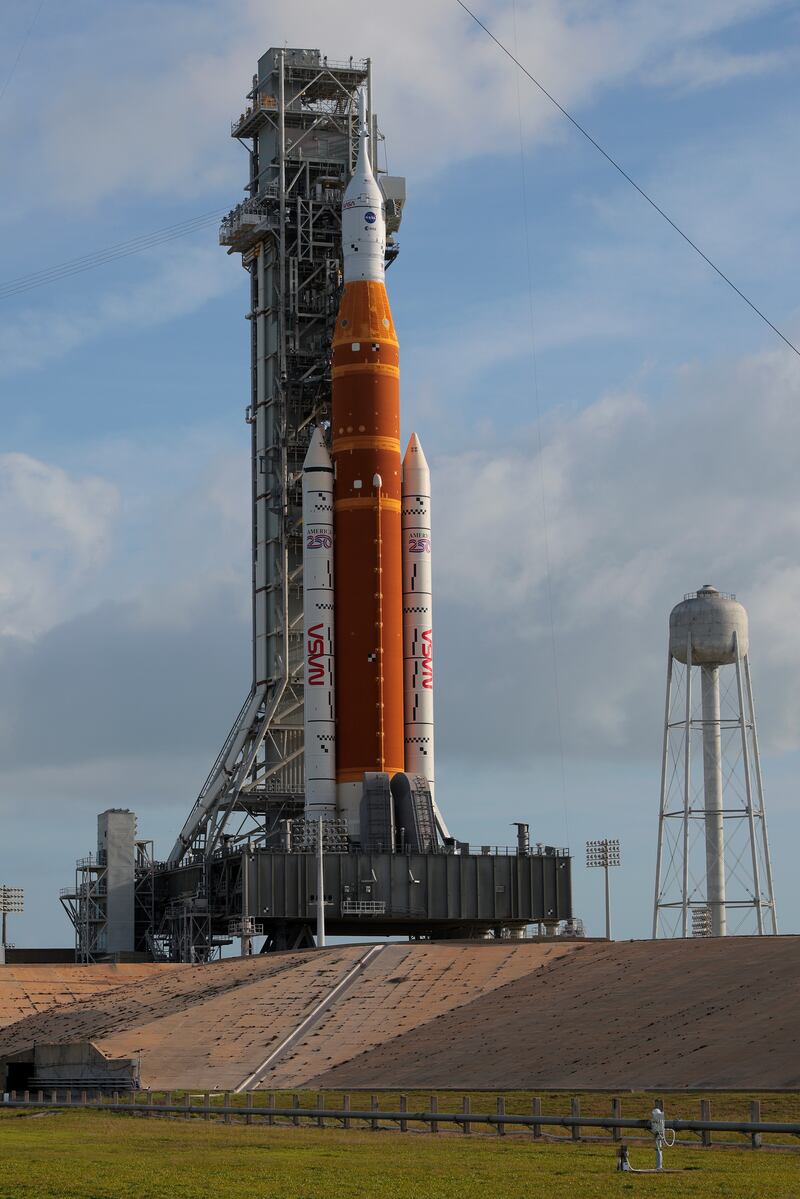
The other reason why it might be postponed is the discovery of technical issues. Nasa originally hoped to launch Artemis II in February but it had to delay it due to hydrogen fuel leaks. The Boeing-built Space Launch System (SLS) rocket then had to be rolled back to its hangar to be fixed after engineers found a “helium flow issue” during a wet dress rehearsal.
[ Artemis II launch: Crowds gather for glimpse of historic Nasa moon missionOpens in new window ]
Who are the crew of Artemis II?
Nasa astronauts Reid Wiseman, Victor Glover and Christina Koch, and Canadian Space Agency astronaut Jeremy Hansen, will be the ones strapping themselves in.
Wiseman (50) is the mission commander. He’s a former US Navy test pilot who spent six months on board the International Space Station (ISS) in 2014.
Koch (47) will become the first woman in deep space. The mission specialist, who is an engineer and physicist, is already a history-maker, having set the record for the longest single space flight by a woman when she spent 328 days on the ISS in 2019. She also took part in the first all-female spacewalk, with Jessica Meir.
Glover (47) is the pilot. A former US Navy fighter and test pilot, he will become the first person of colour in deep space. He previously spent 168 days as a flight engineer on the ISS from November 2021.
This will be the first time in space for Hansen (50), a former Royal Canadian Air Force fighter pilot and physicist. The mission specialist previously led a new class of Nasa astronauts through two years of training.
Will the crew land on the moon?

No, but this test flight will pave the way for a return to the surface. The Artemis III mission, scheduled for 2027, will include rendezvous and docking tests in low Earth orbit. These will involve one or both of the lunar landers being developed for Nasa by commercial companies SpaceX and Blue Origin.
If all goes according to plan, the Artemis IV mission will land on the moon in 2028. The crew for this historic voyage has not yet been announced, but they will join the 12 men who walked on the moon during the six Apollo landings that took place between 1969 and 1972.
Why did the US abandon then revive its ambitions for the moon?
Reaching the moon first allowed the US to declare victory in its space race with the Soviet Union. Amid economic pressures and other political priorities, Nasa’s budgets were cut, and it switched its focus to developing the partially reusable Space Shuttle and later to working with other countries, including post-Cold War Russia, on the ISS.
Now there’s a new space race under way, this time between the US and China. The latter has landed several probes on the moon, including one that collected rock and soil samples from the far side. Nasa, backed by Donald Trump’s administration, is keen to build a $20 billion lunar base before the Chinese and “do the other things needed to ensure American leadership in space”.
Will the 2028 mission be a case of retracing our steps?
No. The next lunar landing site will be on a part of the moon where no human has previously walked: the south pole region. Astronauts will try to locate ice deposits under the surface of what are known as “cold traps”, or shadowed areas that never see direct sunlight. These ice deposits have the potential to reveal more about the history of Earth and the solar system, and they could also be a valuable resource for Nasa as it makes plans for a lunar base. It expects that the Artemis V mission, scheduled for late 2028, is when it will start building this base.
Then what?
Next stop: Mars.
[ Countdown under way for first manned moon mission in more than 50 yearsOpens in new window ]


