

I’ve walked, cycled and driven on Dublin’s streets for 30 years but the closest I‘ve come to serious injury – or worse – was on an e-scooter.
It was the spring of 2019 and the zippy little machines were suddenly all the rage. For a wheeze and for work purposes, I gave one a whirl and such was the excitement in The Irish Times that grown men and women – people who really should have known better – begged for a turn to whizz through the newsroom on the nifty device.
After the brief trial I bought one and travelled happily – if ridiculously – around the city for a month or so until, one miserable spring evening, I found myself travelling under a bus.
It was a damp early April day at the junction of Abbey Street and O’Connell Street and the road was slick and greasy with rain. I zipped around the corner at maybe 15km/h when suddenly the tiny wheels, with nothing by way of a tyre tread, went from under me, causing the scooter to skitter across the street. I went flying and landed in the road just as a bus came thundering past, close enough to make me start reconsidering my commuting options.
READ MORE


A couple of days later, still scooting, I was gliding past a car, helmetless, as is the e-scooter boy way, when the driver door opened, forcing me right into the blaring horns and screeching brakes of oncoming traffic. That was when I decided scooting was not for me.
Some six years on, the dangers of the devices are becoming harder to deny, particularly when it comes to young people, those we can’t really expect to know better.
Earlier this week, a team of medics from Children’s Health Ireland (CHI) expressed grave concern at the scale of injuries they’re seeing among young e-scooter users, with traumatic brain injuries from e-scooter accidents now the leading cause of admissions to Temple Street’s paediatric neurosurgical centre.
That is despite the fact that, under current legislation, anyone who uses one must be over the age of 16 and obey a speed limit of 20km/h, and suggests that the law is not being enforced with the necessary rigour.
[ The crisis of e-scooters and traumatic brain injuries in childrenOpens in new window ]
The letter hailed CHI’s collaboration with the Road Safety Authority on an awareness campaign broadcast in the media from late 2025 but highlighted how more was needed.
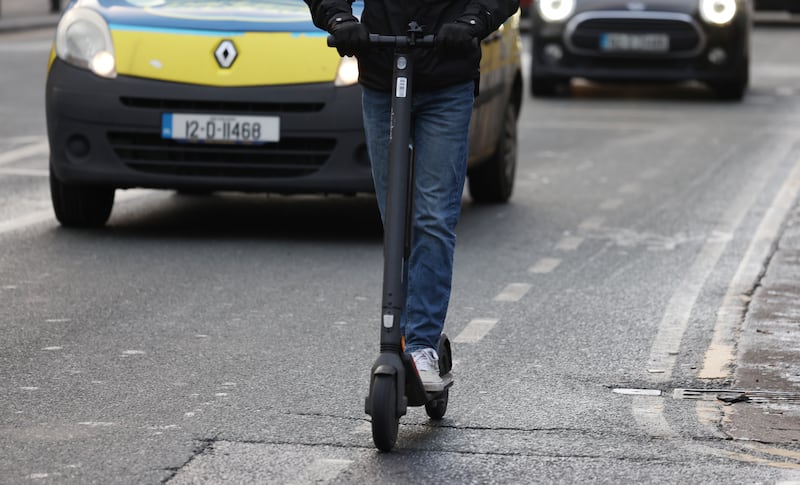
The growing problem of e-scooters and young people was discussed by the Oireachtas transport committee the day after the letter to the editor appeared in The Irish Times, with Seán Canny, Minister of State at the Department of Transport, saying that while they are “of benefit to people” their misuse was down to “stupidity”.
He said the Government is considering a range of measures to target that misuse, including requirements to register, insure and tax e-scooters.
E-scooters are undoubtedly popular and, for many people, particularly in areas not well served by public transport, they are a solution to the daily commute. They are also affordable and easy to transport and to store, making them a more practical answer for those in smaller living spaces.
Fine Gael TD Grace Boland asked the Minister about the letter from the children’s doctors; Canny said the “medical evidence” presented by CHI helped to “demonstrate the end result of this stupidity”.
Dr Irwin Gill is a consultant in neurodisability who practices primarily in CHI at Temple Street with a focus on rehabilitation after brain injuries. He was one of The Irish Times letter’s signatories and believes more action at the highest level can’t come quickly enough.
He points to a broad spectrum of injuries among Ireland’s youngest e-scooter users but says the types that trouble medics most are the traumatic brain injuries, which jumped by 50 per cent in in the past 12 months.
This is out of control in terms of paediatric traumatic brain injury
— Dr Irwin Gill
“The difficulty with traumatic brain injury [is] the effects often only become apparent over time,” he notes. “Initially a lot of the rehabilitation is focused on things that you’ll see, like difficulties with walking and talking and hand skills. And then, over time, the things that are of, I suppose, a special concern to us are neurocognitive skills such as memory, learning behaviour, attention, self-control, self-regulation.”
He says: “Those are things that can take sometimes months or years to become apparent. We’re only starting to see children back in our clinics with enough time having passed for us to really start seeing those effects.”
There are, he says, “children who are really struggling with those invisible challenges that are easily misunderstood”, directly as a result of e-scooter accidents.
Gill says almost all of the injuries hospitals are treating are as a result of single e-scooter accidents where a child travelling at speed hits a curb or a pole or parked car, with young boys “overwhelmingly” the ones being impacted
“We look after these children when they’re in hospital and then afterwards in clinics, but the thing about traumatic brain injuries is that once they’ve happened, you can’t undo them. You can work to rehabilitate the injuries [but they] can’t be taken back once they’ve happened,” Gill says.
He accepts that when legislation was passed making e-scooters legal with certain limitations in 2024, nobody foresaw “that there would be this level of injury coming and I think there’s an obligation on the Government now to respond to what we’re seeing. This is out of control in terms of paediatric traumatic brain injury. It was bad last year and worse this year, and I think it is unlikely to improve, unless there’s more of a response.”
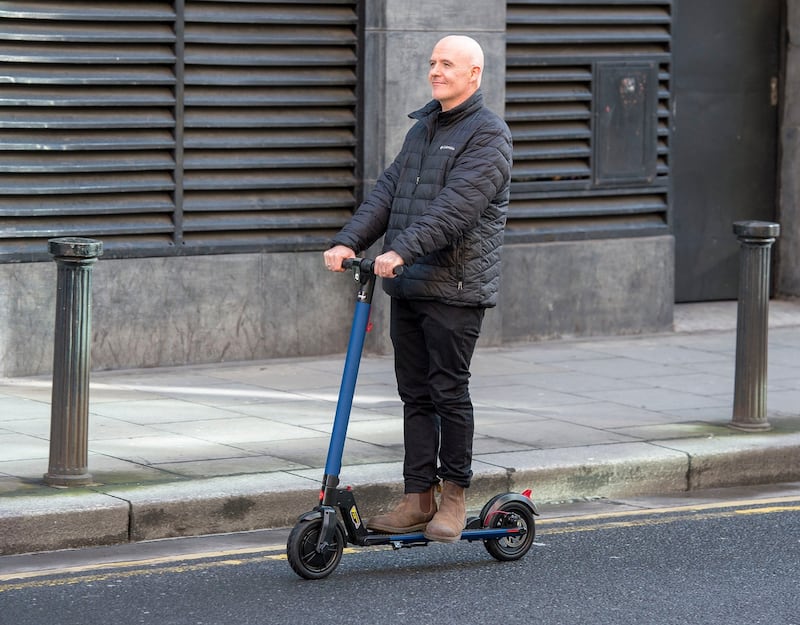
The doctor highlights the absence of international consensus about what should be done. Some countries have not legalised the use of e-scooters; others have. Some have allowed rental schemes and some are banning rental schemes entirely. There are different rules in different places when it comes to speeds, helmets and age limits.
“There is no consensus and I think what that means is we need to keep all the options on the table,” including mandatory licensing and insurance, and the option of “getting them off the roads completely”, he says.
He stresses that a “fatalistic response that we are somehow stuck with the status quo is not appropriate. The fact that they are here now does not mean we necessarily need to accept that they will be here – in this manner, at least – forever.”
A recent study in Britain found the devices are “disproportionately relied on” by lower-income groups.
According to CoMoUK, a charity promoting shared transport, the number of people using rental e-scooters in England has grown by more than 50 per cent in a year.


