
The health and wellbeing revolution sparked by the proliferation of what are commonly called weight-loss drugs is reshaping our world in ways that could scarcely have been imagined a decade ago.
Ozempic, Mounjaro, Wegovy – and other similar medications barrelling down the tracks – have the potential to cut the cost of public healthcare in the world’s most affluent countries by hundreds of billions of euro annually, while allowing hundreds of millions of people to regain a sense of wellbeing and control over their bodies they may have feared was lost to obesity forever.
The drugs are also reshaping how we eat, shop, exercise, dress and drink, and mostly for the good. But for all the benefits of the GLP-1 revolution, such treatments can come with a side order of stigma, even shame.
Many who don’t take the drugs sneer at those who do, while many of those who do take them are embarrassed, sometimes too embarrassed even to share their story with those closest to them.
READ MORE


The scale of the obesity crisis is hard to overstate. A 2019 Organisation for Economic Co-operation and Development (OECD) report suggested the cost of treating weight-related diseases annually was about $425 billion (€360 billion).
In Ireland, where the reported rate of adult obesity is 21 per cent, the annual cost is well north of €1 billion, rising further when indirect costs including productivity losses, increased morbidity and premature mortality are factored in.
But are GLP-1 drugs – originally developed as treatment for Type 2 diabetes – the silver bullet many hope they are? The signs are certainly promising.
In the US, the adult obesity rate declined to 37 per cent last year, having reached 39.9 per cent in 2022, according to the Gallup National Health and Wellbeing Index. The fall is due almost entirely to these drugs. “This is a statistically meaningful decrease representing an estimated 7.6 million fewer obese adults compared with three years ago,” Gallup said.
In Ireland the road is less travelled, with Mounjaro only becoming available on prescription in February 2025, and Wegovy a month later. The latter is made by Novo Nordisk and contains semaglutide, the same active ingredient in the Danish company’s most famous drug, Ozempic, which has been used here largely as a treatment for type 2 diabetes since 2018.

In the simplest terms, the drugs mimic a natural hormone (GLP-1) released after eating to tell the brain a person’s stomach is full.
Would-be patients require a BMI of in excess of 27 to be prescribed the medication privately. It’s not cheap, with few likely to have any change out of €250 a month.
Just one of the weight-loss drugs – Saxenda – is covered by the HSE, limited to about 5,000 patients meeting strict clinical criteria, with the costs of making medication more widely available currently deemed prohibitive.
While about 1.2 million Irish people could be prescribed the drugs, the numbers using it are estimated to be closer to 200,000, with many travelling to Northern Ireland to fill scripts and many more sourcing them online – or trying to.
The number of fake or illegal weight-loss drugs seized by the Health Products Regulatory Authority (HPRA) last year increased 30-fold, with more than three-quarters of a million units of illegal or fake medicines impounded.
While the drugs are undoubtedly a medical marvel, they’ve drawn criticism in ways other medications do not, with “Ozempic face” just one snide way in which users are sometimes being identified.
This infuriates Dr Harriet Treacy, a practitioner with almost a decade of clinical experience who more than four years ago co-founded Beyondbmi, a digital obesity clinic and UCD spin-out company. “The big misconception around these drugs is that they’re weight-loss drugs,” she says. “But these are health-gain drugs. If you’re unable to get in and out of your car because of a bandy knee made worse by weight you’re carrying, that’s limiting your functionality and how you interact with the world. If your child runs down the street and you struggle to run after them without getting short of breath, that’s a functionality issue. If you cannot move around or if you feel awkward, that’s a functionality issue.”

She says when people are successfully treated for “the disease of obesity we’re giving them back health, we’re giving them back functionality, we’re giving them back quality of life. That’s the message that isn’t getting out there strongly enough because we’re being told about skinny jabs and weight-loss jabs and fitting into a dress in the summer.”
She believes there’s a way to go before we “truly remove the stigma and shame associated with the treatment of the disease of obesity. The language used around obesity is starkly different to the language used around other disease. No one would point at somebody and say ‘Jesus, look at your one, she’s cancerous’ but people look at somebody and point and say ‘Look at your woman, she’s obese.’”
She stresses that GLP-1s are not a cure for obesity or a short-term fix. “Have you ever heard of asthma being cured or high blood pressure? They become managed more efficiently. That’s the important distinction. If you sell people a pipe dream of a cure you sell a false sense of security.”
Going on the drugs is certainly a long-term commitment. One recent study published in the British Medical Journal reported that those who stop taking GLP-1s regain lost weight within two years.
And, of course, the lifelong nature of the treatment makes it pricey – someone who starts taking the drugs at 30, paying €250 a month, could well spend more than €150,000 in a lifetime.
‘People are eating smaller portions and snacking less. They’re eating a smaller variety of food types’
— Kevin McCarthy, Advise
At that cost, there’s a real danger that many will be cut off from treatment. Such a health divide is not new, suggests Treacy. “People with private health cover or those who can afford it get more superior chemotherapy than those on drug payment schemes or medical cards. We need an economic model that allows us treat everyone who needs it. Ultimately, it’s a net benefit if we can treat a disease that costs the economy almost the equivalent of building the Children’s Hospital every year.”
There are shelves in the Marks & Spencer food hall groaning this weekend under the weight of salad boxes where the contents play second fiddle to the concept, with the words Nutrient Dense taking up far more space than the words describing the salads.
The new labelling is a small but not insignificant sign of our times and a reflection of how such drugs are reshaping our world.
Nutrient dense foods promise “a more concentrated source of vitamins, minerals, fibre, healthy fats and protein relevant to their calorie content”, the retailer says. “With the increase in popularity of weight-loss injections, a reduced appetite can mean missing out on important nutrients, and that’s why nutrient density is so important.”
Other retailers are also rolling out GLP-1-specific foods, and Treacy says it’s a response to the hushing of the “food noise” that makes life so hard for so many.
“Food noise is this internal chatter that tells people no matter what they eat, they’re still hungry. That’s an all-encompassing feeling. It’s not something people feel in control of. It’s like sex drive or temperature. You experience the end result, but don’t get to pick what your temperature is. You don’t get to pick what your sex drive or libido levels are.”
[ What’s behind surge in fake weight-loss drugs and bogus steroids?Opens in new window ]
Many people are, she says, “tormented” by food noise, and GLP-1s give them control to help them be more “mindful about what they’re eating”.
But the silencing of the food noise has some asking: what comes next? Heston Blumenthal’s Michelin-starred Fat Duck in Berkshire, for instance, has a new menu for those keen to eat more “mindfully”, including those who are on appetite suppressants.
Gareth Mullins is the executive chef at the Anantara The Marker Hotel in Dublin, and he has noticed a shift in diner behaviour, with demand for smaller steaks rocketing.
“Three years ago I didn’t know anybody taking the drugs and now I know more than a dozen,” he says. “They’re eating less and drinking less. What worries me is not the financial implications. I’d a conversation with somebody taking the drugs recently and they said the feeling of hunger disappears, as well as the enjoyment they got from food.
“Food is my whole life. It gives me so much pleasure, and what worries me is GLP-1s could strip a bit of passion from our guests. Hunger is the best sauce – and if you take that away then is the best sauce gone?”

As the co-founder and chief executive of Advise, a data and AI software company supporting clients in the consumer goods sector , Kevin McCarthy is expected to be ahead of the game.
He has been analysing how GLP‑1 medications are reshaping consumer spending, and has seen spending on fitness trackers and workout clothes surge along with a bounce in sales of side-effect remedies including gum, breath mints and soothing teas.
He points to a rebound effect when users stop taking the drugs, with spending habits reverting to normal - with the exception of sweets and chocolate, where spending climbs by more than 10 per cent.
“People are eating smaller portions and snacking less. They’re eating a smaller variety of food types,” he says. “There’s a huge unquenchable thirst for protein-infused products.”
He says that in the US the “snacking aisle has been completely decimated”, while alcohol spending “is down across the board amongst those on GLP-1s”.

The impact on alcohol consumption is being carefully studied. Last Thursday, The Lancet published details of what it said was the first randomised controlled trial investigating whether GLP-1s can reduce alcohol intake in patients with obesity seeking treatment for alcohol-use disorder.
Patients at a Danish mental health centre were offered cognitive behavioural therapy and randomised to receive either a weekly dose of semaglutide or a placebo. At the outset, patients involved had been drinking heavily for an average of 17 days over the previous 30 days. After six months, those receiving semaglutide had an average of five heavy-drinking days in 30, compared to nine days in the placebo group.
According to UK research, up to one-third of people using the drugs say they’re visiting pubs less often, while retail analysts Worldpanel have recorded a 15-point drop in alcohol sales in households with GLP-1 users.
Louis Copeland, Ireland’s best known tailor, has noticed a shift too. “People are coming in saying they are on the weight-loss drugs and looking for suits to be taken in. We have customers shrinking by multiple sizes and coming in for a whole new wardrobe.”

Barry Walsh, who owns the Iconic chain of gyms in Dublin, and Medfit, a medically focused fitness clinic in Blackrock, has some first-hand – albeit anecdotal - evidence that people on GLP-1s are not exactly racing to get on the treadmills.
His clinic partnered with doctors specialising in weight loss, with the hope that those prescribed medications would adopt a holistic approach to their health-and-fitness regime.
“Our initial idea was patients would visit the in-house GP, and if they qualified would be prescribed drugs and use our exercise, rehabilitative service more. But unfortunately there wasn’t a huge appetite among those prescribed the drugs.”
More broadly, he says, “there’s huge conversation globally around the effects of GLP-1s on the fitness industry. Nobody really knows what it means or if it will have a positive impact or a negative impact.”
He is optimistic, however, and stresses that good gyms have moved away from being weight-loss palaces into centres for overall wellness. “Some bad players in the market focus on weight, but I think I think the industry has pivoted. We never sell the six pack and the body beautiful. We prefer the idea of more healthy people with a nice glow, good energy and smiles on their faces.”

Margo certainly has a smile on her face. She has been taking Mounjaro since last February, and while she is happy to share her story with her friends and family – and indeed this newspaper – she hasn’t told her partner, so asked for her name to be changed.
“I’m not ashamed, but he’s old-school – and I just couldn’t be dealing with the palaver, because he’d think it’s absurd that I’m paying €250 a month not to eat. I get the absurdity of that. It took me a long while to get my head around it myself,” she admits.
She first talked to her GP about GLP-1s two years ago because she “was intrigued by something that sounded like a magic pill. He gave me a prescription, but I couldn’t go through with it.”
Fast forward to this year and there was, she says, “much more talk about it, so I went back to my GP. Since February, I’ve lost a stone and a half relatively painlessly.”
‘People went from a size 12 to a 16, and are going on the weight-loss drugs. They’re coming in looking for smaller sizes and are absolutely thrilled’
— Marion Gale, occasion-wear boutique owner
She says not having to rely on willpower has been “a massive win. I’m not constantly fighting with myself about what I should and shouldn’t eat. I’m just genuinely enjoying eating well, and because I’m losing weight I’ve to be careful about losing muscles – so am exercising more and feeling a lot better.”
She says there’s “so much failure associated with being overweight”. She felt shame too: “It was partly health, partly looks, and just being sick of being in fat clothes.”
She wants to lose another stone to take her to 13 stone (82.5kg). “If I was a size 14, I’d be very happy. This is not about being super-thin.”
Her view of food has shifted dramatically. “Biscuits, bread, ice cream or chocolate don’t even feature in my world now, and I don’t have any sense of denial about it. I still go out and share a bottle of wine with somebody and have pizza, but I’ll never be able to finish the pizza.”
Marion Gale runs an occasion-wear shop for women in Donnybrook, Dublin, and has seen a considerable uptick in “slimmer, happier customers who are only delighted with themselves” having started taking GLP-1s.
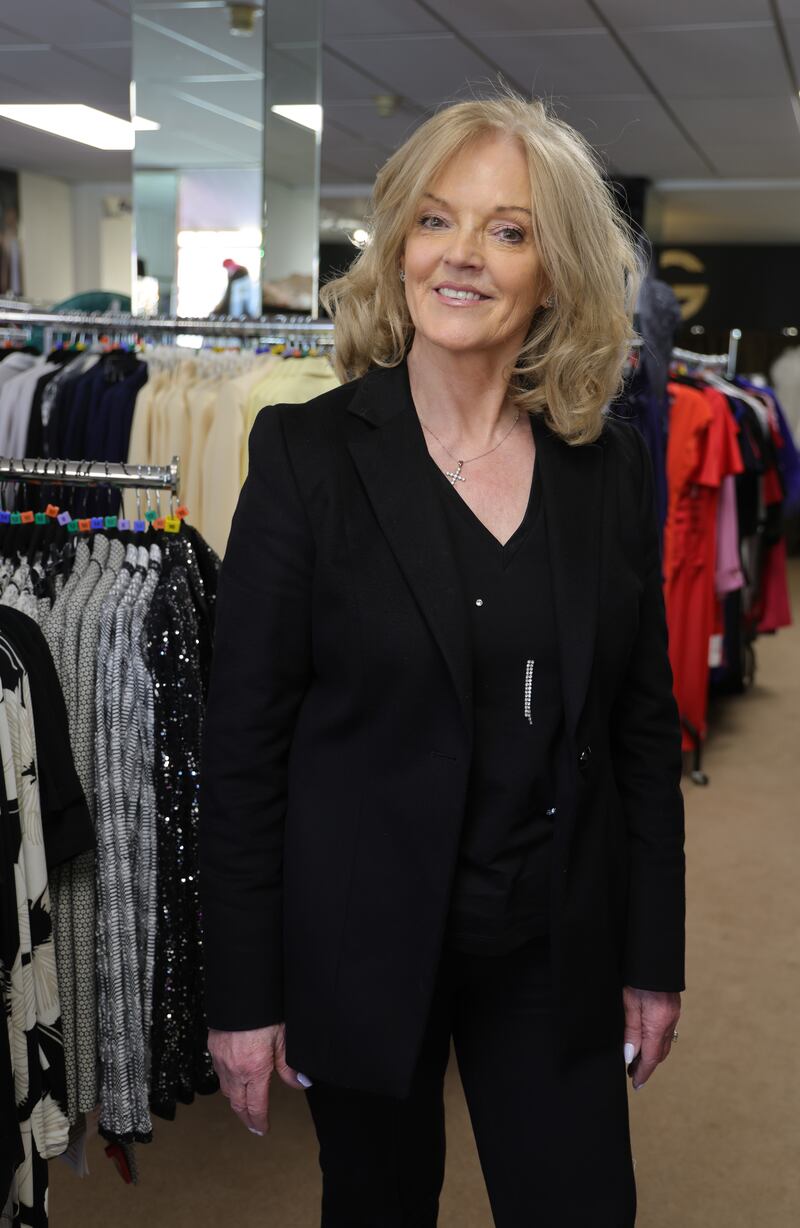
“What happened when Covid struck is everybody got into tracksuit bottoms with their stretchy fabrics and elasticated waists, and didn’t realise that they were spreading all over the countryside,” she says. “People went from a size 12 to a 16, and are going on the weight-loss drugs. They’re coming in looking for smaller sizes and are absolutely thrilled.”
Not everyone is talking about how their weight’s been lost, however. “It is a bit like Botox,” she says. “Not everyone admits it to us, but you know damn well they’ve had it.”
She’s not alone in drawing the Botox comparison, although medics would suggest it’s an absurd one, given there’s no medical benefits whatsoever in injecting a toxin into the face to remove lines.
Gale says she’s seeing the impact of the drugs on women of all ages. “It is a win-win situation. It is a win for them and it is a win for us.”
It’s not, however, always a win-win. Claire (not her real name), a woman in her 40s, describes herself as an early adopter of GLP-1s. She marvels at the impact the drug had. She lost over two stone in a few months, and recalls the thrill of the scales going in a downward trajectory for what she says was the first time in her life.
“I was losing a pound every day at one point. It was remarkable.”
Then she had to have her gall bladder removed.
She’s not alone. Gall bladder surgeries recorded by NHS England last year, for instance, were at their highest level in a decade, with the president of the British Obesity and Metabolic Specialist Society, Ahmed Ahmed, telling the BBC he was carrying out more operations, with “more and more” people telling him they had had weight-loss injections.
Claire came off the drugs eventually, but does not rule out a return to them.
Treacy points out that gall bladder issues are associated with all rapid weight loss, from bariatric surgery to diets to illness. “It is more related to the speed and the percentage of weight loss than it is to the mechanism,” she says.
While weight-loss medications are primarily injected now, pills are on the way. Treacy says there “a possibility this could be a fad if we are not supporting people in the long term. If we are providing people with long-term support and the necessary infrastructure to enable that continued health gain, then I think I will become a way of life.”