
There is nothing like waiting to cross a busy road in the rain to remind me of the societal hierarchy that places motorists at the top of the pecking order.
Sometimes drivers are kind and stop to usher me across, but other times, even if they can only move a few metres in heavy traffic, they insist on making me wait my turn. Sometimes when I’m forced to stand there, and especially if there’s one of those huge, militaristically branded cars, I glance at the driver’s face. It feels as if there’s an enormous cultural divide between me and this driver surveying the world from their comfortable, elevated interior.
Truth is, though, all I would have to do is get back in the shared car that still sits in my drive, and I’d be on the other side of the divide again. I do it every month or two – to reach some awkward location – and I’ve noticed that at first, I feel terribly anxious about the fragile bodies of pedestrians and cyclists, and almost ashamed to be blocking up their streets. And then, if I’m honest, my consideration begins to evaporate, and I slip back into seeing the world through a driver’s eyes again.
But the greater the intervals between driving, the more strongly I feel I don’t want to see the world through driver’s eyes any more. And not just because it’s dangerous, bound up with the fossil fuel industry, and about the worst thing we can do for the climate, but also because, for me at least, driving is a time-consuming and meaningless experience. In fact, the word “experience” is a stretch – I’ve started to wonder if it is more like the absence of an experience.
READ MORE


One of the first things I noticed when I started driving less and walking or cycling more is how, at the end of a day, I often have an inexplicable sense of excitement, as if something remarkable has happened – and yet all I’ve done is cycle to a work meeting or take a circuitous walk to Aldi.
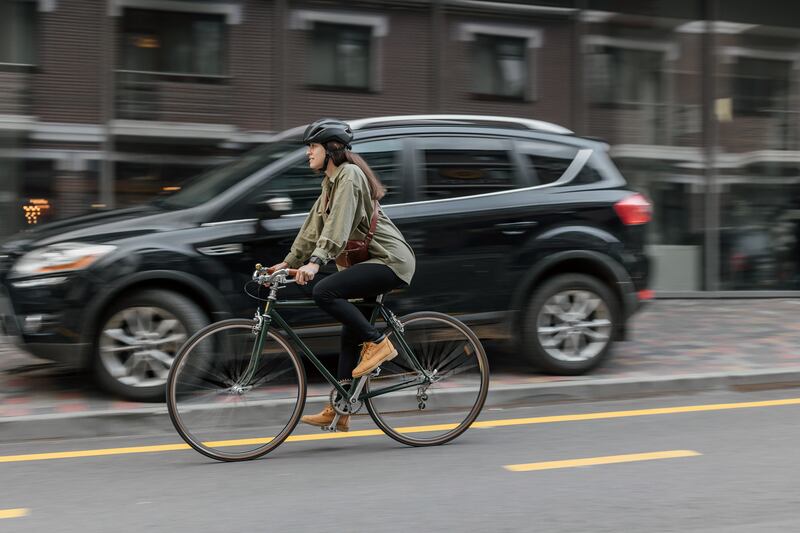
Some of this is the endorphins of exercise, but on the best days – when the rain holds back just for the right half hour, and milk-bottle-chested gulls swoop overhead as I ride the coastal bike path – it feels as if I’m on holiday in my own city. Seen on foot or bike, streets are detailed, different. Paths and short-cuts become as important as roads. Buildings, gardens, trees, flowers, people’s faces – the enormous ecology of city life is there to be studied up close as I move slowly through it.
Instead of visualising the city as a map of roads and destinations, where I have, for example, to get from point A (home) to point B (my children’s school), I see a whole landscape upon which a city has grown. The in-between parts are as alive to me as the destinations. I notice the gentle undulations as well as the steep hills, I feel the cobbles, tar and varying gravel mixes under my feet or reverberating under my bike seat. I can tell you the orientation of every street by remembering whether the sun falls on my face or back. It is as if an insulating layer around my body has been removed.
[ Own a car? Here’s how much it costs to keep it on the roadOpens in new window ]
Before I began driving less, I had long had a melancholic sense that the city lifestyle I lived was cut off from the seasons and nature. This had struck me more often since having children. I remember one summer afternoon in our back garden, when my sons were about two. One of them pointed upwards and said his first real word, “moon!” It took him three attempts for me to swivel and look behind me at the sky because I assumed he was babbling. Having spent so much of my adult life in interior spaces – offices, houses, cars – I’d almost forgotten that the moon and sun often share the sky.

This seems ridiculous to me now, when I see the afternoon sky every day, walking or cycling the two kilometres to collect my sons from school. Ordinary journeys give me so many functional reasons to be outside, whereas in the past, going outdoors purely for “leisure” was a disjointed activity that had to be weighed against the other demands of life. In this way, it feels as if walking and cycling have opened up pockets of time in my day that didn’t exist before.
It strikes me that the intrinsic qualities of walking and cycling come naturally to young children. They have no desire to divide the day into journeys and destinations
When I drove, I thought only of where I was going and what was delaying me from getting there. Streets and buildings and people went past like a video, and then at the most unappealing points, the video paused. The digital clock on the dash advanced whether or not the car was moving, and I was nearly always late.
But when I walk or cycle, I rarely think about where I am going or how long it will take to get there – because this, give or take a few minutes, will be as expected. I am calmer, and time takes on a different quality: my mind is free to wander, my eyes to look, my body to feel whatever it feels. This is not strictly speaking free time, because I am going somewhere, and yet it is.
While I know that driving is a necessity for some, for me, it has been first and foremost a habit. My experience of driving less has reminded me that when we can, it’s worth questioning our habits and resisting the instinct to do what is most comfortable – because what’s comfortable doesn’t necessarily make us feel happy or free. It’s the same principle I apply when I turn the shower to cold for 60 seconds each morning. I am reminding myself that a degree of discomfort will likely make me feel better in the long run. In some magic way, it will help keep me open and less afraid.
Perhaps it’s that I’m getting older, but I wonder lately how we can know that the months and years are passing if we don’t feel them passing every day through the rhythms of light, weather and seasons? When I drove everywhere, I think I lost both my connection to nature and my understanding that, as a human being, I am part of it.
It strikes me that the intrinsic qualities of walking and cycling come naturally to young children. They have no desire to divide the day into journeys and destinations. If I say to my sons, “We’re late for jiu-jitsu!”, they still slow their pace to run their hands over the softened spikes of Victorian railings, or pick up a pine cone.
For them, life is one continuous experience, and adult attempts to carve it up into obligations and appointments are irrelevant. Whether walking, scooting or cycling, one of them will be five metres behind, the other five metres ahead. If there is anything interesting – a cat stretching on a shed roof, a naked figurine on a window ledge – they stop and stare. Neon crisp packets, stones, sticks – their impulse to physically connect with the world is uninhibited, and their curiosity insatiable.
By the time I started university, the only woman I knew who walked daily was my grandmother on my English side
The job of a parent seems to be to train children out of their instincts. I hear myself doing this: “Don’t touch the flowers – they’re not yours!” “Don’t lie on the ground!” “Don’t dawdle when you’re crossing!” “Careful, the people in those big cars can’t see your head!” “Don’t scoot near the edge of the pavement – if you trip you could be killed!” But when I walk or cycle on my own, removed from the burden of their safe-keeping, I too feel the pull to connect with the physical world, to wander and explore it, to pat the spongy heads of hydrangeas that aren’t mine.
So much of the time I spend outdoors with my children is wasted thinking or talking about the danger of cars – something I rarely did when we were in them. The need to be vigilant around cars is a constant interruption to our experience of the environment in a city, and only when we find ourselves in the safest of off-road locations do I feel a reprieve. In this way, cars divide us from the environment, whether or not we are in them.
[ I’m finally ready to ditch my car. Here’s how I’ll manage itOpens in new window ]
It has, of course, long been this way. In the early 1980s, my mother decided to learn to drive because it was becoming too dangerous to walk on narrow pavements with children. She celebrated when she passed her driving test – as I celebrated when I passed mine two decades later – but we never thought to grieve what we were losing. It would have seemed naive, like wishing electricity had never been invented.
By the time I started university, the only woman I knew who walked daily was my grandmother on my English side. When I visited her, I remember thinking there was something demeaning in the way she went about the streets with her shopping trolley. I had imbibed snobbish narratives that aligned functional walking, such as a woman shopping on foot, with dependence and low social status.
A friend reminded me recently that I had grown up in an era when Margaret Thatcher, or someone in her inner circle, could get away with saying, “A man who, beyond the age of 26, finds himself on a bus can count himself a failure in life” (fabulously satirised by the Fatima Mansions in their 1989 song Only Losers Take the Bus).
It occurs to me now that my grandmother didn’t have such a bad life. She exercised daily, talked to passersby on the streets and at bus stops, sat on city benches when she was tired. She didn’t know the panic of overstaying a parking ticket, or the monotony of stuffing a car boot and then a fridge with a week’s supply of groceries.
Yesterday evening, I took it upon myself to walk three kilometres in search of bananas and blueberries. It was a pleasure to be outside in the falling light, to inhale the damp smell of early spring, my arms swinging as I passed the low terraced seaside villas and the neat 1930s semis; a father was vaping guiltily as he pushed his sleeping baby up and down a shaded street, and someone else’s mince dinner was wafting in the air.
As I came to the main road and the crossing before the supermarket, I looked at the traffic and I counted the queuing cars (eight), the people inside (eight), and their combined monetary value (estimated €450,000). How invested we are as a society in these air-conditioned rooms-on-wheels, I thought. And how little we understand about the ways in which they have separated us from the environment, or what this separation might be doing to our bodies and our brains.
To the drivers, I probably looked like a bedraggled, windswept sort of creature, but I felt freer than I have ever felt in a car. Inside, I was consciously shedding every negative walking stereotype, imagining a new kind of 21st-century walking woman, someone with a sharp eye and a decent raincoat, a flaneuse who lives in the real world and only flaneuses on her way to Aldi.
Joanna Marsden is a writer, researcher and audio documentary maker


