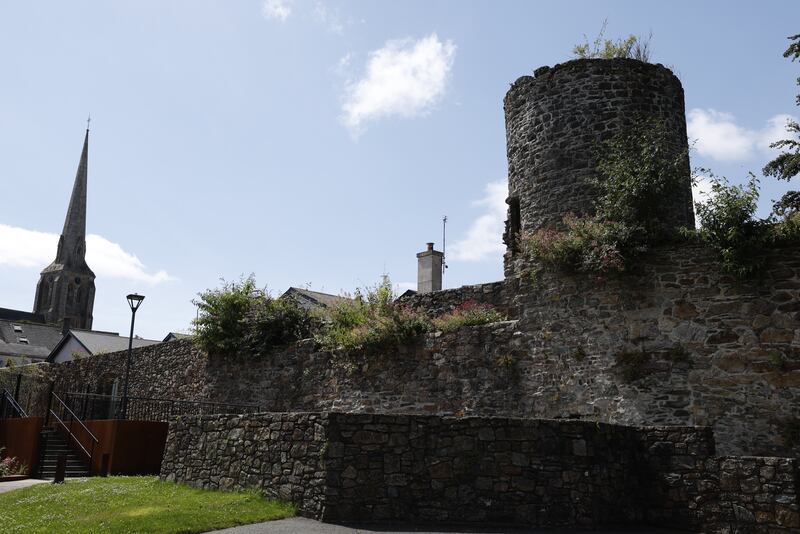
Fethard in Co Tipperary has the “most complete medieval town wall” in Ireland, according to the map provided during a visit earlier in the summer. But it is not the only notable thing about this charming rural town.
The famous Coolmore Stud is only a couple of kilometres out the road, and what local people refer to as “horse money” is evident before even getting out of the car. A van with Coolmore branding is quickly spotted driving over a bridge.
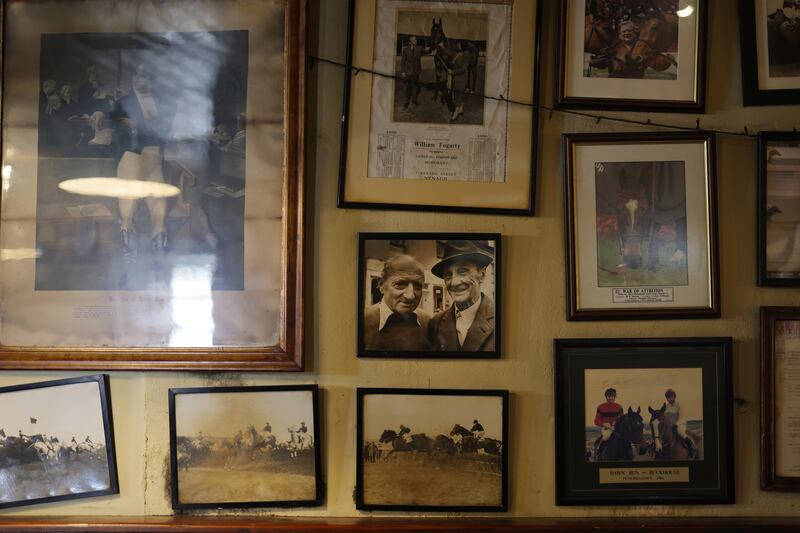
Sadler’s cafe and restaurant is full of racing memorabilia. It is owned by the Magnier family, who run Coolmore Stud. Horses have grazed and galloped in the Fethard fields for centuries – certainly for as long as the medieval town walls have been standing.
Terry Cunningham, who has been involved in the Fethard Historical Society for a remarkable four decades, provides a tour around the town walls. There are, he says, about 30 people in the society.
READ MORE


When he came to live in Fethard 41 years ago, Cunningham says a large proportion of the town was derelict. “Even domestic buildings on the Main Street.”
Along the south section of the wall, which to the untrained eye looks to have been fairly recently repaired, restored or cleaned up in some way, Cunningham draws attention to a faint line. It runs along the wall about two-thirds of the way up and is a lighter colour than the rest of the stone.
“That is where the wall was built up in the early 1990s or thereabouts,” he says. “It probably wouldn’t happen now. The thing now is, you don’t restore, you conserve.”
He explains that, although nobody can really say for sure exactly what Fethard’s stone walls looked like when built during the 14th and 15th centuries, “they were definitely not in ruins”.
Walls, of course, have two sides, and Cunningham talks about the challenge of trying to figure out who is responsible for taking care of them. Apparently if you have a private business or residence on one side, you are meant to be responsible for that side, although this seems to be more of an ad hoc arrangement than anything formal. As for the side that faces public property, that is apparently under different guardianship, although by whom is unclear.
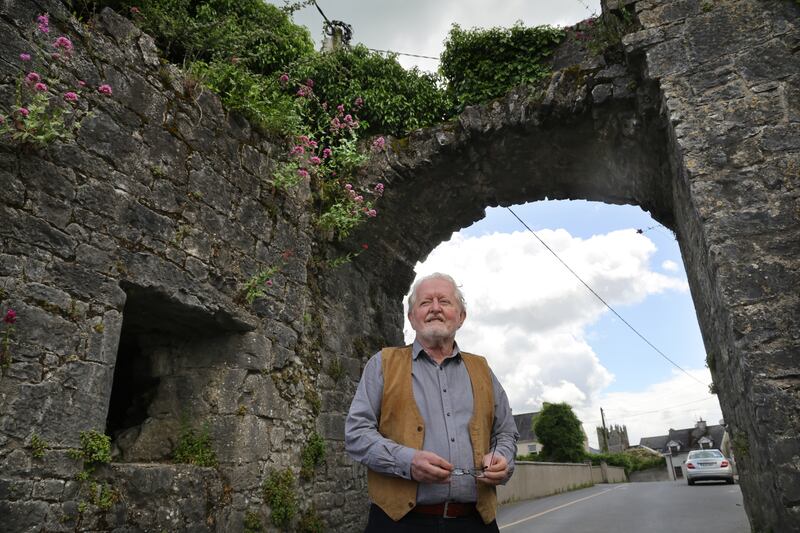
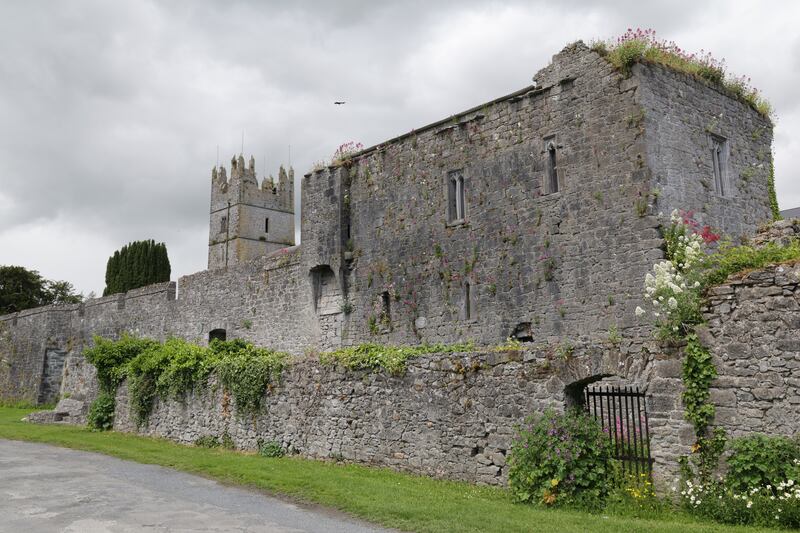
Cunningham points to ivy growing on part of the wall (which he soon makes clear is a particular bugbear of his). “It’s allowed to grow up, because it’s nobody’s job to take it down.”
We walk along the restored walls to the back entrance of McCarthy’s pub and undertaker. The storage space for coffins is inset into the wall. A gleaming hearse stands outside.
Alongside that is the pretty, rambling beer garden that leads up to the back entrance of the pub. From bright sunlight, we move into a space that is so authentically an old-fashioned traditional Irish bar that it almost feels like a movie set.
But it is not a movie set – it is a carefully preserved family bar of which Vincent “Jasper” Murphy is the fifth-generation owner. McCarthy’s deserves to be a destination bar. It is an exquisitely atmospheric place where, on entry, you feel you have travelled a century back in time. It featured in the late Pete McCarthy’s book in which he visited bars throughout Ireland that carried his surname. Murphy lived above the pub as a teenager.
“The wall as we know it now didn’t exist in the 1980s,” he says, speaking of the restored section close to his pub. “It was just a tumbledown wall, and nobody thought twice about it when it was like that. Fethard had no identity as a medieval town when I was growing up. It was in decline as an agricultural hub.
“In the past, people would have herded cows through the night for the fair day; the bars on the town windows aren’t decorative – they were there to keep the cows out.”
Murphy’s great-aunts ran the bar back when monthly fair days were still running. “They would be working all night, making food. They would open at 7am. The food was eaten by 8am, and then the drinking started. Cattle were weighed at the weighbridge, then they’d be put on trains to Waterford and Rosslare and taken on the cattle boats to England and be on the table the following week. That’s what we were told.”

Did Murphy the barman meet McCarthy the writer? “No, but we became friends afterwards. We used to talk on the phone every few weeks.”
It is a truism that we can often take our remarkable heritage, both tangible and intangible, for granted. There is so much of it around us: ruined castles in fields, Norman towers, high crosses, ogham stones, standing stones and medieval walls around towns, that sometimes we do not see it clearly or appreciate it fully.
That is where the hugely important and often unsung network of local historical societies serve communities in ways that often seem invisible. The men and women volunteer their time to record their local history, as Cunningham has done for almost 40 years, and generate awareness of it within their communities.
Mary Hanrahan, a former primary schoolteacher, has lived just outside Fethard for 45 years and is another member of the historical society. We meet in Sadler’s, where horseshoes and photographs of famous race horses hang on the walls.
“We were in our late 20s and early 30s when we started the historical society,” she says. The average age of the society’s members now is about 65.


Why is it that the current generation of 20- and 30-somethings do not seem to be interested in joining?
“I think people are more interested in doing activities for themselves,” she suggests, pointing out that personal fitness is now more important to that age cohort. “People will go walking or cycling or swimming or play sport, rather than volunteering for a historical society.”
Hanrahan says these activities are all positive, but that they do not help to regenerate local societies such as theirs. She recalls the local attitude to the town walls when she first moved there.
“There used to be very little appreciation of how special the walls were,” she says. “They weren’t valued. There was no big deal about it, even though so much of our wall is still standing. One of our main aims as a historical society was and is to open up the rest of it, so that people can walk around to see it. People are already walking around the river walk beside the wall, using picnic tables along the way.”
What changed over the last few decades that local people became more aware of their heritage?
“We started celebrating the walls with a festival, and it brought a lot of people. It seemed to strike a chord with people,” she says. The annual Fethard Heritage Day festival takes place in August.
It seemed so exotic, but I didn’t have the words then for what exotic meant
— Pat Looby
Hanrahan, like most people, would love to see more visitors come to the town, and she sees the walls and cultural tourism as a way to do this. Nearby Cashel, with its famous Rock, attracts many, but those tourists do not stray far from a set route.
Local schools can also be of fundamental importance in teaching children about the heritage surrounding them.
Pat Looby, an artist and former art teacher in the secondary school, lives in a striking cabinet-of-curiosities type house in the middle of the town. She clearly recalls her first introduction as a young person to Fethard’s medieval associations.
The town’s Holy Trinity Church is one of the largest medieval parish churches in the country, with parts of the building dating back to the 1200s. At one point the church held religious oak-carved statues, including of John the Baptist, God the Father and Christ on Calvary, which attracted many visitors. These are now held in the National Museum of Ireland.
“My first introduction to Fethard being a medieval town was seeing a picture in one of my art history books of the wooden Christ figure,” she says. “It seemed so exotic, but I didn’t have the words then for what exotic meant. It came from Fethard but it was in the national museum.”
As a teacher, she later initiated many projects with her students aimed at making them aware of their town’s medieval origins. The 2012-13 transition year cohort made a large model of medieval Fethard as it was in 1650, which is displayed upstairs in the Holy Trinity Church.

“They were really proud of it,” says Looby, adding that being involved in the project made the students value their heritage.
Looby oversaw several other projects with her students that focused on the town’s medieval origins. “We looked at medieval shoes, hats and clothes,” she says.
Later, Hanrahan provides a tour around the beautiful Holy Trinity Church, which she explains is her favourite part of medieval Fethard, standing just inside the town walls. “When you step into the Holy Trinity you are stepping back in time,” she says, adding that “very little has changed”.
Upstairs is the model Looby’s former students created. Downstairs, there are various memorial tablets on the walls. One large imposing white marble memorial stone is dedicated to the memory of former members of the Sankey family: Captain Sankey, who died in 1881, and his sisters Anne and Dorothea. The inscription reads:
“In their lives they were beautiful
And death but came with healing in his wings
To waft their spirits upwards through the skies
To God’s fair mansions of the blest.”
The nearby ancestral Sankey family home still survives. It was, and still is, called Coolmore House.
For the last half-century or so, it has been home to John Magnier of Coolmore Stud.
How Ireland’s walled towns came to be