
My wife photographed this pair ‘in a hurry’ going somewhere on our doorstep. We wonder what they were? Eric Gill, Firhouse, Dublin
They were a pair of centipedes – Lithobius forficatus – looking for a bit of peace and quiet away from the paparazzi. Despite being called centipedes, they do not have a hundred legs. They have one pair of legs on each segment, and this species has a total of 15 pairs when mature. They are voracious carnivores and hunt in the garden at night. They catch insects, worms and slugs and quickly kill them by grabbing them with their venomous claws.

I saw this bug about the size of a ladybug on a raspberry shoot in my garden recently. I would love to know what it was. Mary Power, Mount Merrion
As your garden is in Ireland not America, this insect, about the size of a ladybird, is a Rosemary beetle – Chrysolina. Rosemary beetles originate in southern Europe and were first found in Ireland in north Co Dublin, in 2012. While most of the sightings are still from Dublin, they have been found in Cork and Tipperary too. They munch on lavender, sage and thyme as well as rosemary.
READ MORE


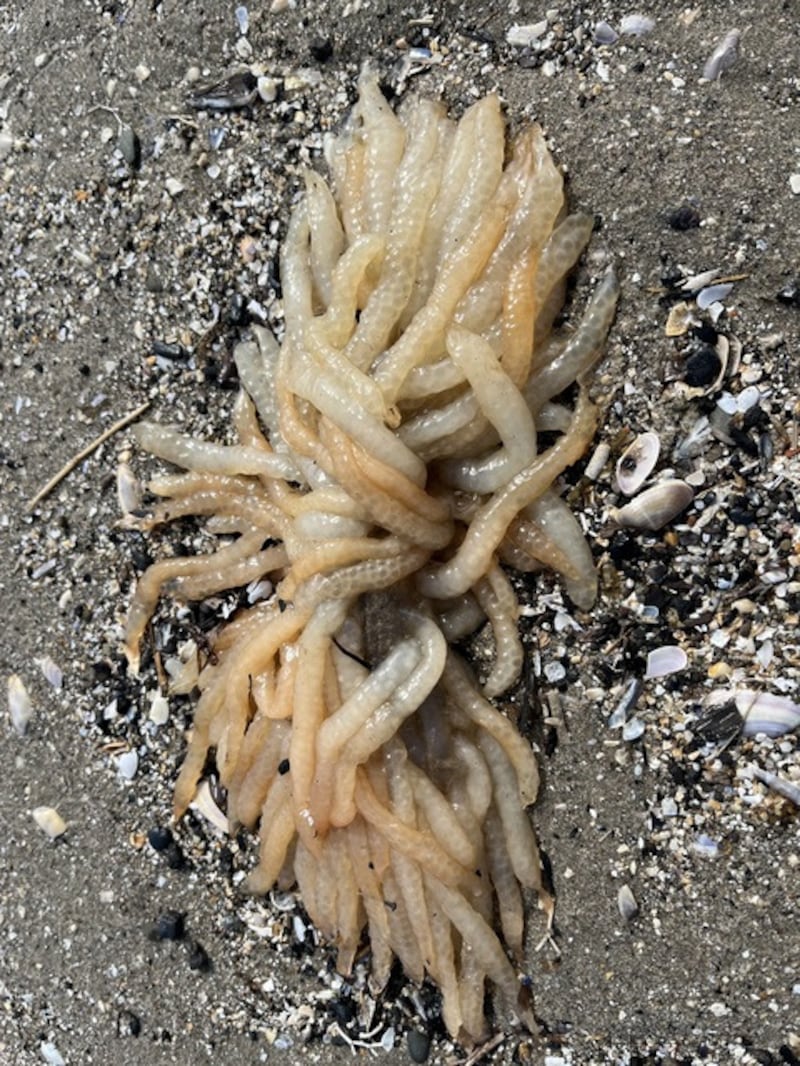
We spotted this jellylike cluster on Seapoint beach in Termonfeckin, Co Louth, over the May bank holiday weekend. On close examination there appeared to be eggs in the tube-like capsules. We haven’t seen this in all the years of walking on the beach and wondered if they were squid eggs. Eoin O’Flynn
Joseph Whelan spotted some, too, on the pier in Barna. They are indeed squid eggs as confirmed by the marine ecologist Dr Julia Nunn. When the female is ready to spawn, she passes her eggs from her ovaries through special glands that coat them in a thick, sticky, jelly-like substance. She mixes the eggs with sperm helpfully given to her in a packet by a passing male and then ejects them, shaping them into a large mop-like mass as they go. She attaches them to rocks and so on but these must have been washed ashore by storm waves.

This little insect joined me for breakfast on May 12th. I’m wondering if it’s a type of moth, and if it’s one of the more than three trillion insects, which I read, migrate to the British Isles each year. Sean O’Reilly, Swords
You give no scientific reference for this unsubstantiated claim. We do get migratory insects in Ireland each summer. How anyone could count three trillion seems impossible. These migrants stay and breed here and some of them retreat southwards again in autumn. This, however, is a true stay-at-home native – the white-shouldered house moth. It is attracted to light and breeds all the year round. Its larvae feed on grain and cereals as well as woollen clothes. It may have been after your Weetabix, or indeed your woolly jumper on which to lay eggs.

I saw this lad popping up out of the 5th green in Celbridge golf club. What is it and what was he doing? Stephen Fahy, Celbridge
You were a witness to the emergence of a daddy longlegs. Crane flies – to give them their formal title – lay their eggs in the soil where they develop into larvae called leatherjackets. These feed on the roots and stems of cereal crops and golfing green grasses too and grow big and fat. Eventually they turn into a chrysalis inside of which the winged adult develops. This pushes its way up to the surface with its legs and wings tightly folded. Then, with great relief no doubt, it quickly expands and flies away looking for company with which to mate.
Please submit your nature query or observation, ideally with a photo and location, via irishtimes.com/eyeonnature or by email to weekend@irishtimes.com
Please submit your nature query or observation, ideally with a photo and location, using the form below or by email to weekend@irishtimes.com


