The Madonna of Asia
New Theatre, Dublin
★★★☆☆
The Madonna of Asia is a beautifully staged production, minimalist and suggestive. Mai Ishikawa, dressed in black, performs expressionistic dance movements to a layered, synthy soundscape while visuals – night drives through Hong Kong, memories of girlhood, text messages and abstract, strobing lights – are projected on to the floor. The sensibility is romantic, melancholic, nocturnal and very appealing.
Written and directed by Choy-Ping Ní Chléirigh-Ng, the play tells the fictional life story of Rin Asari, a once famous actor who has withdrawn from public life. In 2014 she’s working in a call centre in Dublin, where a chance phone call from Tara, an Irish woman living in Hong Kong, disrupts her anonymity.
Tara recognises Rin’s voice, and their mundane customer-service interaction becomes the scaffolding for the entire piece: a series of phone conversations gradually excavates Rin’s past.
Her history is presented in shards: glimpses of her childhood, teenage arguments with her parents, her rise in Hong Kong cinema, her fraught marriage to a much older director and her eventual disappearance from the industry. These moments are conveyed through a blend of live performance, recorded projection and sound design. Together they evoke quite an unhappy life.
READ MORE


There’s a particularly haunted scene in which the face of the 16-year-old Rin is projected on to the floor – she’s singing in a contest that would launch her into fame – while the older Rin mouths along to the lyrics onstage.
Another memorable scene projects a snowstorm over a choreographed fight with a samurai sword, a re-enactment of a cinema trope that becomes oddly elegiac. There’s a consistent underwater, dreamlike quality to these images, fitting for a play that has the associative, recursive structure of memory.
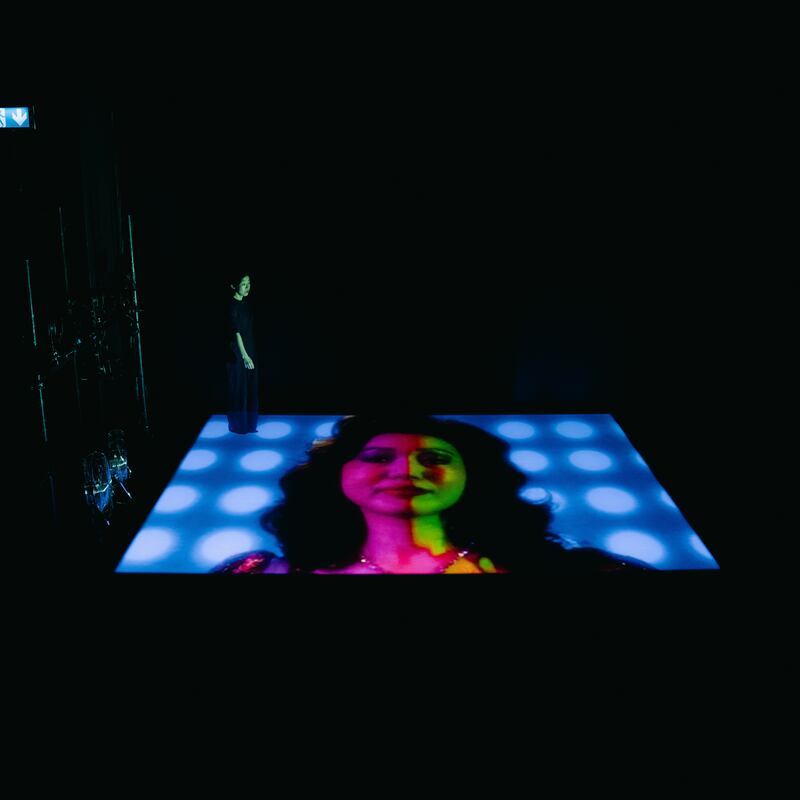

But the blurriness that gives the piece its aesthetic power might be more effective if the narrative itself were more clearly executed. Key aspects of Rin’s life are left underdeveloped. Certain propulsive plot points, such as her marriage and her real reason for retreating from the public eye, are disappointingly handled.
We’re given a few key facts: Rin was married at 22 to a prominent director twice her age, she starred in his films, then the marriage fell apart, and her career ended. From these facts we can infer a sad and familiar story, but the narrative resists deepening it, withholding the specificity or surprise that might make it more compelling.
In doing so it leans heavily on the audience’s ability to fill in the gaps with their own assumptions. This reliance on what already exists outside the work begins to mirror the production’s aesthetic choices. While the projections and voice work (with performances by Clare Barrett, Agnes Hui, Kaai and Jun-Ling Clarke-Ng) are effective, the reliance on them makes the play feel a little overdetermined.
The connection between Rin and Tara, a necessary framing device, ends up being the emotional centre of the piece. It’s a shame, because the friendship between the two women is the least interesting aspect of the play.
Rin suggests she might visit Tara in Hong Kong, where they will share a plate of mincemeat and eggplant. It is a soft, sentimental conclusion that feels hastily tacked on. Still, you can forgive almost anything if it’s this pretty.
The Madonna of Asia is at the New Theatre, Dublin, until Saturday, May 2nd