

Alan Stivell is thinking back to the time he taught Shane MacGowan to sing in Breton, the Celtic language of France’s northwest Atlantic corner, which is at the heart of the harpist’s lifework reviving the traditional culture and music of Brittany.
“He was a like a quiet pupil at school. He was asking: is it okay? Is it okay? Repeating and repeating the same phrase until I said it’s good,” Stivell recalls of that recording session at a studio in Nantes.
“He could spend an hour or two hours on a single phrase for a song. It was a really striking contrast to the bottle in his hand.”
Stivell, a towering figure in French folk music credited with reviving the traditional Breton harp, had invited MacGowan to sing with him on his 1993 album, Again.
READ MORE


The result was a memorable duet of The Foggy Dew, featuring Stivell’s harp-playing, and two traditional Breton songs in which MacGowan sang in a language that had nearly been lost.
“Of course, you know Shane MacGowan. I love this man, as an artist, but we know that it’s part of himself to be a little bit broken,” Stivell says.
“He had the microphone, in one hand vodka, in the other hand white wine, and the mic in the middle.”
Now 82, Stivell is speaking in advance of a series of gigs in Ireland, a country that has been a source of deep inspiration for him from childhood. He recalls keeping a notebook as a child riding the Paris metro, to write down words he discovered were similar in Breton, Welsh and Irish.

Kate Bush also performed on the album. The singer-songwriter had previously invited Stivell to record with her on The Sensual World, from 1989, after receiving a letter from him.
“I had for years been a fan of Kate Bush, and one day I took my pen and wrote a letter to her, through her publisher. Some days after, Kate Bush called me,” Stivell says. “She told me, ‘I wanted to be in touch with you and I didn’t know how, and I received your letter with your phone number.’”
The lucky coincidence led to a recording session in London that left Stivell with an enduring memory of Bush’s exacting standards and her command of the production process. “The music and quality of her knowledge, her vocal ability, it inspired me to step up as well,” Stivell says.
His musical journey had begun as a child “immersed in a fusion of the music of the Celtic archipelago”. Stivell’s father, Georges Cochevelou, an instrument-maker and enthusiast of Breton history, re-created a prototype of a Celtic harp that had been played in Brittany during its period as an autonomous state but had long been lost.
Stivell became a young prodigy on the instrument and played a series of influential concerts credited with reintroducing the Celtic harp into Brittany’s traditional folk music from the 1950s, alongside traditional bagpipes and bombards. It was part of a broader Breton revival.
The harp made by Stivell’s father would prove to be only the first pioneering harp prototype that he would play.
“I was jealous of guitarists, and already dreaming of electric harps,” Stivell says, laughing. “I wanted to bring the traditional Breton culture into the modern world.”
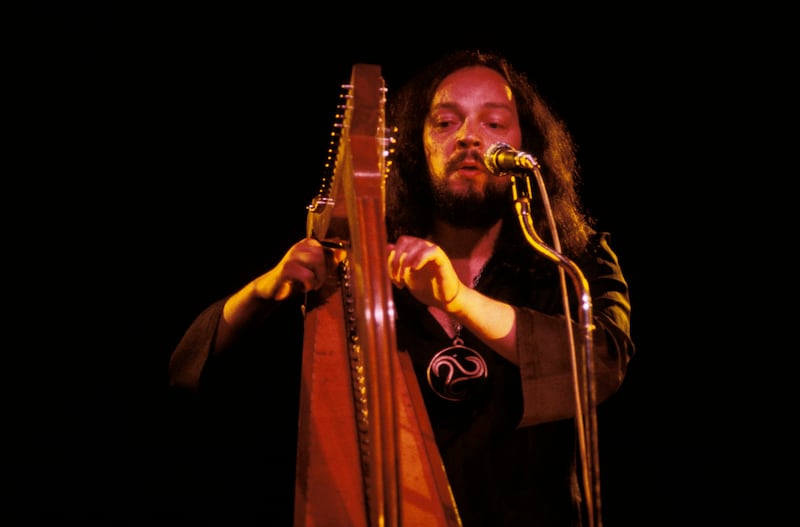
His music in the 1960s and 1970s, when he developed the electric harp, pioneered the sounds that would go on to become Celtic rock.
A crucial discovery as he worked to develop his pan-Celtic repertoire was the work of Seán Ó Riada, the musician and composer who was central to a contemporaneous revival of traditional Irish music in the 1960s.
The two met shortly before O’Riada’s death in 1971. At that time Stivell was playing a metal-stringed “Bardic harp”, modelled on the wire-stringed harps of medieval Ireland, and close to the harps played at the Belfast harp festival of 1792, which preserved a fading tradition.
“I came with my bardic metal harp, which was not exactly Brian Boru’s but a cousin of it,” Stivell says. “He told me that he had been dreaming of somebody that would build again a metal-string harp and play it.”
The idea of a Celtic archipelago connected by routes around the Atlantic, and stretching from Scotland to north Africa, has been a crucial inspiration for Stivell’s musical career.
Politically, he is an advocate for the political autonomy of Brittany and official status for the Breton language alongside French, which he considers its “only hope to survive”.
He fears that a far-right victory in presidential elections in 2027 could lead to attempts to dissolve Brittany as an administrative unit and opposition to the Breton language.
“They are opposed, they are obliged to accept Europe, but they are anti-European. The aspiration of Brittany is openness to Europe, openness to Ireland,” Stivell says.
He doesn’t spare the left, either. “On the left as well, there is profound nationalism in France. There is a left that is more Napoleonist than truly left,” Stivell says. “There’s a feeling that France doesn’t exist without the disappearance of other cultures.”
Alan Stivell plays the Ambassador Theatre, in Dublin, on Monday, May 25th, St Nicholas’ Collegiate Church, in Galway, on Tuesday, May 26th, and Live at St Luke’s, in Cork, on Wednesday, May 27th


