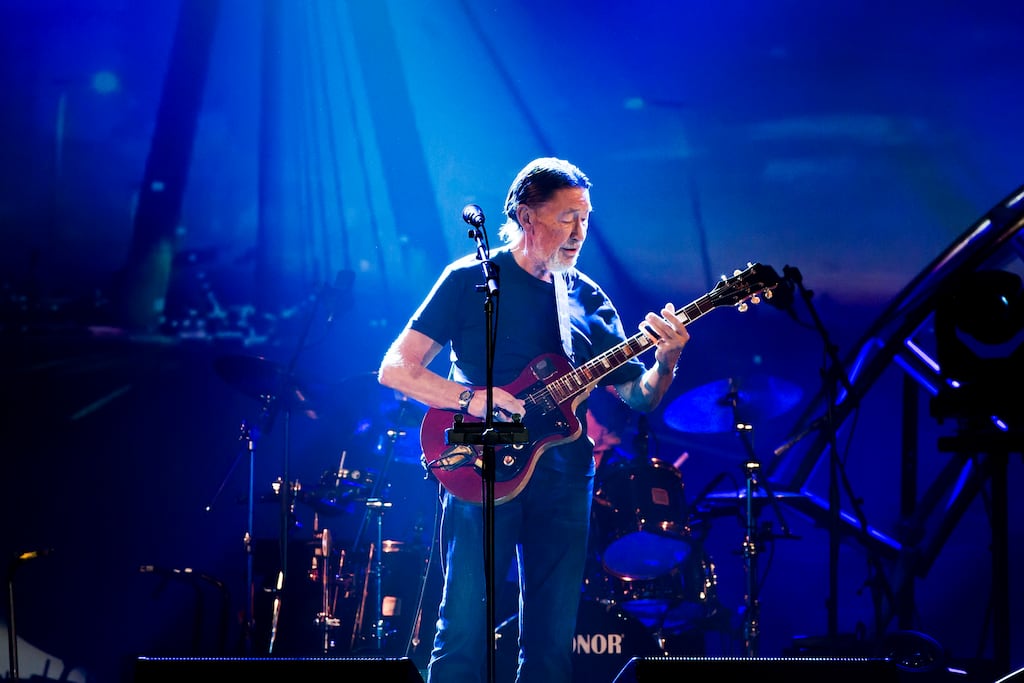

Chris Rea could clearly recall the moment he no longer wanted to be a pop star.
It was July 1986 when he was opening for Queen at Slane Castle in Meath. The singer, who has died at age 74, had come of age musically as a blues player and believed authenticity was more important than success. To be standing in front of a rock audience expecting nothing more challenging than a cheery singalong filled him with disquiet.
“I’ve always struggled with the big places. Playing Slane Castle was one of the most awful experiences in my life. It just seemed so silly. It was Monty Python-silly,” he told me years later. “Here we were, musicians – not rock stars. We had no huge lights, no costumes, no special sound. We’re doing this semi-jazz blues type set and we’re being looked at by 42,000 people, most of whom are drunk. It was just surreal.”
But it was that reluctance to be a pop star that made him such a memorable presence in the charts, where he remained a regular throughout the 1980s. Hits such as Fool (If You Think It’s Over) and I Can Hear Your Heartbeat were beautifully catchy, but they were threaded through with a soulfulness that set Rea apart from peers such as Phil Collins and Sting. He was an artist, never an entertainer, and that streak of earnestness elevated him beyond other hitmakers of the day.
READ MORE



He also belonged to that special category of musicians who were especially beloved in Ireland. It was a small but esteemed club that would later welcome Jeff Buckley and David Gray. But Rea got there first, after 1983’s I Can Hear Your Heartbeat charted at 15 in Ireland while flopping at 60 in the UK.
He saw a direct connection between African-American music and the traditional Irish equivalent, which he had been introduced to by his Irish-born mother, Winifred Slee. “There’s something about the blues that melts your heart, that gets you going. It just moves me. It’s always fascinating that the blues was born between Irish church music and black music. And that was the beginning of pop music. I think it just gets you.”
Rea was born in Middlesbrough, England, in 1951. He described his Italian father as “a distant figure, autonomous, a cross between the Pope and Mussolini”. He grew up with dreams of becoming a motor-racing journalist and did not pick up a guitar until he was aged 21. But he was drawn to the blues and, within a few years, was playing in the local band Magdalene, where he ended up as the frontman by accident. “That was only because the singer didn’t turn up,” he said. “Everyone heard this voice and that was it.”
When he went to London with dreams of breaking into the industry, he was following in the footsteps of another north of England artist, Mark Knopfler from nearby Newcastle. But his record label saw potential as a mainstream troubadour – somewhere between Billy Joel and Elton John. Against his better judgment he was persuaded to record his song Fool (If You Think It’s Over), which he had initially written for gospel singer Al Green. It took off and, as it did, his dreams of making his way as a humble bluesman went up in smoke.
“This thing started to happen underneath me. I was sat on top of it, a big manure heap of bubbling stuff,” he said. “I had no control over it. No one would let go because I was the goose that laid the golden egg, and it was hell for me.”
Success in Ireland convinced him that he could navigate fame on his own terms, which he did with beautiful songs such as the aforementioned I Can Hear Your Heartbeat, written for his wife Joan, whom he had met at school in Middlesbrough, and the darker Road to Hell, which drew on his sense of foreboding in the late 1980s that the world was heading towards a dark place. He also wrote one of the great modern Christmas songs: Driving Home for Christmas.
Inspiration struck Rea during a long commute back to Middlesbrough from London in December 1978. Amid heavy snow, he and Joan were caught in a traffic jam outside Nottingham, which is where he dashed out the lyrics – though he would only record the song in the 1980s, when it became an immediate seasonal staple.
Such was his love for Ireland that in 1984 he wrote his seventh LP, Shamrock Diaries, in Dublin, saying the city reminded him of Middlesbrough. “Middlesbrough back then was about 65 per cent Irish ... And half my family are from Ireland.”
Ill health would later derail his career. He had his pancreas and much of his stomach removed at the age of 50. Before the operation, doctors told him there was every chance he would not make it. But he did, and when he returned to music it was as an old-school blues player – without the flash or fuss. Having struggled with fame, it was when the spotlight left him that he found true happiness and real creative fulfilment.
“I’d forgotten why I’d wanted to become a musician in the first place,” he told me. “You know, starting out it was because of my love for music. And I’d slipped into this sort of corporate rock thing. All of a sudden I could see how ridiculous it was. I asked myself: is that how I wanted to be remembered?”