

“Democracy is not something achieved once and forever,” Sergei Loznitsa says. “It’s a quality of life that must always be defended by every generation.”
Set in the Soviet Union against the turmoil of the Great Purge in 1937, the Ukrainian director’s new film, Two Prosecutors, adapts Georgy Demidov’s novel into a claustrophobic thriller with lessons for the present.
The drama follows Aleksandr Kuznetsov’s young provincial prosecutor, a communist official whose unwavering faith in the system begins to falter as he investigates the wrongful imprisonment of an old Bolshevik.
Since premiering at the Cannes film festival last year, Two Prosecutors has been hailed as a vital “warning from history” on both sides of the Atlantic. Loznitsa expresses a degree of surprise.
READ MORE


“I wasn’t expecting that the film would be perceived in this way, especially in the United States,” he says. “If we’re talking about that country, then we don’t really need to warn them, because their history hasn’t taken place. What I’ve discovered through the film is that other countries, especially democratic ones, also see it this way.”
In common with earlier Loznitsa films, Two Prosecutors is less about the psychology of a single character than about the wider architecture of the system that shapes his protagonists. The director’s Donbass, from 2018, unfolded through a series of loosely connected episodes set in that separatist region. A Gentle Creature, from 2017, adapted Dostoevsky into a labyrinth of oppressive institutions. State Funeral, from 2019, compiled archival images from across the Soviet Union of the mourning following Stalin’s death.
“What interests me is not simply an individual story but the system surrounding that person,” he says. “The protagonist exists inside a structure that is much larger and more powerful than the individual. By following one person moving through that structure, the viewer begins to understand the logic of the system itself.”
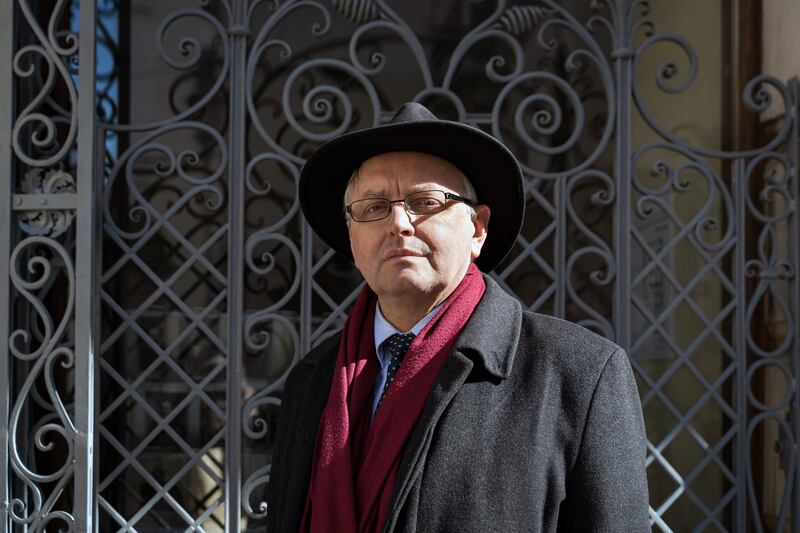
Two Prosecutors had been developing in Loznitsa’s mind for years before the cameras rolled. In many ways it grew directly out his 2018 documentary The Trial. That film reconstructed the legal proceedings against a group of engineers and economists accused of belonging to the so-called Industrial Party, an alleged conspiracy blamed for sabotaging the Soviet economy.
“The Trial dealt with innocent people who confessed to crimes they had not committed,” he says. “After finishing it I began to think about what happened to those people once they were inside the prison system.”
Few contemporary film-makers move as fluidly between documentary and fiction as Loznitsa, who has built parallel careers in both forms with notable international success. His nonfictional work, including Maidan, The Trial and Babi Yar. Context, have been widely praised for their rigorous use of archival material and observational style, while his fiction films have made him a regular contender at Cannes.
“When I make a feature film I have about 100 to 150 people working with me,” he says. “When I make a documentary it’s about 10 or 15 people. That’s nice, because it means I need to talk 10 times less. My attitude to the material is the same, but in documentary there is something that does not exist in fiction: ethics in relation to the people on screen. In fiction you can do whatever you want.”
Loznitsa developed the visual language of Two Prosecutors with the cinematographer Oleg Mutu, who is known for his work on key films of the Romanian new wave, especially for his collaborations with the Palme d’Or winner Cristian Mungiu.
Mutu and Loznitsa first met more than a decade ago.
“When we met in Chisinau [in Moldova] in 2009 we looked at each other and understood everything. Since then we have worked together on every feature. We share a view of the world around us. Oleg is not just a cinematographer; he is also a philosopher. He gives me problems to solve, and we must solve them. That is what you see on the screen.”
Returning to familiar collaborators helped Loznitsa speed through the production of Two Prosecutors, despite potential complications such as period costumes and production design.
“All the people I work with are on the same wavelength,” he says. “That’s why we were able to shoot the film in only 18 days, which is a very short time if you know how long it usually takes to make a film. The result is not just my work; it belongs to the whole group of people who created it together.”
Loznitsa was born in 1964 in the city of Baranavichy, in what was then the Byelorussian Soviet Socialist Republic. He grew up in Kyiv after his family relocated to the Ukrainian capital. His education couldn’t have been further from the arts: he graduated from Kyiv Polytechnic Institute with a degree in applied mathematics and went on to work at the Institute of Cybernetics, where he researched artificial intelligence, including developing “expert systems”, or software that emulates human decision making.
“Working with abstract information is an amazing discipline, and I recommend it to everybody,” he says. “Once you understand that the world exists in abstractions and that there are models you can use to describe it, you can do whatever you want.
“Mathematical objects don’t exist as such. You can’t find them in your surroundings. You can’t show me a zero. You can’t show me a one. You can’t show me plus or minus.
“In mathematics we are using a language that has all these objects that don’t exist. However, they are absolutely logical, and we can use these models to create things that do exist in reality.”
That training proved useful when Loznitsa later shifted towards the moving image.
“Cinema is similar. A frame doesn’t make sense by itself,” he says. “It’s just a projection. It disappears. But you put together these projections and the result is something that actually exists.”
Loznitsa turned decisively toward film-making in 1991, enrolling at the renowned Gerasimov Institute of Cinematography in Moscow. He began to make documentary films soon after he graduated, establishing himself in St Petersburg at the turn of the millennium with a series of studies of life in former Soviet Europe.
“I always watched movies, but at the time I had no idea it would become my fate to work in the cinema industry,” he says. “I like visual art. I like literature. I like history. I thought all these things could combine if I made films. It was just a plain logical decision.
“I would have loved to live different lives, and cinema allows us to do that simultaneously. But my friends were laughing and saying, ‘How can you go to film school if you don’t even know who Jack Nicholson is?’”
Loznitsa’s subsequent work can seldom be mistaken for romantic comedy. In My Joy, his first fiction feature, a truck driver’s delivery journey across rural Russia spirals into a nightmarish encounter with violence, corruption and arbitrary cruelty. In the Fog, set during the Nazi occupation of Belarus in the second World War, follows a railway worker accused of collaboration who is taken into a forest by partisans to face execution, only for the film to unravel the tragic moral ambiguities that produced the accusation in the first place.
Despite the weight of the material, Loznitsa says that the mood on his sets is cheery.
“The strange thing is that, when we are filming, we are actually often in very high spirits,” he says. “Even though we are making a film about something tragic, it is still a work of art, and its form has to be harmonious.”
It has not been an easy few years. In March 2022, during the frantic early weeks of Russia’s invasion, the Ukrainian Film Academy abruptly expelled Loznitsa for opposing a blanket boycott of Russian art.
The director was particularly shocked that his documentary Babi Yar. Context, a scholarly reconstruction of Ukrainian collaboration in the Nazi massacre of Jews in 1941, had played a role in the body’s denunciation of him as a “cosmopolitan”.
The man behind such fiercely anti-Russian films as Donbass had already resigned from the European Film Academy for issuing a statement of solidarity with Ukraine that he viewed as “neutral, toothless and conformist in relation to Russian aggression”.
Loznitsa, who moved with his family to Berlin in 2001, is characteristically dry when asked if the Ukrainian academy’s denunciation hurt him personally.
“No, it didn’t have an impact on me,” he says. “It had an impact on the Ukrainian Film Academy. It became known to the world.”
Two Prosecutors is in cinemas from Friday, March 27th


