

Danielle Galligan – Dani to her pals – tells a funny story about her busy mother depositing her at stage school when she was just a kid.
“It was so she could work,” she says. “God bless her. You know, my mum never took a day off in her life. She needed to go to work on a Saturday. So that meant I had to essentially go to work too.”
You can take a guess as to how that went. She immediately fell for the thespian arts? Every hour was devoted to Ibsen and Shakespeare? Hence her position as the busiest Irish actor of the moment.
Not quite.
READ MORE


“Honestly, I hated it so much,” she says, laughing. “I would cling to her leg. I would cry. Because I didn’t want to get up and do any acting or any singing. I was left so I could just sit in the class and I wouldn’t have to do anything. My mum was, like, ‘I have to go to work. Will you please just take my child anyway?’ And they were, like, ‘Okay’. It was basically paying for childminding!”
We will come back to how, not too much later, Galligan swung back towards the limelight. But her current prominence is not in doubt. You may have seen her in the second series of the crime show Kin. She was also in the black comedy Obituary on RTÉ One. She is the plucky Claire Walsh in The Walsh Sisters. She is Lady Olivia Hedges in House of Guinness.
We meet before the release of Brian Durnin’s fine film Spilt Milk, in which, scarcely recognisable in big glasses and 1980s hair, she plays mum to a family hit by the heroin epidemic that ravaged inner city Dublin 40 years ago.
Galligan has worked consistently since graduating from the Lir, the National Academy of Dramatic Art, in 2015, but the past few years have been an almighty buzz. That must be exciting. But it must also be a challenge.
“I love travelling. I have very itchy feet,” she says. “I love being able to see new places. It’s a real luxury and a gift and a blessing when your job can do that for you. We can all lose our way. Life is hard. But I have great tethering in my family and in my friends. They will always show me the way home when I need it.”
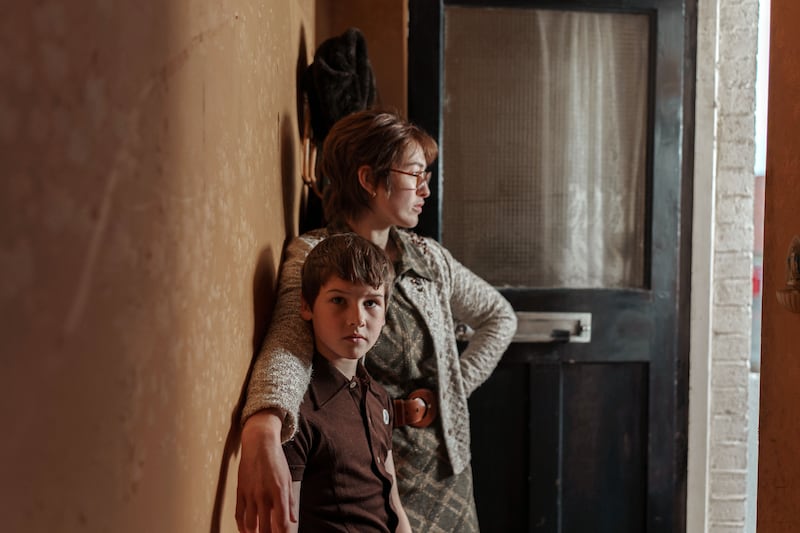
Galligan doesn’t need much encouragement to talk. Give her a nudge and she will deliver an articulate, amusing dissertation on anything you throw at her. She seems, for example, to have thought seriously about the Dublin her character inhabits in Spilt Milk.
The film, from a script by Cara Loftus, sets off in lighthearted mood with 11-year-old Bobby O’Brien, played by the sparky Cillian Sullivan, exercising a marginally anachronistic obsession with the 1970s TV show Kojak.
He happens upon mystery. He happens upon clues. It soon becomes apparent that some of those conundrums are linked to the increasing presence of hard drugs in their neighbourhood.
“I think Dublin overall was suffering from a lot of economic struggles and unemployment,” Galligan says. “And this area that we’re focusing on in Spilt Milk, the north inner city, was also suffering from the affliction of the heroin epidemic.
“And that really was an unknown drug at the time. It just swept in and absolutely ravaged the communities. Cara Loftus has a background in documentary-making, so she knew a lot about the time, and what she’s done is tell it through the eyes of a child.”
Spilt Milk also has much to say about the women – many of them mothers – who organised in resistance to the dealers and to establishment apathy. The film is not without hope.
“The real heroes of the story, for me, anyway, were the women and the others in the community who came together and formed Concerned Parents Against Drugs,” she says of the most prominent action group.
“They got all the dads involved as well – and the community workers. They would hold meetings and hold marches in order to expel the dealers from the communities.
“When I read the script I found that so inspiring. I think it’s a real message about the power of community and togetherness over individualism.”
Galligan was raised in Rathfarnham, in Dublin, a decade after the events depicted in the film. Her mum, obviously a big influence, helped run the family’s well-established beauty college. Happily, the early stage-school experience did not traumatise Dani for life, and, when her single-sex school staged a production of Oklahoma! during transition year, she happily signed up for one of the male roles.
“Yeah, fake beard and chaps and everything,” she says. “My biology teacher said to my year head, as I came out to sing the first number, ‘I didn’t know that they did this play with the boys this year.’ He was told, ‘That’s Danielle’. From then I was, like, ‘Well, I like this. I don’t know why I like it, but I like it.’ And my drama teacher then said, ‘No, you’re pretty good at this. You should go to drama school.’”
She then made her way to Ann Kavanagh’s highly respected Young People’s Theatre and, ultimately, to the Lir, which is part of Trinity College Dublin.

“I owe a lot to Ann Kavanagh, for sure,” she says. “She taught me the foundations and the building blocks I still use today. I wouldn’t be an actor if I didn’t have that.”
Galligan laughs about filling out a confused CAO form as the Leaving Cert approached. She had medicine on the list. She had “bar studies” as an alternative. Her uncle wanted her to be a lawyer. She admits, however, that “deep in her limbic system” she knew that she wanted to act.
You can believe that. Galligan looks to have made things happen during the quiet periods. With Venetia Bowe, Rachel Bergin and Fionnuala Gygax she set up the experimental theatre company Chaos Factory. She performed opposite Éanna Hardwicke – later her costar in the fine 2022 film Lakelands – in Gavin Kostick’s take on The Odyssey. That sounds like an exciting time.
“Yeah, it was incredible,” she says. “It was more my amazing friends like Fionnuala and Venetia. It was them that were burning with ideas and burning with the need to make art and make work. They were looking at European theatre and all that. And I felt, yeah, cool, I’ll get involved. So I learned a lot from them. The way that we worked was so exciting and so rebellious.”
Does Galligan worry that, as she gets more work in film and on the telly, opportunities to be so experimental and so rebellious will become rarer? You don’t see Kate Winslet improvising in pub theatre or Christian Bale performing avant-garde mime for lunchtime audiences.
“Yeah, of course,” she says. “But I think it’s hard as well, because sometimes people say to you, ‘You choose such interesting roles, and tell me about that.’ Choose? I’m begging people to hire me!”
At any rate, she has now manoeuvred herself into a happy position. Early TV work came with brief turns in Game of Thrones and Krypton. Then she secured a strong role in Netflix’s adaptation of Leigh Bardugo’s fantasy novel Shadow and Bone. Along the way, like so many of her Irish contemporaries, she moved to London.
“I’m in north London. I’m an Arsenal supporter – my uncle will be devastated,” she says. “I came over the first time in 2020, which was a great year to try and change things. Ha ha! I lasted a little while but was very homesick and came back home again.
“I was then speaking to a producer, Lucy Ryan, a few years ago, about how I wanted to go back but didn’t feel safe. I didn’t have an agent. I didn’t have work. She looked at me and said, ‘You can just go for personal development. Because you’re a human!’”
Right now, House of Guinness and The Walsh Sisters have made Galligan delightfully unavoidable. In the former Netflix historical romp, she plays the Corkonian aristocrat Lady Olivia Hedges, who becomes Lady Olivia Charlotte Guinness when she marries, in the person of Anthony Boyle, Arthur Guinness, heir to the 19th-century stout empire.
Written by the tireless Steven Knight – creator of Peaky Blinders – the series has won fans by not taking period verisimilitude too seriously. You will, famously, hear Kneecap on the soundtrack.

“Not that everything needs to be modern, but how do we engage the audience sitting at home today?” Galligan asks, rhetorically. “How can we get them to relate to it? I think using the modern music was really interesting. The use of Kneecap was very controversial, very interesting. I just think it opens you up a little bit more.
“There are rules here. But once we know what the rules are, we know that we can break them. I tried to keep that in mind with Lady Olivia all the time, because women were so bound – physically bound, financially bound.”
The Walsh Sisters sees Galligan, alongside co-stars such as Carrie Crowley and Caroline Menton, take on an adored series of novels by Marian Keyes. It is hard to put into words how much people identify with these characters. Galligan, whose character is a struggling single mother, can’t have taken the responsibility lightly.
“I definitely felt a lot of pressure, and I have a lot of reverence for Marian Keyes’ work,” she says. “I think the beauty of Marian Keyes is that she writes for every woman. Everyone can see themselves in those characters. That was very scary.
“But I had experienced that feeling before, with Shadow and Bone. How do you take on this character who is loved by everyone? The magic of reading a book is creating a world for yourself.”

I will be enormously disappointed if she tells me Keyes was not a treat throughout.
“No, she was,” she says. “Marian is just incredibly generous. She’s a very generous person. I think her baseline is generosity. So obviously that extended to spirit and to creativity and to advice and to everything. So she came into rehearsals and she sat with us. She went through each character with us. She was generous with space and with licence.”
As we speak, Galligan is taking a deserved breather. But one senses a coiled desire to fire off at the next job. She seems a natural. It is hard to believe she ever doubted her vocation for the theatrical life.
“It took me a long time to say, ‘No, I love this,’” she says. “But I don’t care if I’m good or bad or if I succeed or fail. I just love it, and I feel like this is what I have to do with my life.”
Spilt Milk is on cinema release


