Just what we need in this retro-obsessed, legacy-artist infested theme park of pop culture, right? Yet another book about Bob and the mop-tops, another Mojo reader necro-fest for the same old fossil fuels of rock, more Dylanology, more Beatles bores. In a time when the touring economy has been crippled with corporate parasitology and dominated by monopoly operations in which the ticketing systems, venues and radio stations are all run by the same Lovecraftian squid monsters, this is exactly what the rock ’n’ roll doctor ordered: the millionth trip down Penny Lane with a side detour to Desolation Row.
That’s the devil’s advocate position. My own personal teenage Beatles intolerance was born of a bratty reactionary stance towards Fab fundamentalists browbeating me into admitting John, Paul, George and Ringo were the undisputed GOAT. To me the Beatles were musically supreme but they had no governing lyrical vision. Somehow the Velvet Underground, the Doors, Iggy and Bowie meant more.
Dylan, on the other hand, had the Rimbaudian charisma, but his records weren’t as gorgeously harmonious or as musically diverse. He specialised in electrifying old forms: Woody Guthrie topical songs, cryptic folk riddles, cranked-amp blues, vaudeville Americana. Joan Baez and Peter, Paul and Mary sweetened his songs for mass consumption, but his own recordings were nobody’s idea of pop radio ear candy.
New York Times writer Jim Windolf’s stringently researched and efficiently executed book focuses on the two acts’ historical intersection points. In the beginning, it was a shared devotion to Black music and social songs (folk in the US, music hall in the UK). But once they met, they began to influence each other’s lightning evolutionary trajectories, exploring electric pop, world music, film, political commentary, poetry, prose and experimental art.
READ MORE


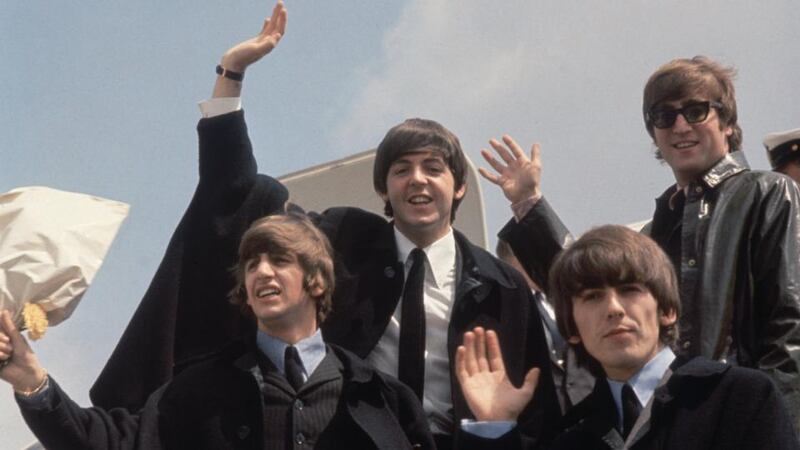
The Beatles were a social as well as musical phenomenon, the immediate antidote to America’s post-Kennedy depression. They landed at the newly renamed JFK, a road-hardened Hamburg bar band armed with slapstick wit and radical haircuts, and proceeded to ignite a musical, political, narcotic and spiritual revolution. In the space of eight years they pioneered Rickenbacker jangle-pop (Ticket To Ride, Paperback Writer), narrative songwriting (Eleanor Rigby, She’s Leaving Home), modern-day Tin Pan Alley, (When I’m Sixty-Four), trance-dance (Tomorrow Never Knows), proto-punk (Helter Skelter), pop bricolage (A Day In the Life, Happiness Is A Warm Gun) and avant-garde tape loop experiments (Revolution #9).

Dylan was by contrast the visionary individualist, the auteur, lyric-driven and dangerous. Until The Band he was a fly-by-night loner, a master thief, a gifted dilettante. The Beatles were a functional but volatile democracy. (Only characters as mercurial as Lennon and McCartney could treat George Harrison, the man who wrote Here Comes the Sun, Something and While My Guitar Gently Weeps, as a junior partner.)

The two camps were enamoured of, intimidated by and sometimes antagonistic towards one another’s genius. Dylan is said to have turned The Beatles onto pot. The Beatles showed Dylan the possibilities latent within his own songs’ genetic code. What if you took those hyper-poetic words and melodies and turned them technicolour with electric 12-string chimes and crisp beat group rhythms? You get The Byrds’ Mr. Tambourine Man and My Back Pages. You get The Animals’ House of the Rising Sun (a trad-arr. standard covered by Dylan on his debut). You get a whole new lexicon of pop vocal phrasing (you can hear his intonation in everything from Sonny & Cher’s I Got You Babe to Cockney Rebel’s Come Up and See Me (Make Me Smile) and Mott the Hoople’s All the Young Dudes). And Dylan showed The Beatles how to integrate surrealistic storytelling techniques into their songwriting chops, beginning with You’ve Got To Hide Your Love Away and Nowhere Man, proceeding through Strawberry Fields Forever, I Am the Walrus and Across the Universe.
Above all else, Where the Music Had to Go delineates why the late 60s were such an unparalleled era of musical innovation. Pop fans were the beneficiaries of an almost Olympic level of artistic competitiveness. Bringing It All Back Home inspired Rubber Soul which in turn inspired Blonde on Blonde. The resulting sounds dopplered outwards to the Beach Boys’ Pet Sounds, the Doors’ Strange Days, The Who’s Tommy, Bowie’s Ziggy Stardust, and on and on.
Maybe such high stakes were demanded by the times: Vietnam, MLK, Malcolm X, the Bigger-than-Jesus and Newport controversies, Manson, Altamont, drug busts and burnouts. The wonder is not that Dylan and The Beatles were cinders by the decade’s end, but that they lasted so long, and left such spectacular legacies. And they were kids.
In the end, after Dylan’s abdication to woodshed songs in Big Pink with The Band, and The Beatles’ retreat to the studio to craft the stunning end-sequence of the White Album, Abbey Road and Let It Be, you could only genuflect before the focus and fortitude of a bunch of true innovators who managed to paint their Picassos while the canvas was on fire. Jim Windolf’s triumph is he manages to render sepia history as technicoloured real time.
Peter Murphy is the author of the novels John the Revelator and Shall We Gather at the River (Faber). He records and performs as Cursed Murphy.
[ The Beatles, Paddy’s Wigwam and lesser-known ties between Dublin and LiverpoolOpens in new window ]