
One of the earliest recorded critiques of Irish hair was rather crude. In Topographia Hibernica (circa 1188), Giraldus Cambrensis observed:
“This people ... is truly barbarous, being not only barbarous in their dress, but suffering their hair and beards to grow enormously in an uncouth manner ...”
This judgment was refuted centuries later by Thomas Moore when he renationalised Irish hair. His song, Though the last glimpse of Erin with sorrow I see, presents Irish hair as beautiful and immune from the “Saxon” grasp:
“And I’ll gaze on thy gold hair as graceful it wreathes,/ And hang o’er thy soft harp as wildly it breathes;/ Nor dread that the cold hearted Saxon will tear/ One chord from that harp, or one lock from that hair.”
READ MORE


Moore’s note refers to The Act for the English Order, Habit and Language (1537) that forbade the Irish hairstyle known as “glibs” (long fringe and sides). In The Origin of the Harp, Moore exalts Irish hair more when he shows how the broken-hearted Siren’s long hair, wet with her tears, became the strings of the harp: her hair “was chang’d to bright chords, uttering melody’s spell”.
These comments form part of a discontinuous debate about Irish people’s hair that has endured for centuries, now primarily in poems.
Hair attracts narratives of dominance and resistance. Any head of hair belongs uniquely and privately to a particular person, yet because of its visibility and materiality, and its potential separation from the rest of the body, hair participates in a sociopolitical system, to be judged, praised, condemned, or excised.
The social and political conflicts of the moment, whatever they may be, can be expressed through it.
Growing up Irish-Nigerian in the Dublin of the 1980s, Emma Dabiri endured the same insults as the medieval Irish: her hair was “barbarous” and “presented as a problem that needed to be managed”. What Dabiri wrote of black African hair in Don’t Touch My Hair (2019) can be said of hair generally, that it is a site of social and cultural contestation.
Irish poems about hair hover over the moment when the meaning of one person’s hair – almost always a woman’s hair – is challenged.
A poem can precipitate that moment, as Anne Gregory found when Yeats wrote a poem about her hair. Her memoir, Me and Nu: Childhood at Coole, documents a hair-incited struggle played out in a field of texts.

Yeats summoned Anne (then 19) to his sitting room to hear his new poem, For Anne Gregory, an argument between the poem’s speaker and Anne herself, as Yeats constructed her. When the speaker claims that no man will ever “Love you for yourself alone /And not your yellow hair,” the poeticised Anne insists that if she dyes her hair, a young man may indeed “love me for myself alone”. In the third and final stanza, the poet claims higher authority – an “old religious man” – to support his side of the argument: “ ... only God, my dear,/ Could love you for yourself alone/ And not your yellow hair.” Anne thought the poem “doggerelly” and not “romantic” but she listened to it again, thanked Yeats, and then ran off to wash her hair.
That was not the end of it. Years later, Anne Gregory was with “a couple of boy friends” when Yeats read the poem over the radio, and this time she was “thrilled,” and the boys seemed appropriately impressed. But the next morning there was an envelope by her plate at breakfast, and in it there was a poem “To Anne G ... after WBY”.
“If I was alone on an island,
And only Anne with me there,
I’d make myself cushions and bolsters,
By stuffing her skin with her hair.”
The impulse to predict the fate of Anne’s hair, and of Anne herself – in both poems more a comment on male behaviour than on hair – continues, but Anne was pleased enough to wrap both into her memoir. Her memoir takes the place of the unwritten fourth stanza.
The same motif – a male figure who values the hair but not the woman – appears in Nuala Ní Dhomhnaill’s The Hair Market (Margadh na Gruaige, 1999, translated by Eiléan Ní Chuilleanáin). Hair has commercial value when it has been excised:
“ ... it’s there you’ll see plaits and chignons and ponytails
Flowing smooth or curling from ceiling to floor,
Heaps of tresses raked and teased out,
Servants combing them, armslength after armslength.
Were you ever in the Hair Market?
I went there once myself on a certain day.
They cut my long red locks close to my skull,
And sold them to a Sultan for the best price of all.”
The phrase “close to my skull” (ó bhonn na cluaise) reminds us of the speaker’s authority over her own bodyparts; it shocks the reader into connecting this merchandise to a person and compels attention to the moment the hair leaves the head and is commodified. Like the poem written by the boy who would stuff Anne’s skin with her hair, this one associates hair detached from the body with male control.
In recent poems, women speakers associate hair with a comforting feminist presence, one that can be imagined or invoked to offer female strength. The speaker gets her lost hair back in Nithy Kasa’s Alopecia, thank you (2026). This recovery is enabled not only by “cocoa butter” but by an invocation of women all over the African continent and the soothing ointments they put on their hair:
“ ... a powder called chebe,
That women of the Nile greased in each other’s hair,
The Nubians, shea butter for the Westafs.”
Kasa’s roots “have my hair kept not shackled, free / as the women in the dreams of our foremothers ...” When, at the end, her Afro pops, her rejuvenated hair receives ancestral maternal celebration: “I swear I’ve heard grandmama cry Hallelujah!”
In Ailbhe Darcy’s Hair (2018), the role of Kasa’s supportive grandmama is taken by the “Kind bolus of hair” pictured in Alice Maher’s drawing, Andromeda. The speaker prays to a thick braid suggesting the chain that tied Andromeda to the rock, or all the conventions and labours of women’s lives: “we who have shoe-horned ourselves into dream dresses ... we who have lain on carpets / beside infants.” With the word “Kind” Darcy imputes sympathy to the pictured hair, seeing in it a quasi-sacred power devoted to helping women.

Eiléan Ní Chuilleanáin’s The Lad of the Skins (2023) adds the poet’s own voice to comfort a woman with a hair-related trauma. According to the story alluded to in the title, translated by Lady Gregory in Gods and Fighting Men, the daughter of the sea god Manannan lives under an unusual geas (vow or curse): if anyone makes a request of her while she is combing her hair, she cannot refuse it. The poem makes this woman, and not the fighting men, the centre of the story. Two men collude to question her at the intimate hair-combing moment: her husband betrays her secret, and when Finn Mac Cumhaill asks her how to succeed in his next adventure, she must tell him.
But unlike the original text, the poem includes a speaker reading the story, and she intervenes with a feminist sympathy for the violation of the woman’s privacy. She’s
“ ... thinking of the woman
trapped, a comb in her hand. After the day,
a quarter of an hour to sit and attend to her hair,
and he comes pestering her with his questions.”
The poem restores the wife’s interiority: she “ ... retreats under her hair, / as if to her lost palace under the wave.”
The discontinuous tradition of Irish hair poetry has such force that intertextuality has always featured in it, as in the anonymous boyfriend’s “ ... after WBY”.
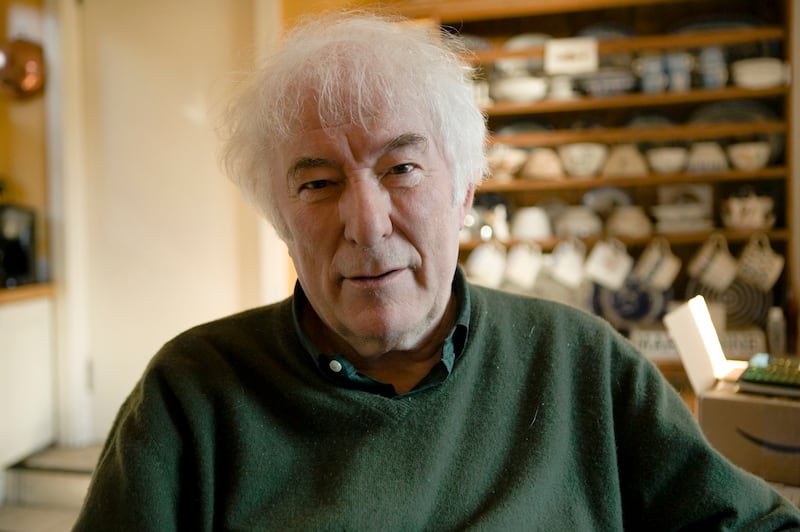
Nuala Ní Dhomhnaill once told me a story (one she is happy to have repeated) about the time Seamus Heaney also revisited the same hair poem. The setting was a poetry reading, at a time when Ní Dhomhnaill was a new young poet. By her own account, she was acting rather aloof and unsociable. Heaney walked over to where she was sitting, sat next to her and said: “ ... only God, my dear, / Could love you for yourself alone / And not your yellow hair.”
The audible quotation marks around the words, as Heaney uttered them, may have changed utterly the original meaning, or may not have. Ní Dhomhnaill heard the lines as a friendly nudge. Like Anne Yeats, she kept them in her memory.
Lucy McDiarmid’s most recent book is Slightly Magical Irish Poetry and the Long 1990s


