
Five people, including three teenagers and a priest, were shot and killed by British soldiers who “lost control” in Belfast more than 50 years ago, a coroner has found.
Margaret Gargan (13), David McCafferty (15), John Dougal (16), Patrick Butler (37) and Fr Noel Fitzpatrick (42) were fatally wounded within minutes of each other in the Springhill and Westrock areas of west Belfast on the evening of July 9th, 1972.
Delivering his inquest into their deaths in the city on Thursday, Judge David Scoffield ruled that none of the five was posing any threat when they were shot and the soldiers used force which was “not reasonable”.
Soldiers located in Corry’s Timber Yard on the Springfield Road, “in particular E and A ... overreacted to a perceived threat and ultimately lost control”, he said.
READ MORE


The coroner ruled that Gargan, McCafferty, Butler and Fitzpatrick were “unarmed and posing no risk”, while Dougal was “shot in the back while running away”.
Each was killed by a single, aimed, high-velocity round, with the exception of Butler, who was fatally wounded by a bullet which passed through Fitzpatrick and then struck him.

The coroner said a soldier known as Soldier A was responsible for four fatalities – Fitzpatrick, Butler, McCafferty and Dougal – and Soldier E for Gargan’s.
He criticised the Ministry of Defence over multiple missing documents, including the list which would have identified the soldiers, and said it was now “impossible to conclude what the true identity is of any of the soldiers, especially A and E”.
The coroner said he expected to refer the case to the Director of Public Prosecutions – as is required when an offence may have been committed – but he said there was “little prospect of any prosecution”.
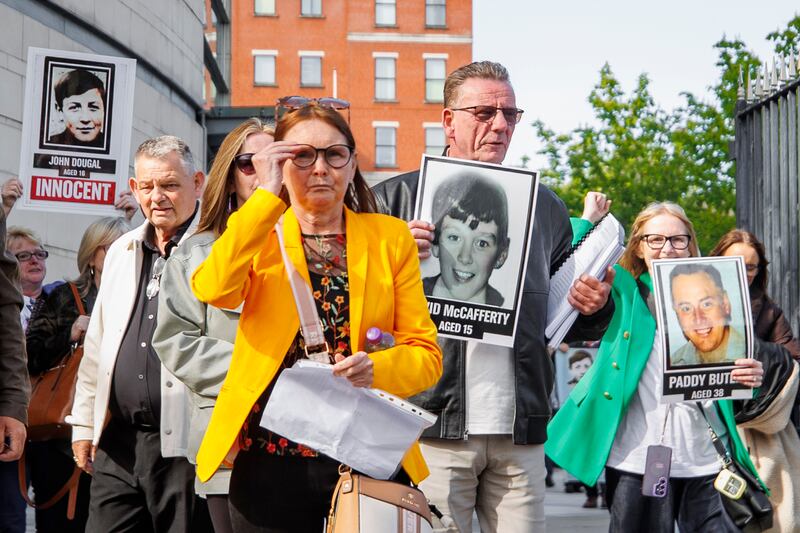
Speaking outside the court, relatives of the deceased spoke of their relief that their loved ones had finally been declared innocent, and there were calls for an apology from the UK government and for prosecutions of the soldiers responsible.
“The burden of blame and prejudice that has lingered for so long has now been lifted, and the record has now been set straight,” said McCafferty’s sister Betty Kennedy.
Butler’s daughter Jackie said her father’s “only crime was his kindness, helping those who were injured, [and] for that he was wrongly labelled a gunman”.
A fresh inquest into the deaths was ordered by the North’s Attorney General in 2014, after an original inquest in 1973 returned an open verdict.
It finished hearing evidence in April 2024, just hours before the cut-off introduced by the former UK government’s Legacy Act – which the current government is replacing with fresh legislation – ended all Troubles-era inquests.
The coroner took more than five hours on Thursday to deliver a summary of his 640-page judgment to a packed courtroom.

He said the deaths had taken place against the backdrop of the breakdown of an IRA ceasefire on July 9th and “sporadic” shooting in the wider area, including around the British army post at Corry’s Timber Yard.
Two cars – one or both of which may have been on “IRA business” – had stopped to “interact” with each other at the so-called “circle” area at Westrock Drive and “something triggered” the soldiers to begin firing at one of the cars.
The coroner said it was “unclear” what “precisely gave rise to the decision to commence firing”, but it was “likely” to have been influenced by a “high state of apprehension” among the soldiers due to the breakdown of the IRA ceasefire and the shooting dead of two of their number earlier that day.
The coroner wholly rejected claims by the Ministry of Defence that the soldiers had been under a “co-ordinated assault” on their position at Corry’s Timber Yard.
The coroner apologised to the families of the deceased for the length of time that had passed since their loved ones’ deaths.
A spokesperson for the Ministry of Defence said it acknowledged the coroner’s findings and was “considering them carefully”.


