

There is a line in the 1989 Kevin Costner film, Field of Dreams, where the narrator tells Costner’s character Ray Kinsella to build a baseball field in his Iowa cornfield: “If you build it, he will come”.
In the decades since, the quote from the film – which sees long-dead White Sox and Yankees baseball players later playing in the field – has been often garbled, and subjected to a thousand interpretations.
The quote’s essence springs to mind as one approaches Studio Ulster’s home in the Belfast Harbour Studios complex on the left-hand side of Belfast Lough, just before the M2 swings left for Ballymena.
Today, Costner would not have to go to Dyersville, Iowa, or to Galena, Illinois, or Boston’s Fenway Park to film Field of Dreams, since every blade of corn or wisp of grass could be created on Studio Ulster’s giant LED screens.
READ MORE


Put aside thoughts of computer-generated imagery (CGI) that looks fake, however: “We can create environments in this building that are impossible to find anywhere else: the Mojave desert, or a blizzard, or anything else,” says Declan Keeney, the chief executive and co-founder of Studio Ulster.
Inside its cavernous interiors, one stage is filled with a backdrop of a harbour at night-time, with lights flickering from a portside café, a ship bobbing on the water’s edge. Everything has been created on LED screens. And it looks real.
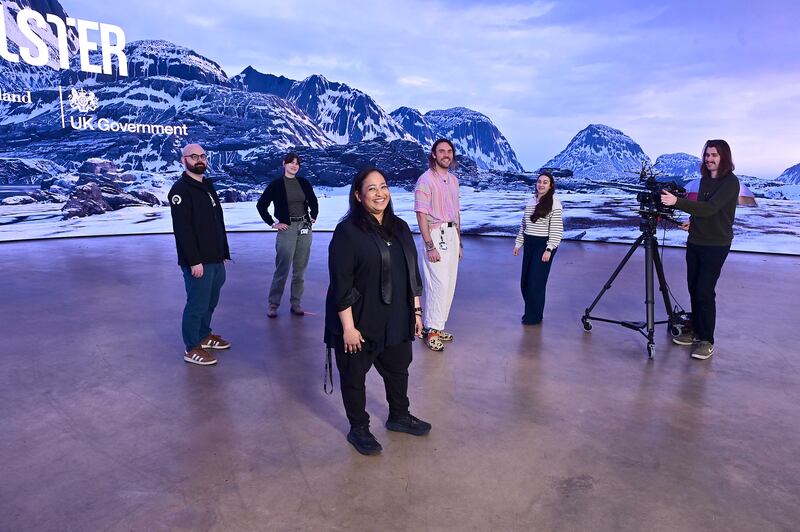
Past efforts to do anything like this would not have looked as realistic, would have cost fortunes to make and would have taken weeks to build and dismantle. Here, everything can be done within days. Hours, often.
Pointing to the screens, Keeney says: “It depends on what they want. If they want it in this configuration, it’s just a matter of throwing up the content. If they want us to move the wall, that’ll take a little longer.”
Everything can be moved on omnidirectional wheels, he says, as he seeks to find the joystick required. “They’re hiding it on me. They get very nervous when they see me coming,” he says, laughing.
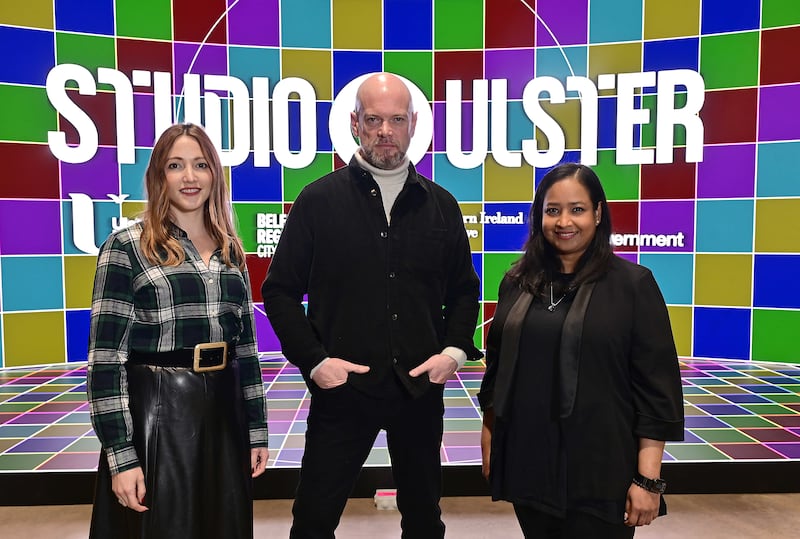
“We can start from scratch and rebuild the stage. It literally takes three people to do it all, two to make sure we don’t run into anything, and one to move it. Then it’ll take a day or so to reset and do all of the other bits and pieces.
“For anybody else in the market currently that’s work that takes five or six weeks. For them, it’s like starting from scratch each time, even if they have only to move four feet to the left,” Keeney declares.
The Dargan Road premises, which just opened in June, has already been used by two critically-acclaimed BBC series, Blue Lights, centred on the Police Service of Northern Ireland, and the four-part Titanic Sinks Tonight series.

Alyssa Boyle, the studio’s head of operations, has so far shown Studio Ulster off to 500 leading executive producers from around the world since January.
“There is a huge interest in this, it has been phenomenal,” she says. “We have a busy new year ahead. That’s a great complaint to have. From then, everything really kicks off in a way that even we could not have anticipated, and we have tried to anticipate everything.”
Though much of Blue Lights is filmed on location across Belfast, some night-time scenes were brought indoors to Studio Ulster “and done at two o’clock in the afternoon, rather than two o’clock in the morning in the rain”, says Keeney.
For Titanic, set designers used a 3D model of part of the ship created by a preservation society in England to “create a bit of the deck of the ship, and the cabins, and it looked extraordinary”, Keeney tells The Irish Times.

The finished product was so good that executives at Sony, which owns the makers of the series, the Belfast-based Stellify Media, came to see for themselves: “They couldn’t understand just why, and how it looked so good.
“It just feels like you’re on the ship. Look on camera and you can see the whole ship at sea, the water’s dynamic, it’s live,” says the Donegal-born Keeney, who, besides his role in Studio Ulster, is also professor of screen technologies and innovation at Ulster University.
“The actors loved it because they just felt that they were standing on the deck”, rather than against blue and green screens used by film-makers up to now for digitally-created backgrounds, Keeney goes on.
Studio Ulster does not exist in a vacuum, however. Standing on the roof of its building, one can easily see across the Lagan to the Titanic Paint Hall at Titanic Studios, where much of Game of Thrones was filmed.
“Eight seasons of Game of Thrones, the very biggest serialised drama show in the world, has helped us build an infrastructure here that is world class, one that can cope with any scale of production here,” he says.
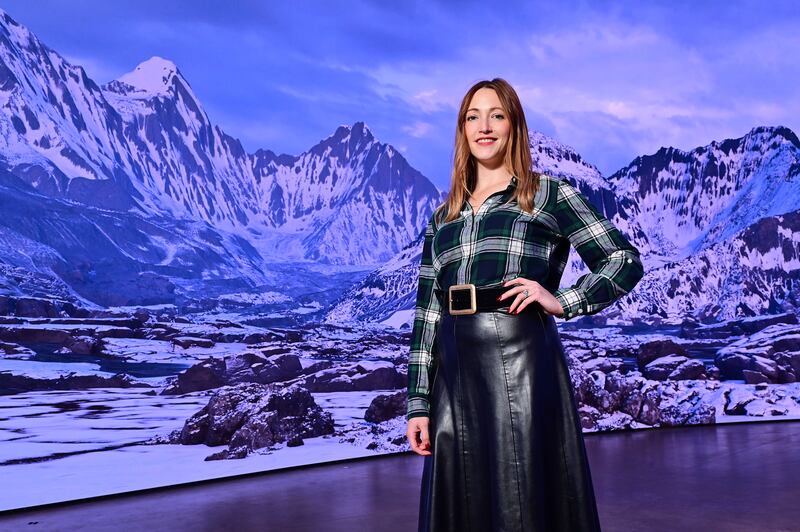
Today, Northern Ireland is home for up to 1,200 highly-trained film crew along with 6,000 extras, says Boyle: “We could have three feature films, two or three TV series and a whole lot of other stuff going on at the same time.”
Though the land that is home to Studio Ulster came from Belfast Harbour Commissioners and the project itself has been heavily backed by British government money, Studio Ulster is a wholly-owned subsidiary of Ulster University (UU).
The university is investing heavily in film and animation. Today, there are 845 students enrolled in 10 degree courses run by UU’s Ulster Screen Academy, “ones endorsed by the industry”, Keeney tells The Irish Times.
“We are building quite a complex ecosystem here,” he says, adding that about 400 of the film crew already available in Northern Ireland are fully trained in virtual production, with a couple of hundred equally-skilled graduates emerging each year.
Everything works together with the university’s Costar Screen Lab, one of several such technology hubs around Britain funded by the British government, specialising in developing new waves of technology.
“That’s the really critical piece. Independent research lies cheek-by-jowl with commercial industry. That’s the difference. It’s not that Studio Ulster owns a research wing,” says Keeney, “That’s not that unusual.
“But what’s unusual is that we have an independent, government-funded research lab, one of the best funded in Europe, right in the heart of the business. That is a fundamentally different ecosystem to anywhere else,” says the former BBC news cameraman.
Opportunities
The alliance creates opportunities for small local tech companies, north and south of the Border. Their number is growing: “They’re creative technology companies inside film, animation, games, immersive. It’s not only just about film,” he continues.
Studio Ulster’s technological advantage has been hard-won, but Keeney and his colleagues have gone to extra lengths to ensure that that advantage remains. “Everything here has been future-proofed,” he says.
Ninety fibre-optic cables “with 32 channels of 8k uncompressed video at the same time” serve the building. For professionals in the trade, the numbers just quoted would “leave their jaw sitting on the floor wondering how that is possible”, he goes on.
Under a deal finally announced in November, but long in the planning, Dell Technologies supplies the building’s world-leading IT sinews: “Dell are quite proud of what they’ve helped us achieve here. We have a mini data centre here,” he declares.
The pride felt by everyone involved in the technological leap it offers is evident, but encountering the reality on one of its sound stages filled with the backdrop of a jungle genuinely impresses.
The backdrop changes as one walks “into” the jungle, unveiling previously unseen parts. Turn left, or right, and the view changes again, with new paths becoming visible, while one can bend down and touch. For the watching cameras, one is in a jungle.
Pointing back to Blue Lights, Keeney said that it is just one example of how the film-making world will be changed by virtual production – with far fewer locations needed, far greater productivity, far lower costs.
“Like I said about those night-time shots for Blue Lights, those can be done at two o’clock in the afternoon, perfectly dry, unless they need rain on the vehicle. If so, that can be arranged with the flick of a switch.
“The quality of life for the actors, for the crew will improve, too. They’re avoiding the late nights; the productivity is twice as high. They can get through maybe nearly half as many again sequences in a day.
“And you don’t have cars backfiring and ruining images,” he says, adding that directors of photography “love” virtual production because they can use many cameras and know “nobody is going to fall off the back of a low loader”, he goes on.
The end of needing to go “on location” for months at a time, working all the early-morning and night hours that God sends to get the shots required by film directors means that film becomes attractive for workers who had moved away from it.
“People who have stepped away because they couldn’t work in the middle of the night because they have young families or whatever can go back in. They can be fairly sure that studio days can be fixed daytime office hours,” he continues.
Without the opportunities offered by Studio Ulster, the makers of the Titanic TV series might well have had to go to Cape Town in South Africa for filming on water, or use CGI blue and green screens.
Life-like backgrounds so good that no one could tell that they were filmed by the side of Belfast Lough are just a part of Studio Ulster’s capabilities, as a display of its “motion capture” equipment quickly shows.
Forty-five years ago, Christopher Reeve was mounted on to a fibreglass body and attached to a counterweighted rig that allowed him to “fly” for the Superman sequences that made him a worldwide star.
No computer-generated imagery, still in its infancy, was used, but multiple cameras and highly-reflective screens created the illusion that Superman was flying at lightning speeds. It was the work of months of planning.
Child’s play
Today at Studio Ulster, such matters are simpler, if not child’s play. Sensors attached to an actor track movement, creating a life-like avatar: “So, all the small breaths, the little twitches, all the little nuances are captured,” says Eranka Weerasuriya.
Weerasuriya, Studio Ulster’s head of production, is but one of several sought-after international staff who have been attracted by the opportunities it offers to make their home in Northern Ireland.
Now little more than three months in Belfast, Weerasuriya, who lived in London for a decade, saw the position advertised on LinkedIn: “I never had it in my head to go to Belfast but I came anyway and fell instantly in love with the place,” she tells The Irish Times.
She came with a reputation, though she has to be pressed by Keeney into giving details of her past career, which includes working for Star Wars creator George Lucas’s production company Lucasfilm.
Once Lucas sold the company to Disney, Weerasuriya worked on the Marvel films before moving to London where she joined others “initially dabbling” in the early days of virtual production, before moving on to Netflix.
Even with that background, Weerasuriya is clearly impressed by the things that Studio Ulster can do that would have been deemed impossible until now, saying that she had “never seen anything like it before”.
Multiple shoots can be held at one time, stages can be changed, while film-makers can block-book times for a series of scenes confident that they will not be delayed by weather, traffic or anything else, she says.
Belfast appeals, too, she says: “First of all, I love the people. They have a generosity of spirit that I haven’t experienced elsewhere. And they’re funny. Good craic, too,” she says, with a smile.
India Vadher-Lowe is another who has come to build her field of dreams. Raised in Oxford, she arrived last January for the Titanic series, even before the studio officially opened.
She started as a runner in a company making video games in 2015. Following time working on Disney films, she entered virtual production during Covid when film-makers could not take anyone anywhere for filming.
“I’ve settled here. Everyone’s lovely. The place is changing a lot. But you’re never more than 10 minutes away from everything. I’m not travelling an hour and a half into London to go to work. I travel 12 minutes down the road.”
Now living in a small town in Co Antrim, Callum Smith-Halvorsen is yet another arrival, and one equally taken by the lifestyle offered by life in Belfast, rather than the southeast of England.
He also came even before Studio Ulster opened and was then persuaded to stay. He did “amazing work”, says Keeney. Smith-Halvorsen stands, looking embarrassed.
Life in Belfast suits, he says: “It’s nice. I’ve come from a small village, so I’ve gone into another village and I’m building a home up there. It’s been good, very good. Life here is so much more,” says the softly-spoken Englishman.


