
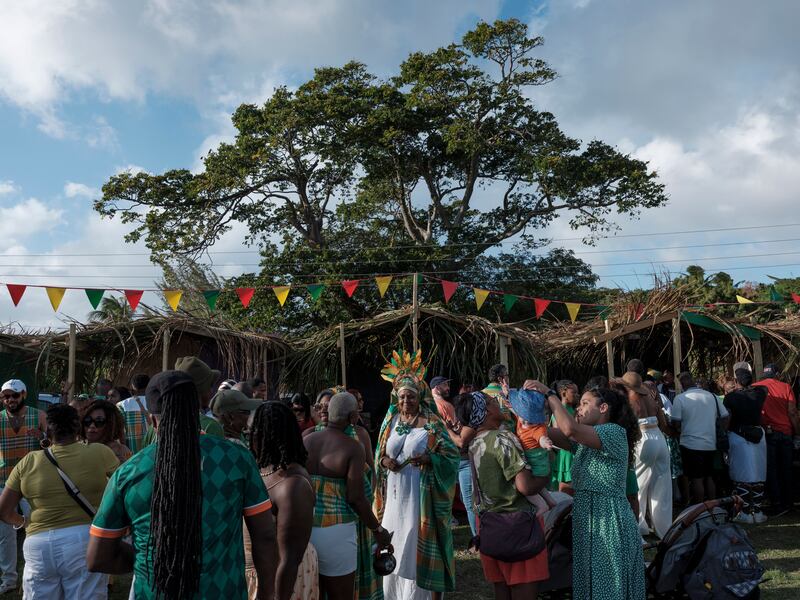
The men dressed in kilts danced as they paraded down the main road on Tuesday. Everyone donned green, from babies in strollers to pensioners watching from their porches. Shamrocks were everywhere, from the street decorations to the passport stamp.
This was not a local parade in an Irish town, but on the tiny Caribbean island of Montserrat, the only other place in the world to observe the feast of St Patrick as a national holiday.
Montserrat treats St Patrick’s Day as both a celebration and a more sombre milestone: a reminder of a failed slave rebellion on March 17th, 1768. The uprising was stopped before it even began and was reported to the British, leading to the execution of nine people and imprisonment of about 30 more.
“I would not say celebrating St Patrick’s Day, but more so commemorating the attempt for freedom,” said Crenston Buffonge (51) who serves as Montserrat’s parliamentary secretary overseeing culture, tourism and diaspora affairs. He said he wears green but prefers to do so in a more traditional African madras cloth that also has orange and white.
READ MORE


Irish settlers began arriving in Montserrat in the 1600s, including Irish Catholics who came as indentured servants. Through the centuries, Irish and African cultures mixed, which led to a St Patrick’s Day tradition that became a national holiday in 1985.

Today, Montserrat is often referred to as the emerald isle of the Caribbean because of its green and rocky terrain and historical connection to Ireland. Villages here bear names including St Patrick’s, Kinsale and Cork Hill, and people have last names such as Reilly, Sweeney and Meade.
While technically a British territory, Montserrat is very Caribbean. The residents often describe themselves as Montserratians of African descent. The island is quiet and largely rural, with small villages scattered on the west side.
Early on Tuesday, dozens of people, many dressed in traditional African garb, stood along the island’s main bay to honor the Africans who died en route to the Americas as part of the transatlantic slave trade.
It was a solemn moment in which a handful of people waded into the shallow waters to place red heliconia, the island’s national flower, into the sea and let them slowly float away. The ceremony was followed by prayers and music.
[ An Irishwoman’s Diary: Meeting islanders with Irish ancestry on MontserratOpens in new window ]
Afterwards, the attendees shared the traditional foods of their forebears – ginger beer, salted codfish, a sweet potato and coconut dumpling called duckna, sugar cake and more.
“Even though we’re not shackled, like our ancestors were shackled, there are times when you feel that way,” said Veronica Dorsette-Hector, the acting premier of Montserrat. While she is the head of government, the island is still overseen by a UK governor appointed by Britain’s King Charles.

“You don’t have your own money,” she continued. “You don’t have your economic independence. We have a constitution that allows us to make our own laws, but if the governor does not assent to the bill that we passed in parliament, it’s still not ours.”
On Montserrat, St Patrick’s Day is also an opportunity to simply have a good time, Caribbean style. It is the culmination of 10 days of merriment – including the so-called Insomnia Weekend, when the party extends into the early morning.
People on Tuesday tossed what they called leprechaun dust at each other while drinking and dancing to dance hall music, a popular Afro-Caribbean genre, during the traditional predawn celebrations that are typical of Caribbean carnivals. Here, they come with an Irish twist, including green powder.
The festivities are the biggest driver of tourism every year, said Rosetta West-Gerald, the chief executive of the Montserrat Tourism Authority. Of the nearly 15,000 people who visit the island annually, as many as 3,000 come for this holiday, she said.
The St Patrick’s Day parade along the main street of Salem village was the biggest event, ending with a food and music festival that serves goat water, a hearty stew that is Montserrat’s national dish.
The parade was led by nearly 30 masquerade dancers, dressed in brightly coloured outfits, bishop-style hats and masks that were a mix of European and African influences. A troupe leader, dressed in green and holding a whip meant to symbolise a slave master, danced as he led the group past the crowds.
Joseph Morris, a 30-year masquerade veteran, said the tradition derives from enslaved people who used scrap-cloth costumes to emulate plantation ballroom dances while maintaining their anonymity.
The main street was lined with people – all wearing at least one item of green clothing — hanging out on porches, in their yards and at bars. A flatbed truck carried enormous speakers and a DJ. Small marching bands followed behind, playing their own tunes.
Darian James (44) who works in the hotel industry in Los Angeles, left Montserrat after the 1995 eruption of the Soufrière Hills volcano. The blast that buried the capital city, Plymouth, left two-thirds of the island uninhabitable and forced the mass exodus of more than 9,000 people. Today, only about 4,500 remain on the island.
James didn’t return to Montserrat until 2018, when he and others from his displaced hometown reunited on the island. He has since come back every year to participate in a dance troupe during the St Patrick’s Day parade.
“Wherever we all migrated to, we don’t have the same celebration,” he said. “So this gives us a sense of purpose, a sense of origin and of meaning, to come back to who we are.”

For Genny Browne Turay, this St Patrick’s Day was her first time visiting the homeland of her father, who died in 2024.
Browne Turay (33) came from London to experience one of Montserrat’s most important celebrations and to spread her father’s ashes across the island, including in his hometown.
“I couldn’t miss seeing this,” she said, decked out in green as she watched the parade. “It’s one of the biggest St Patrick’s Day celebrations outside of Ireland and New York, but what is so fascinating about it is it has nothing to do with St Patrick at all.”
Next year, she said, she planned to return.
This article originally appeared in The New York Times.
- Are you Irish and living in another country? Would you like to share your experience in writing or by interview? You can use the form below, or email abroad@irishtimes.com. Irish Times Abroad submission guidelines here.
- Follow us on Instagram to keep up with the latest
- Sign up to The Irish Times Abroad newsletter for Irish-connected people around the world.
2026 The New York Times Company


