
Germans love low-wattage showbiz couples and, for the last decade, the couple that had best fit that bill was Christian Ulmen and Collien Fernandes. They were B-list red carpet reliables whose talk shows, comedy series and even commercials saw him as the lovable loser archetype and her as the woman who loves him anyway.
Now a real-life drama around the since-divorced couple has shattered that illusion, and triggered countrywide marches, parliamentary speeches and emotional debate over digital violence against women.
It kicked off when Fernandes told Der Spiegel magazine how a years-long hunt for the man who was impersonating her online - on dating apps and porn sites – had ended at her own front door.
Her former husband, of more than a decade, Christian Ulmen, had, she said, confessed to using her pictures, and even sending sexually explicit videos to men online to live out his sexual fantasies of seeing his own wife humiliated and violated by strange men.
READ MORE


The person impersonating her online, she said, had communicated ”with men with a AI-generated voice of me, at some point it tipped over into telephone sex”.

Finally, she said, the fake Collien Fernandes had sent men videos “in which I was raped, in which I clearly say I don’t want this, that I am in pain and I am afraid”.
Ulmen, through his lawyer, has denied some but not all of the allegations. In particular, he disputes allegations of creating deep-fake videos, where a face of one person is digitally appended to another person’s body.
[ German Protestant churches riddled with sexual abuse and cover-ups, report findsOpens in new window ]
His lawyers have vowed to take legal action against Fernandes and Der Spiegel magazine, accusing both of spreading “false facts” based on hearsay and one-sided claims.
Undeterred, Fernandes has become the figurehead of a campaign in Germany to push back against the largely unregulated world of digital violence against women.
At least 10,000 people joined a march at the Brandenburg Gate in Berlin, with many holding signs reading “shame has to change sides”, a phrase coined by French woman Gisèle Pelicot who, for years, was drugged and raped by her husband and other men.
One protester’s placard read, “I can’t believe that we still have to protest against this s**t.”

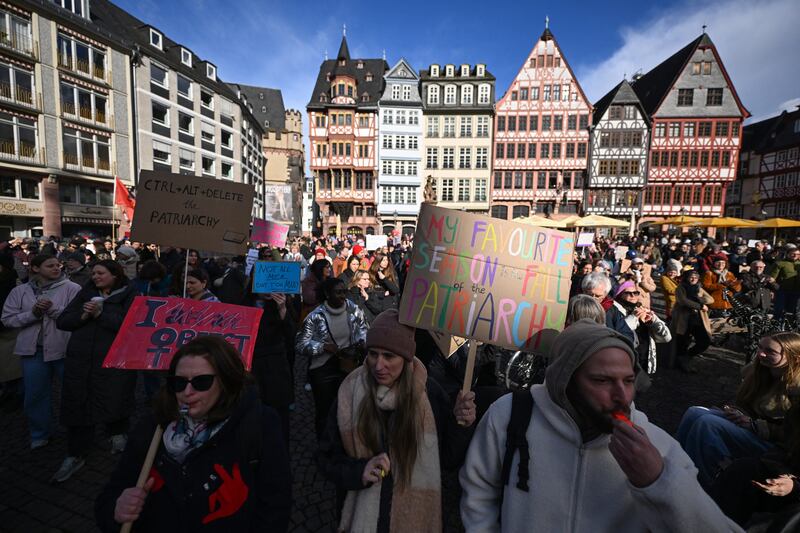
At a demonstration in her home town of Hamburg, Fernandes appeared onstage to speak about the violent pushback against her allegations.
“I’m standing here with a bullet-proof vest, police protection and security because I am getting death threats,” she told the crowd. “Given that, you can’t be surprised that so many women simply don’t have the courage to go out and say that this or that was done to me.”
In regular Instagram posts on her case, Fernandes says she is fighting an exhausting, multi-pronged battle: against doubts sown by her ex-husband’s legal team, litanies of detailed questions from media outlets, and a German legal system she says had previously blocked the investigation.
The latter prompted Fernandes to file charges last December in Majorca, where she and Ulmen once lived.

German authorities say they dropped the case because Fernandes’s lawyers failed to provide requested documents. Either way, the case appears to be heading back to Germany after a Spanish court in Palma ruled that it did not bear responsibility.
The shock of the case is so great that federal justice minister Stefanie Hubig agreed to appear on a top-rated television talk show on Sunday along with Fernandes.
Hubig insisted she would not talk about any specific cases but that, as a result of Fernandes’s ordeal, would tighten up still further a law already being drafted on digital violence.
This will criminalise the distribution of all deep fake videos, with additional punishment for production of those with pornographic content. “It is not about limiting freedom of expression online,” said Hubig, “but punishing what is really dishonourable and humiliating.”
In the days since that appearance, however, the tone of the debate has begun to shift. Ulmen’s chief defence lawyer Christian Schertz criticised the talk show for declining his offer to appear.
After the broadcast, he called it “a television court in session with the highest judicial representative in the land and the complainant”.
High-profile legal experts agreed, with media lawyer Joachim Steinhöfel arguing on Twitter/X: “While an investigation is ongoing, the justice minister – protector of the presumption of innocence – appears with the complainant in a talk show. Who needs a [court] ruling?”
Women’s groups have welcomed how the case has highlighted the wider issue of male violence against women and girls in Germany – calculated at one case a minute – and even femicide, where one woman a day is estimated to be killed by a man in Germany.

After breaking the story, Der Spiegel argued that “men are the problem. Yes, all of them.” An Instagram “detoxmasculinity” profile has attracted 12,000 likes for its log of the reaction – or lack thereof – to the Fernandes claims by actors who have worked with Christian Ulmen.
Pushing back, the Süddeutsche Zeitung daily has warned against releasing long-pent-up fury blaming all men for all male violence against women. That approach could backfire: “Excessive fury always triggers a violent reaction. That that risks losing people you’ll need as allies.”