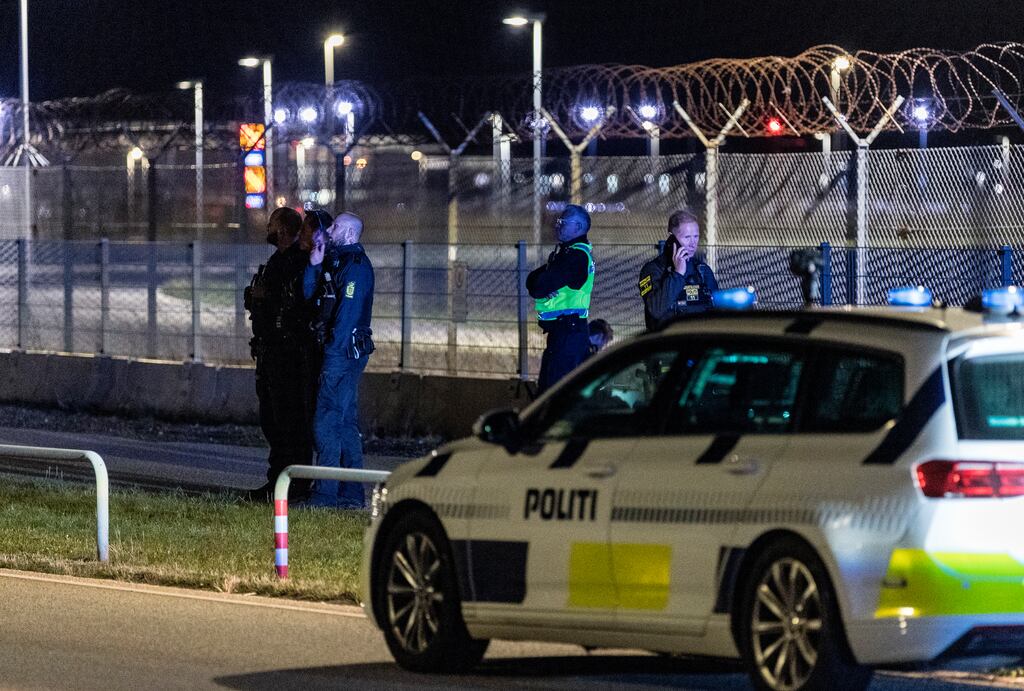
Danish authorities are investigating a drone incident at Copenhagen airport that halted flights overnight as a potential hybrid attack by a state actor, with Russia among the suspects.
The presence of several large drones shuttered Scandinavia’s busiest hub for four hours on Monday evening, with the terminals reopening shortly after midnight on Tuesday when the drones had disappeared.
Denmark’s prime minister, Mette Frederiksen, called the incident a “serious attack” on Danish critical infrastructure.
“I can’t rule out that it is Russia,” she told reporters on Tuesday, adding that the incident is being investigated in connection with recent developments in other European countries, including drone attacks, airspace violations and cyberattacks on airports.
READ MORE


Russia’s ambassador in Copenhagen, Vladimir Barbin, denied the country’s involvement in the incident, calling the suspicion “ungrounded”.
“Russia is not interested in further escalating tension in Europe, which could have unpredictable consequences,” he said in an email relayed by the embassy. “The incident in the sky above Copenhagen Airport reveals a clear desire to provoke Nato countries into a direct military confrontation with Russia.”
Danish police described the situation as “very critical” and said there are indications that “a capable actor” caused the incident, without providing further details on the transgressor. It is now working with Denmark’s intelligence agency and authorities in other countries to determine what happened.
One hypothesis is a hybrid incident involving a state actor, Flemming Drejer, operations chief at the Danish police intelligence service, said. One scenario, among several, is that the drones were launched from ships.
The incidents underscore the growing vulnerability of major transport hubs to outside interference. Over the weekend, a cyberattack on a key airline check-in system snarled travel at major European airports, forcing staff to process passengers manually, triggering delays and cancellations.
Unauthorised drones have also been a recurring challenge for aviation authorities across Europe in recent years.
The European Commission is in “full solidarity” with Denmark, spokesperson Anitta Hipper said in a briefing on Tuesday, indicating that Russia could be behind the incident in Copenhagen following airspace incursions in Poland, Romania and Estonia in recent weeks.
“When we are putting the things into context, while not prejudging the results of the investigation of the authorities, we have seen a clear pattern when it comes to drones violating our airspace, and this points to Russia,” she said.
Denmark has now been invited to join other European Union member states for a meeting on Friday to discuss a proposed “drone wall” to boost the bloc’s defences.
More than 30 aeroplanes heading for Copenhagen on Monday had to be diverted and more than 100 flights have been cancelled so far, a spokesperson for the hub said. Some 20,000 passengers were affected. In Norway, about 12 flights were impacted.
The North Atlantic Treaty Organisation (Nato), meanwhile, has promised a “robust” response to Russian incursions into its airspace and said it would use all options, including military, to defend itself.
“Allies will employ, in accordance with international law, all necessary military and non-military tools to defend ourselves and deter all threats from all directions,” Nato said in an emailed statement on Tuesday. “Allies will not be deterred by these and other irresponsible acts by Russia.”
The military alliance met for talks on Tuesday at Estonia’s request after the country said Russian fighter jets had violated its airspace on Friday for 12 minutes.
The Baltic nation called the incursion part of the Kremlin’s broader goal to test Europe and Nato’s resolve.
The breach is Russia’s fourth in Estonia this year, the country said, and the third that Nato members have reported this month, following incidents in Poland and Romania.
When asked if Nato was prepared to scare Russia to prevent further airspace violations, Nato secretary general Mark Rutte said: “of course”. He added that decisions on whether to shoot down an intruding aircraft are based on “available intelligence on the threat posed by the aircraft, including intent, armament, potential risk to civilians and infrastructure”.
Russia’s defence ministry denied its jets had entered Estonian airspace on Friday, saying the aircraft followed a planned route from the Karelia Republic, which borders Finland, to the Kaliningrad exclave. – Bloomberg


