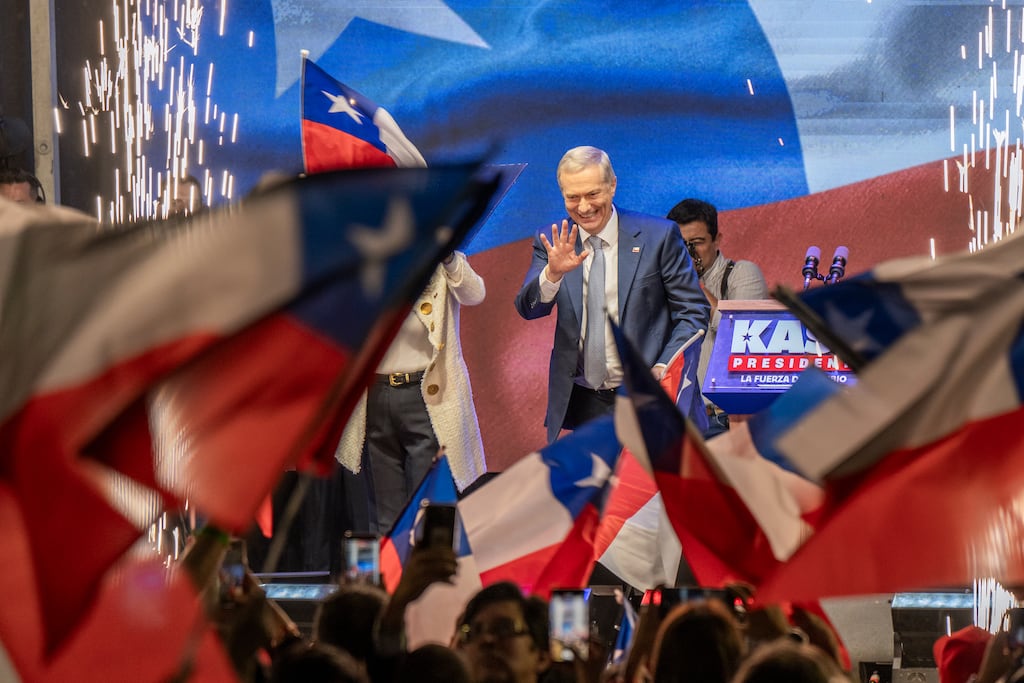


Right-wing populist José Antonio Kast’s sweeping victory in Chile’s presidential election on Sunday is good news for Donald Trump. But repositioning the mineral-rich country strategically may not be straightforward.
A tricky course for Kast
After four years under Gabriel Boric, its most left-wing president since Salvador Allende, Chile has elected in José Antonio Kast its most right-wing leader since Augusto Pinochet. Kast’s landslide 58 per cent to 42 per cent win is a powerful endorsement for his hardline policies against immigration and crime.
As our correspondent Tom Hennigan noted in his excellent report ahead of the election, Kast will be the latest in a succession of right-wing populists to take power in Latin America. His election is welcome news for Donald Trump, whose National Security Strategy identified the western hemisphere as the administration’s top foreign policy priority.
That document says Washington will enlist regional champions and expand alliances to combat drug smuggling and illegal immigration into the United States. And it warns foreign states and companies that the US now regards Latin America as its own economic sphere of influence too.
READ MORE


“We want a Hemisphere that remains free of hostile foreign incursion or ownership of key assets, and that supports critical supply chains; and we want to ensure our continued access to key strategic locations,” it says.
This is a reference to China, which has expanded its footprint in Latin America since the start of this century, becoming the region’s biggest trading partner. China has built much-needed infrastructure across South America, notably the enormous Chancay port in Peru that Xi Jinping opened in November 2024.
Chile is crucial to the competition between China and the US because it lies at the heart of the Lithium Triangle, which also stretches through Argentina and Bolivia. This area is home to more than 75 per cent of the world’s reserves of lithium, an essential ingredient in the batteries that power the green energy transition.
If South America has most of the world’s lithium, China has a near monopoly on its processing and Chinese companies have major stakes in the industry throughout the Lithium Triangle. Bolivia’s Rodrigo Paz and Argentina’s Javier Milei have reoriented their countries’ foreign policy towards Washington and opened the door to more US investment in the minerals sector.
Kast is ideologically aligned with Trump and he will be a more amenable partner for the US than his left-wing predecessor Gabriel Boric. But there are constraints on the incoming president’s capacity to engineer a strategic repositioning of Chile.
China is Chile’s biggest trading partner for exports as well as imports and it is the number one destination for the country’s most important export, copper. Even Milei, whose rhetoric has long been hostile towards Beijing, has found China too important a trade and investment partner for Argentina to turn away from.
Previous Chilean leaders of all political stripes have taken a pragmatic approach by seeking to remain on good terms with both Washington and Beijing. For all his affinity with Trump, Kast may find this to be the most prudent course, even if it is a tricky one.
Please let me know what you think and send your comments, thoughts or suggestions for topics you would like to see covered to denis.globalbriefing@irishtimes.com