

We met in the Titanic Quarter in Belfast, and it couldn’t have been a more appropriate venue. Everybody present had struck at least one major iceberg during their career. Warm, firm friendships were re-established within moments, the banter and the humorous insults flowed.
Maybe you’ve guessed, it was a gathering of international referees, those of yesteryear. There was also a welcome sprinkling of TMOs at the party, in case we couldn’t agree. It was a great evening, impeccably organised by former Test referee Brian Stirling, who can still claim fame – as the father of international cricketer Paul. The Irish contingent was led by Stephen Hilditch, Dave McHugh and Alan Lewis. The visitors from the UK included Derek Bevan (Wales) and Ed Morrison (England), both World Cup final referees, and Jim Fleming (Scotland). How the game today would benefit from that little group.
When the conversation turned to rugby, it was clear there was a huge amount of knowledge in the room, allied to common sense, of which there is precious little about these days.
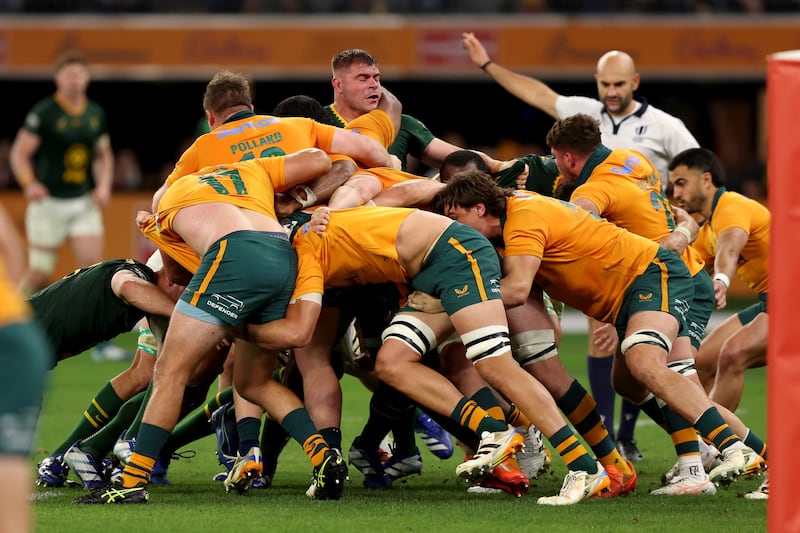
Here’s one very interesting common-sense thought: when the referee delivers a yellow card for repeated infringements, that should wipe the slate clean, rather than the next infringement automatically getting yet another card. If that had been in operation, then Andrea Piardi would have avoided the excoriation that followed Australia v South Africa last month, when four yellows were issued, reducing the Wallabies to 11 players at one point.
READ MORE


Having reflected on it during the train journey home, I think the suggestion has real merit, but with a necessary adjustment: the warning remains alive, but another yellow would only follow if the next offence was cynical, such as a maul collapse or a deliberate knock-on. But other offences, such as a mistimed offside blitz defence or a mistimed poaching attempt, would be penalised but not carded.

We saw common sense go completely Awol when New Zealand referee Ben O’Keefe gave a card warning to Argentina (v Australia) for a lineout offence. Shortly afterwards he penalised Argentina again, for a different issue, but did not produce a card, saying the warning only applied to lineout offences. Whichever hat he pulled that rabbit out of, he needs to put it back.
In the last few months, we have seen refereeing that hasn’t been up to scratch. Better is needed as we head into Europe and part two of the Nations Championship. Irish referee Andrew Brace is not included in that comment: he gave a fine, assured display last weekend in the New Zealand-Australia game. And, mercifully, he was not verbose, his communication was measured, and all the better for it. From time to time I’ve been on his case, but certainly not on this performance, which hopefully will become his permanent template. He can further help himself by becoming intolerant to backchat, which went on for too long.
We have also watched the officiating of breakdown side-entry all but disappear. The majority of referees seem happy to ignore it, even though its intent is to clear out a legitimately-placed opponent who has the right to contest possession. To execute an “effective” side-entry, the first offence is offside, but strangely that’s never a consideration. Maybe it’ll need a couple of serious knee-ligament injuries for this to be put back on the agenda; it really does need to be addressed by World Rugby.
After all, World Rugby recently told us the “knee-drop” and “hip-drop” tackles were to be banned on the grounds of player safety. They have actually introduced new laws to cover these, so why not reaffirm side-entry at the same time?
The knee-drop provision means a player cannot drop on to one or both knees to execute a tackle. At first sight it seems as if a good technique has been outlawed. It has caused quite a stir, prompting World Rugby to tell us that a player on the ground is already out of the game; but that if the knee drop happens simultaneously with the tackle, then it’s all okay. There will be some tight calls needed.
The hip-drop is when a tackler, coming from behind or from the side, pulls the ball carrier to the ground so that the tackler’s body weight falls on his lower limbs. It seems straightforward on paper but, in reality, it won’t be easy to adjudicate, a very tough one to referee.
When New Zealand’s Leroy Carter was injured in the act of scoring, the question arose as to whether the Australian tackler, Rob Valentini, was guilty of the hip-drop technique. This new law doesn’t take effect until November but it is already being hotly debated and there is no consensus as to whether Valentini’s action was dangerous or the injury was caused accidentally, which is my view. But one thing is pretty certain: both of these will lead to more delays and more TMO involvement, just when we’d all like to see less.
Lineout driving mauls have become the prevalent play in rugby union, with a staggering total of 10 tries scored from this tactic last Friday evening in just two URC matches. These mauls, formed illegally, are dominating the game, apparently with the full blessing of match officials.
Added to recent law directives that make defending it much more difficult, the driving maul is now a nightmare for defences. World Rugby must surely show some gumption and instruct officials to apply the law. They should pay no attention to excuses that it is difficult to referee – that is no more than a smokescreen, illegal formation is easy to spot. Otherwise, just give any good courier a shout – they’ll be happy to deliver the World Cup to South Africa.