A legal challenge to a decision by Northern Ireland Secretary Chris Bryant to halt an Orange Order parade down the Garvaghy Road in Co Armagh is set to be heard.
Bryant revoked permission for the Drumcree parade, which had led to a stand-off between Orangemen and nationalist residents of the Garvaghy Road in Portadown lasting almost two weeks.
It came after Northern Ireland’s chief constable Jon Boutcher asked Bryant to review the Parades Commission determination which ruled the controversial Orange Order march at Drumcree could go ahead.
The Orange Order’s legal representatives have applied for an emergency judicial review against the decision. It is set to be heard at the High Court in Belfast on Saturday afternoon.
READ MORE


The Orange Order is also seeking urgent meetings following the banning of the parade.
Overnight the Orange Order issued a statement to say it is seeking urgent meetings with Bryant and Boutcher in the coming days.
It expressed “profound disappointment” at the decision of the Secretary of State to “overrule the legally established rights of Portadown District Orange Lodge No 1”.
It also claimed a “capitulation to the threat of mob rule and violence”.
“This unprecedented action, and the abdication of responsibility by the Chief Constable, can be seen as nothing more than a capitulation to the threat of mob rule and violence,” it said.
“In stark contrast, the Brethren of Portadown have complied with the rule of law, exercised restraint and maintained a dignified and resolute stand in the face of intimidation and intolerance.
“It is evident that those who, in defiance of the law, have been content to stand alongside the representatives of those who murdered 345 of our members, have no interest in extending any degree of tolerance or respect towards those who share an Orange heritage.
“Furthermore, it is evident that the statutory authorities have neither the will or ability to uphold the law in this instance.
“We commend the Brethren of Portadown for their resolute stand and reinforce their message that this is a time for responsibility and lawfulness.
“We cannot undermine our cause by adopting the illegal and offensive actions of our opponents.
“Urgent meetings with both the Secretary of State and Chief Constable will be sought in the coming days where their decision making and actions in this matter will be robustly challenged.”
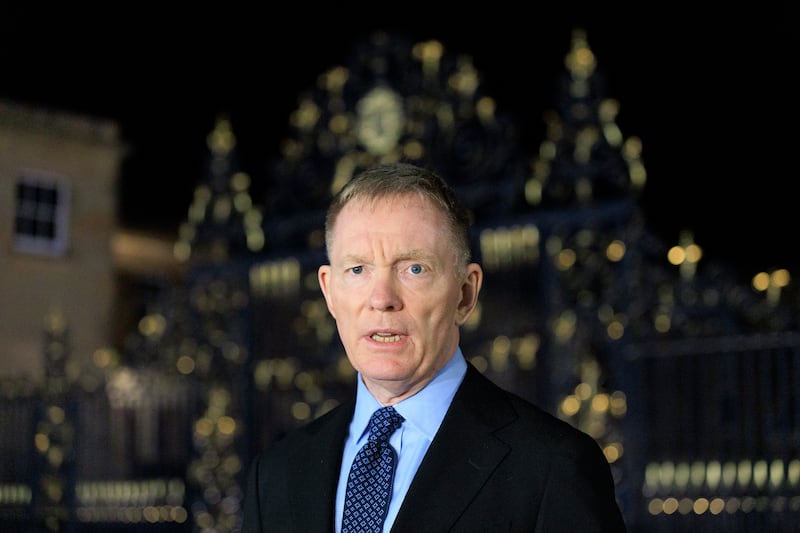
In a statement confirming he was now banning the parade, Bryant said he had not taken the decision lightly.
He thanked the Portadown Orangemen “for their peaceful and law-abiding approach and their co-operation at all points with the PSNI”.
He added: “Respect for the rule of law is fundamental to our society and I am grateful to those who have behaved peacefully and legally and sought to ease tensions in their respective communities. Those who have acted unlawfully should face the consequences of their actions.
“I am also grateful to all those who took part in good faith in the negotiations at Hillsborough. I heard the concerns of people on all sides and I only regret that we could not reach a compromise on a way forward and that many residents across Portadown have felt anxious and worried.
“With this in mind, I call for all protests, rallies and demonstrations to be stood down. There is no excuse for a continued ratcheting up of tensions.”
In a statement on behalf of Sinn Féin, the party’s president and Northern Ireland First Minister Michelle O’Neill welcomed the decision.
“Today belongs to the residents of the Garvaghy Road, who have shown remarkable strength and dignity in the face of provocation and intimidation. There will be an enormous sense of relief within the community this evening,” they said.
But DUP leader Gavin Robinson said: “These decisions are a mistake, and send profound signals that the country should be run on force of numbers and who shouts the loudest.
“The framework for both parading and protests now lies in tatters and the rule of law has been fundamentally undermined ... The PSNI must now pursue the evidence of lawbreaking without fear or favour.”
The parade, on September 27th, was blocked by protesters on the mainly nationalist Garvaghy Road and did not go ahead, and a stand-off between the two sides developed.
In his statement, Bryant said: “The chief constable has advised me that it would not be possible to enable the procession to happen without a major intervention which would carry an unacceptable risk of serious injury, disorder and a wider contagion effect across Northern Ireland.”
He said the Parades Commission had also advised him that, “while ultimately a matter for the courts to determine, the Commission is of the view that, in light of this current assessment by the chief constable, the original determination does not now have enduring legal effect“.
The PNSI’s chief constable welcomed Bryant’s decision, saying he had asked him to review the matter under section 9 of the Public Processions (Northern Ireland) Act 1998.
“I outlined in my letter to the Secretary of State that my current assessment was that all available, lawful and proportionate options to facilitate completion of the procession had been exhausted.
“Any remaining options would have required a substantial public order intervention that was not assessed to be proportionate, and which would have carried an unacceptable risk of serious injury, disorder and a wider contagion affect across Northern Ireland. Further to this, such an operation would in my view have had not only catastrophic long term consequences for trust and confidence in policing, but for the Northern Ireland Executive and the peace process.
“I also outlined in the letter that mediation and political engagement had not produced a sustainable agreement, and the position of the respective parties had become more entrenched.
“Finally, I highlighted that the current and continuing costs and impact upon the Police Service of Northern Ireland were significant and in the context of our existing funding challenges could not be sustained indefinitely.”
Boutcher added: “This past two weeks has had a marked impact on relationships within and between communities and the police. It is in everyone’s interest that time and space is now created for conversations about finding long term solutions to this complex and sensitive issue.”
A judgment in the latest court challenge to the Parades Commission’s original determination is due to be delivered at the Court of Appeal in Belfast on Monday.
Prior to Bryant’s decision, the Orange Order had warned of “serious consequences” if the Northern Secretary stopped the march.
DUP MP Carla Lockhart said on Friday she expected Bryant would “most likely allow for the court hearing” and reiterated her concerns that “the lawful people ... seem to be cast to the side, and the lawbreakers are being rewarded”.
Earlier on Friday it emerged that Northern Ireland’s First Minister, Michelle O’Neill, is to be interviewed by police in relation to her participation in a protest which blocked an Orange march in Portadown.
In a statement on Friday afternoon, O’Neill – who is also the Sinn Féin vice-president – confirmed she had “received a letter inviting me for a police interview in relation to a peaceful protest on the Garvaghy Road.
“I will co-operate with the investigation.”
She said that “for the last two weeks, I have stood in solidarity with the Garvaghy Road residents as attempts were made to force an unwanted Orange march through their community.
“I will continue to stand with the Garvaghy Road residents who should be allowed to live in peace and free from sectarian intimidation” because “it is always right to stand up for what is right and there can be no going back”.
[ Who is Chris Bryant, Secretary of State for Northern Ireland?Opens in new window ]
Earlier, Sinn Féin president Mary Lou McDonald had told reporters at a press conference on the nationalist Garvaghy Road that she had not received a letter, but expected to.
On Thursday, a senior PSNI officer confirmed the service was issuing letters to those “reasonably suspected” of having committed a criminal offence in relation to the ongoing stand-off in Portadown.
The Irish Times has seen a copy of one of the letters, which informs the recipient that “it is reasonably suspected that you may have committed offences” linked to the protest against the Orange parade in Portadown, and invites the recipient to a “voluntary interview under caution”.
Sinn Féin Senator Conor Murphy, and MLAs John O’Dowd (Minister for Finance in the Northern Assembly), Gerry Kelly and Deirdre Hargey have received them.
“There will be processes now, legal processes, investigative processes that will be under way, and of course, just like every citizen, of course we are subject to the law, and we will co-operate with it,” McDonald said.
She reiterated her party’s call on Northern Secretary to step in to resolve the dispute, saying she had spoken to him on Friday morning “urging him again to act”.
People Before Profit MLA Gerry Carroll said on Thursday he had been invited by police to attend a voluntary interview under caution in connection with the protest.
It is understood that, as of Friday afternoon, no SDLP members had received letters.
SDLP leader Claire Hanna told The Irish Times she recognises that she may receive such a letter in the coming days.
A statement said she would “always be accountable for her actions and will engage fully with any policing or judicial process”, but “when faced with a choice between standing with the Garvaghy Road community or doing nothing, she is clear that she made the correct decision”.
[ Sinn Féin and the DUP are happier arguing over a parade than agreeing a budgetOpens in new window ]
This year was the first time in 28 years that the march, which in the 1990s sparked serious violence which led to more than 20 deaths, was given permission to proceed by the Parades Commission, the body which rules on applications for marches in Northern Ireland.
The decision has been the subject of multiple legal challenges, and the latest judgment is expected in the Court of Appeal next week.
The Garvaghy Road protest was not notified to the Parades Commission, and as an “unnotified” parade is therefore deemed illegal.
– Additional reporting: PA