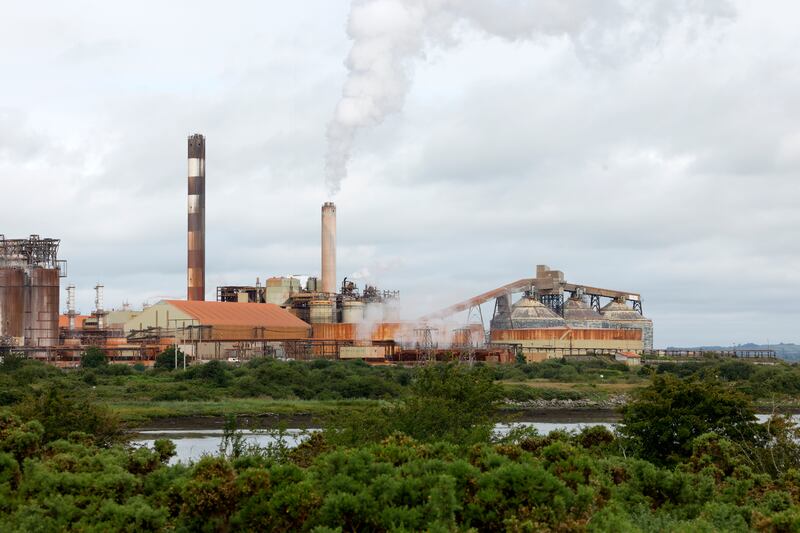
The Government needs to await the outcome of its Aughinish Alumina investigation and to see “evidence” before making decisions on whether the company should be included in European Union sanctions against Russia, the Minister for Justice has said.
Jim O’Callaghan’s remarks came in advance of an informal meeting of European home affairs ministers in Dublin as part of Ireland’s presidency of the Council of the EU and following reports that exports of alumina from Ireland to Russia have increased so far this year compared to 2025.
Revised figures provided by the Central Statistics Office on Wednesday show half of the alumina – 50.25 per cent – produced in the Co Limerick plant in the first quarter of this year went to Russia, up from 43 per cent last year.
Meanwhile, The Irish Times reported that a Government report on the refinery is expected to say it cannot rule out the possibility that Irish-produced alumina is ending up in the Russian military supply chain because of the lack of hard evidence.
READ MORE


However, it is also unlikely to conclude that material from the Aughinish Alumina plant is being used in the country’s arms industry, according to three sources with knowledge of the work involved in the review.
The report will be sent to Brussels and the Government will begin an engagement on the issue with the European Commission, which is unlikely to be concluded until the autumn.
The Government has come under pressure over Aughinish after an investigation by The Irish Times in March – published with journalism consortium the Organised Crime and Corruption Reporting Project – said Limerick-produced alumina had entered Russia’s weapons supply chain.
O’Callaghan was asked to comment on the increased alumina exports from Ireland to Russia as he arrived at Thursday’s meeting in Dublin.
He said Minister for Enterprise Peter Burke’s department is reviewing the issue and “we need to await the outcome of that report.
“We really need to see the hard evidence before we start formulating any conclusions in these matters.”
O’Callaghan did not refer to Thursday’s Irish Times story outlining the expectation that the result of the investigation will be inconclusive on the possibility that Irish-produced alumina is ending up in Russia’s military supply chain.
Asked if Aughinish Alumina should be included in sanctions against Russia, O’Callaghan said: “I think we need to see evidence. I’m not prepared to make really important decisions or make proposals in respect of important decisions without seeing the hard evidence.”
He said he was sure Burke will “bring forward a very detailed report and once that’s available we’ll give consideration to it”.
At a later press conference, it was put to O’Callaghan that the Government’s forthcoming report on Aughinish Alumina is expected to be inconclusive on whether alumina from Ireland ends up in the Russian military supply chain.
He said: “Let’s wait to see what’s in the report before we start determining what should be the response of Government.”
Separately, Estonia’s minister of the interior, Igor Taro, was asked if the increased exports of alumina from Ireland to Russia reinforced his country’s previous call for alumina exports to be included in sanctions.
“Yes,” he replied. “I think we should deal with that and as I said before actually all the measures imposed on Russia should be very strict and we can’t just close our eyes and act as [if] nothing has happened. It is a very important issue that we don’t feed the war mechanism.”
European commissioner for internal affairs and migration Magnus Brunner would not be drawn on whether alumina should be included in the next package of EU sanctions against Russia.
“I think the next sanctions package is really important and I hope that the member states who are in charge and have the competence to decide on it will decide quickly because we need this next sanctions package, of course, and I hope there will be a decision quite soon.”
In the Dáil, Tánaiste Simon Harris said “this country will never cherry pick” when it comes to sanctions. “We support sanctions packages that come from the [European] Commission.”
He said when the investigation was completed the Government would “work in lockstep with the European Commission in providing any and all relevant information”.
“Should we arrive at a position where the European Commission makes a recommendation in relation to sanctions” there would be “conversations about two things: about workers, absolutely, and also about crucial supply chains”.
Harris was responding to Social Democrats deputy leader Cian O’Callaghan, who claimed the Government’s report on Aughinish Alumina would be a “classic fudge” and that the Coalition was “hiding behind an unpublished report”.
“You do not need a report to figure out that alumina from Aughinish is ending up in Russian weapons,” he said.
Australia found alternative markets for its alumina as soon as Ukraine was invaded and “exports stayed stable and are now forecast to grow”.
The Social Democrats TD said there was huge concern about jobs. Given “the Government has ruled out nationalisation”, he asked what measures were being considered to protect jobs and when there would be engagement with workers at the plant.
The Tánaiste said discussions about workers and about crucial supply chains for the EU would take place when the European Commission made a recommendation about sanctions.
“Ultimately, it’ll be for the European Commission to make a recommendation.”
Meanwhile, on Thursday the EU ministers are discussing organised crime and co-operation with third parties, visa polices to support internal security, and information exchange with third countries.
The European Commission has been negotiating a visa waiver framework agreement with the United States aimed at bringing about an enhanced border security partnership that would grant access to information stored in national databases, including biometric databases. The framework will not apply to Ireland as it is not part of the EU’s Schengen travel zone.
The Minister for Justice was asked about the issue on Thursday morning. “Ireland is not a Schengen member but, notwithstanding that, holding the presidency it is an important part of our policy. We want to see advancement in terms of the framework arrangement between the United States and the EU,” he said.
“There’s progress ongoing in respect of that and I hope it’s something that we’re able to advance during Ireland’s presidency.”