There has been sharp Opposition criticism of the Government’s plans for the Occupied Territories Bill with claims in the Dáil that excluding services means the original legislation has been “gutted”.
Taoiseach Micheál Martin defended the Government’s Bill, citing Ireland’s leadership among other European countries in supporting Palestine while stressing the need to protect multinational jobs here from possible negative US reaction to the legislation.
The Government’s proposed legislation, formally titled Israeli Settlements (Prohibition of Importation of Goods) Bill 2026, will ban trade in goods from illegal Israeli settlements in Palestine but does not include a ban on services.
The original legislation put forward by Independent Senator Frances Black was aimed at banning trade in both goods and services.
READ MORE


Speaking during Leaders’ Questions in the Dáil on Tuesday, Sinn Féin leader Mary Lou McDonald argued that the Government has “taken a wrecking ball” to Black’s legislation
McDonald said the Government’s suggestion that including services is impossible to implement “simply doesn’t stack up” as contended it is in line with a ruling of the International Court of Justice (ICJ) that “makes no distinction between goods and services.”
Addressing the Taoiseach she said: “You’ve said you’d support the Occupied Territories Bill, but you have stalled, delayed, blocked and now you have gutted the Bill.”
She said this is the Government’s response to 14 Irish citizens on a humanitarian flotilla to Gaza being “kidnapped, detained, and brutalised by Israeli forces” last week and it is its response to “slaughter and genocide in Gaza”.
She said “Ireland should be leading” and “excluding services and pushing forward with hollowed out legislation is a cop out and a dangerous one.
“It can’t happen, Taoiseach.”
Martin rejected McDonald’s points and said “from the outset, we’ve taken a series of measures that have been at the leading edge in terms of any European Union member states’ response to the genocide in Gaza, to the continued violent behaviour of the settlers in the West Bank and indeed in terms of continuing war in Lebanon which is completely unjustified.”
He mentioned how Ireland has recognised the State of Palestine; has intervened in the ICJ genocide case South Africa has taken against Israel; and provided €146 million in aid to the Palestinians, among other measures.
Martin said the original Bill would not have been legal in terms of how it was framed and that the Government version will cover around €200,000 in goods – fruit and vegetables – coming from illegal settlements.
He said services are “intangible” and banning them is “impossible to implement”.
Martin also said he has to protect about 250,000 jobs here, adding that there have been “a lot of attacks on Ireland because of the leadership stance we’ve taken as a Government”.
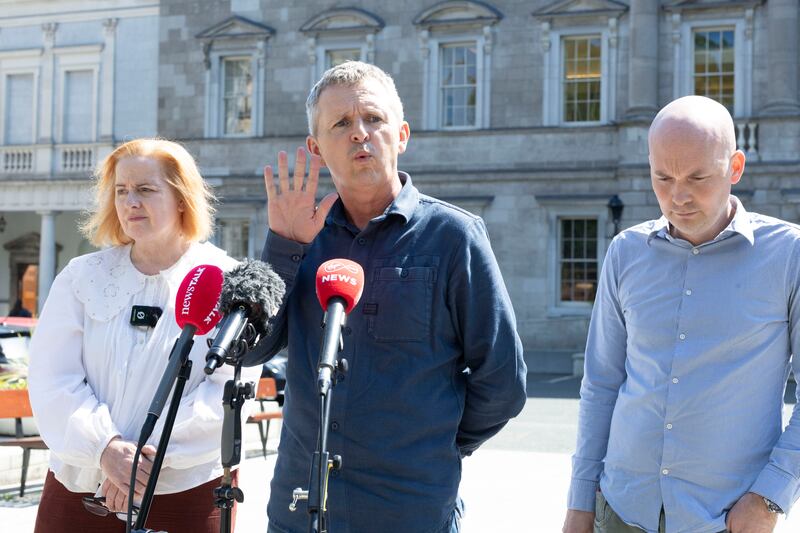
Later, People Before Profit TD Richard Boyd Barrett accused the Government of “speaking out of both sides of its mouth on the question of sanctioning Israel”.
He criticised the Government for opposing his party’s legislation aimed at bringing in wider sanctions against Israel. He said this week the Coalition made headlines on progressing the Occupied Territories Bill but it is actually “going to gut the original Bill drafted by Frances Black by not including services”.
Martin responded, saying: “We don’t have the power, if we wanted to even, to stop trade with Israel right now. That’s a European competency.”
He also warned of the implications for multinational workers in Ireland, should Ireland seek to ban all trade with Israel.
He said the Palestinians and others in the Arab world have thanked Ireland for leading on the issue of Palestine.
Speaking in advance of Cabinet, Martin said banning trade of services would potentially “damage Ireland more than anybody else”.
Minister for Foreign Affairs Helen McEntee said she hoped the Bill would be in place by the Dáil’s summer break.
Once the Bill is enacted and commenced, the importation of goods originating in the settlements into Ireland will be an offence under section 14 of the Customs Act 2015.
But the legislation will only include a ban on the trade of goods and not services.
Independent Senator Frances Black, who first introduced a version of the Occupied Territories Bill in 2018, said what the Government had agreed this week “was essentially a partial ban on trade with the illegal Israeli settlements”.
“It omits the majority of Irish trade, in intangible services like tech and IT, and greatly undermines the scope of the legislation. Government still haven’t given any coherent, detailed justification for this beyond short soundbites,” Black said.
Labour, the Social Democrats, the Green Party and People Before Profit have all raised concerns about the omission of services from the Bill.
”.
The Irish Human Rights and Equality Commission said if “Ireland is to give real meaning to its commitment to international law and human rights, the Bill must include services as well as goods. This is a moment for courage and principled leadership.”
Its chief commissioner Liam Herrick said while the IHREC acknowledges “there may be practical challenges in enforcing restrictions relating to services in the short term but said these should not prevent the legislation being enacted in full.”
“Any operational difficulties can be addressed through phased commencement provisions. They do not justify excluding services from the legislation altogether,” Herrick said.