

In a documentary on RTÉ next week, former Kerry footballer Dara Ó Cinnéide will tell the strange, tragic story of Patrick Foley (1872-1930), a local historian who emigrated from Dingle to the US early last century and, in mysterious circumstances, came to a violent end.
Foley is little known today, even in his home county, although his three books are now collector’s items. A copy of his small history of Kerry, with special reference to “Corkaguiny” (1907), has been advertised on one auction site for €650.
But when Ó Cinnéide found another copy in a pile being thrown out of an old house some time ago, it set him on a journey that led to Boston, Texas and Oklahoma, while trying to solve a murder case that may have involved common criminals, bootleggers or the Ku Klux Klan.
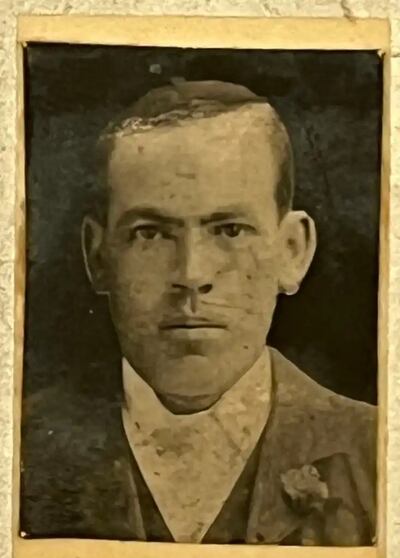
Photographs of Foley depict a man with fierce, piercing eyes. The books suggest he had fierce opinions too. He was an ardent nationalist, a proud gaeilgeoir, and perhaps on occasion a bit of a grump.
READ MORE


Here, for example, in a preface written when he was the father of a one-year-old daughter and while his wife was pregnant with their second child, he explains away any shortcomings in the text: “Regarding style, method, and arrangement, the author has no further apologies to offer than to state that the book has been written in haste, and by one who had not one single hour at the work without being interrupted.”
One of many things he felt strongly about were the evils of alcohol. A footnote to a later book, published in 1916, by which time he was in San Francisco, lectures on the subject with a zeal Fr Mathew would have admired: “Whiskey is the water of death to every person. The saloon keeper, or publican, who gives drink to a child or young girl under the age of 21 years is the devil’s best agent on earth.”
And yet, by the mid-1920s, Foley was being arrested for public drunkenness in Boston. In the process, he assaulted a patrolman Kelly, taking what one newspaper called “a couple of healthy swings at Kelly’s jaw”.
Another time he was found walking the streets naked, while drunk or on drugs, earning him two months in a “psychopathic hospital”.
Foley emigrated in 1909, leaving his wife and young children. Presumably he went in search of work and money, intending to return. And in later years, his diary records visits to California, Texas, Mexico and Cuba, suggesting he had become a man of means.
Some of his movements in the US coincided with the fundraising tours of Éamon de Valera. Foley had certainly not lost the love for his country, at least in 1916, when a whimsical inscription on his latest work read: “Erin you are still grá-mo-chree.”
But he never made it back to Ireland. Meanwhile, from the 1920s, as Ó Cinnéide found when trying to follow the elliptical trail, he seems to have been a haunted, and then hunted, man.
The company he ended up among was a long way from his childhood Dingle, although, as recorded in a list of folk customs and beliefs in the 1907 book, there was occasional skulduggery even there.
He mentions one custom by which local fishing boats or canoes were sometimes rendered unusable. Witnesses would claim to have seen the vessel at sea with strange persons on board who, when approached, disappeared in thin air.
“If the crew were at home that night and not fishing, and the tale was told by a respectable person or corroborated by one who was not a notorious liar, no person would venture into the boat or canoe forever after.”
To this, in typically stern fashion, the author added analysis: “One-third of these visions were imaginary; two-thirds were founded by jealous neighbours and malicious persons who saw themselves outstripped by the success of some local families or crew as fishermen.”
That practice had died out, Foley was glad to report. But, on a tangential note, he also recorded how, even in his time, it was still “almost impossible” for anyone of the surname Shea or O’Shea to find fishing partners locally, due to the unfortunate tendency of their boats to sink.
Disregarding the many supernatural explanations for the phenomenon, he confirmed its general truth: “The striking fact remains that of the names of persons drowned on this peninsula within the last century ... Shea or O’Shea outstrip all others.”
This was even more remarkable, he added, in that for obvious reasons they had become more risk-averse than most fishermen, and less likely to venture out in storms. His only explanation was that, when faced with problems at sea, “want of confidence” left them unable to cope.
Dara Ó Cinnéide’s documentary on the rise and mysterious fall of Patrick Foley is entitled Rian na Fola (“Trail of Blood”). It will be broadcast on RTÉ One and the RTÉ Player on Monday, May 4th, at 6.30pm.


