
The social media platform Snapchat recently found itself at the centre of an EU investigation following regulator warnings that the platform appeared not to be doing enough to prevent child grooming and the sale of illegal products.
Created as Picaboo in 2011 by former Stanford students Evan Spiegel, Bobby Murphy and Reggie Brown, Snapchat quickly became a potential rival to Facebook. From its unmistakable mascot – a cartoonish ghost against a yellow background – to the mobile-first, ephemeral photo-sharing model, the company offered something different that initially appealed to a more privacy-conscious audience.
Focused on person-to-person sharing, the app’s premise was simple: share photos with friends that can be viewed once before they disappear. Shortly afterwards, video was added, and the following year, Snapchat launched Stories, where a string of posts remained visible for 24 hours unless they were saved, and could be shared to a wider audience. Users could also see which of their friends had viewed their stories, and how many times they had been rewatched. Fun filters transformed people into puppies, added hearts to their eyes and even made people appear to vomit rainbows.
Snapchat remains a firm favourite among Irish pre-teens and teenagers, with many having moved away from, or never used, more traditional methods of texting.
READ MORE


The platform has been the subject of numerous controversies over the years, mostly linked to user privacy, child safety and moderation of content. The photo filters have been linked to body dysmorphia among users, and in some cases – with speed filters, for example – have been accused of encouraging reckless behaviour among users. The My AI chatbot, introduced in 2023, has raised fears about privacy and the relationship it encourages with a virtual sidekick.
Gearoid Sheedy (25) is a teacher at south Dublin boy’s secondary school Marian College, where there is a complete pupil phone ban.
Sheedy used the instant messaging app himself as a secondary school student. In fact he’s still using it, but only minimally now: “It is on my phone because that was the main form of communication when I was a teenager and in my early 20s.”
[ Snapchat: the rise of the disappearing social networkOpens in new window ]
“The big worry is the lack of regulation, at home and in a broader sense. I think parents and people have this idea that Snapchat is only used to chat to your mates, which is not true,” he says.
He believes particular problems can be encountered when using the app. “Snapchat will actively push other accounts on to you. It has an ‘add friends’ section. If I go into mine here, there’s a list of 30 or 40 accounts [being suggested] and I can say with confidence I do not know one single person.”

It’s not the only aspect of Snapchat that gives Sheedy cause for concern. Snapchat “premium”, he says, is a paid subscription, “and all it is is a few extra features, and one of them is you can see where you are on your friends’ ‘best friends’ list; or the person you’re going out with. It’s like a ranking system.”
Of the potential impact on students, he says: “It’s feeding into how they look at themselves, and their self-worth.”
The temporary nature of the platform has also made it a focus for cyberbullying, with reports of children being harassed with edited images and hateful messages. Of particular concern for parents have been allegations that it has been used for child grooming and exploitation online, with Britain’s NSPCC saying in 2024 that it was the most commonly used messaging app for grooming.
Speaking to the Oireachtas Joint Committee on Children and Equality recently, Snap Inc’s head of public policy for the UK and Ireland Freddie Cook said the company saw “real value” in stronger age-appropriate design requirements and robust oversight of its platforms to mitigate risk. “At the same time, legislation cannot do everything – well-resourced education, youth services and mental health services are vital to supporting teen self-esteem and to responding when harm occurs,” she said.
The European Commission will now investigate whether the platform is ensuring a high level of safety, privacy and security for younger users, as the new Digital Services Act requires. A Snapchat spokesperson said it has “fully co-operated” with the commission to date, stating that the safety and wellbeing of its users is “a top priority”, and that its teams have worked for years to raise the bar on safety. “As online risks evolve, we continuously review, strengthen and invest in these safeguards.”
[ Elon Musk can learn from the changing fortunes of SnapchatOpens in new window ]
Snapchat is not intended for young people simply looking to keep in touch, Sheedy suggests. “The idea that this is a communication app is misleading. It’s very misleading… The biggest weapon that can be used against these lads is the camera on their phone. And it incorporates that, plus the disappearing messages, so things, in their head, are not traceable.”

Cook told the Oireachtas committee that messages disappear by default in order to replicate how day-to-day conversations take place, and noted that users can change that setting to an hour or a few days.
Alex Griu is aged 19 and has used Snapchat since she was 13. “Everyone had it,” she says. “It was just for chatting with people, and I thought it was that you were sending pictures to each other.”
Griu has had a lot of negative experiences on Snapchat – some of which involved being sent “inappropriate images” of a sexual nature. This happened “all the time”, she says. “Of course you have to accept people [as friends on Snapchat] to get these messages. I would get requests from people. It says under it [the account] who follows them.” A quick scan revealed to Griu that the account looking to send the material was followed by a number of her friends and so she deemed it safe to accept the request, believing the person on this basis to be “a friend of a friend”.
She found this very upsetting. “It’s very distressing for a 13-year-old to see that. It’s too young. It’s way too young.
“I’ve seen so much stuff,” she says. “I would block them after, but the damage was done.”
Griu also points to the “addictive” nature of Snapchat “streaks”, a feature Snapchat has publicly said is a “friendly reminder to keep in touch” intended to “strengthen friendship bonds”, rather than keep people hooked into the platform. But Griu recalls sharing her password with her best friend and pleading with the friend to continue her streaks, if Griu didn’t have access to her phone for 24 hours. “They keep you on the app.”

The Snap Map feature, which pinpoints user location, never presented Griu with difficulties in terms of potential predators, but she says it does contribute to teenage insecurities. “When you’re an adolescent and let’s say your friends are going out for something ... and you don’t know about it, because they don’t post about it. And you look at the map and you see that they’re all out without you. That can be very problematic in adolescence when peer reinforcement is so strong.”
She uses Snapchat less now, preferring Instagram or WhatsApp. Some of her friends still use Snapchat, and continue to use the Snap Map to see where each other is located when going out. Griu says she restricts who can see her location.
Alan Sieprawski (18) says he personally never really had any negative experiences with Snapchat when growing up. “It’s pretty handy because you can send snaps immediately almost, and the location service of others is pretty handy as well if you’re trying to meet up with your friends.” He’s conscious though that the location service can let other people know where you are too: “But that’s why there’s a service where you can [make] private your location.”
Sieprawski has his location on for his parents, which he feels “is a bit invasive” of his own privacy. “Now that I’m an adult, it’s a bit different. I’d rather have it off,” he says, but he understands it gives them peace of mind.
Having grown up with Snapchat, Sieprawski says his only concerns are “older people trying to message you, or scammers trying to get kids to follow this [particular] page and it goes towards something not very suitable for their age”.
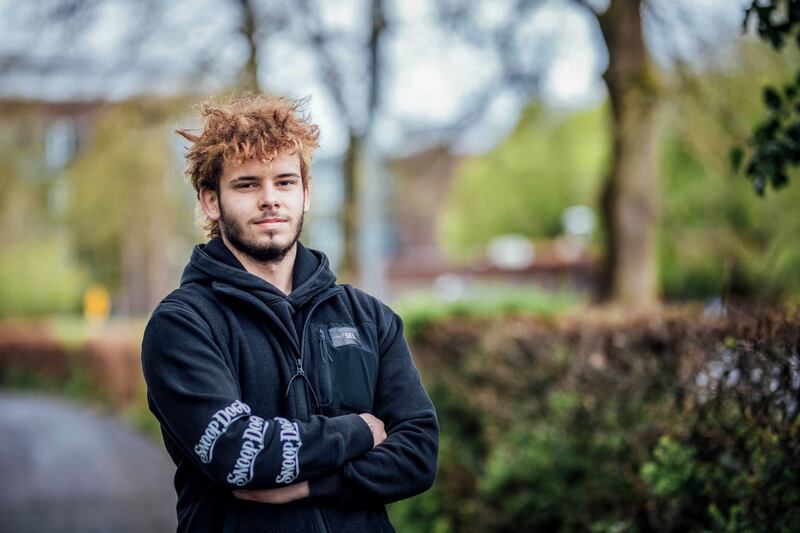
He’s not especially fazed by the disappearing-messages function. “If you’re having secretive chats, maybe that’s a plus for you, but a minus for the parents … but also you can save chats.” If a screenshot is taken, Snapchat notifies the person who sent the message, which brings its own problems. “If some other person is bullying them, and then the person that gets bullied takes a screenshot, that can lead to more bullying.”
Snapchat, for its part, has tweaked policies and introduced parental controls that allow parents to monitor who their child is talking to – if not the actual content of the conversation. The Family Hub also imposes content restrictions for younger users, and accounts are private by default for those under 17. The latest addition is the Keys, a 45-minute interactive course to educate teens and their families about online risks and how to protect themselves.
[ More than $1bn wiped off Snapchat’s value after Kylie Jenner dissOpens in new window ]
But is it enough? In the past, cofounder Spiegel has called for age verification responsibilities to also fall on the app stores, alongside app developers. It recently criticised the EU for allowing exceptions to its privacy rules that enabled the use of technology to detect child sexual abuse material to expire in early April, saying it created uncertainty for companies trying to protect children on their platform. At the same time, it has pushed back on the social media ban for under-16s that Australia implemented and that Norway is considering, commissioning research into its effectiveness and highlighting concerns among parents that children then simply migrate to other, less safe platforms.


