When I think of Christmas, I think of Louisa May Alcott’s Little Women. I think of the cosy March sittingroom with Beth, Jo, Meg, Amy and Marmee all assembled in front of the hearth. I picture snow outside the window and the girls engaged in various wholesome activities. They are probably making decorations from a gown they’ve decided was too prideful to wear or knitting socks for poor army veterans.
I reread the book recently. In chapter five, Jo visits her neighbour Laurie for the first time. In a scene that I’d forgotten, Laurie expresses all my feelings about the Marches and that sittingroom:
“I can’t help looking over at your house, you always seem to be having such good times. I beg your pardon for being so rude, but sometimes you forget to put down the curtain at the window where the flowers are; and when the lamps are lighted, it’s like looking at a picture to see the fire, and you all round the table with your mother […]."
That’s all we want at Christmas, isn’t it? To be having such good times. Of course the Marches endure hardships in the book. The book opens with the girls sighing about having no presents at Christmas (a fact they cheerfully accept only a few pages later). Money is tight and father is not home for Christmas because he is serving in the American civil war. And yet there is an unmistakably warm glow off the family scenes in this book that get under your skin faster than a trad wife Instagram account. As I read, I was filled with yearning all over again. I am 48 years old. The year is 2025. I do not knit socks and I have two sons rather than four daughters. I never imagined presiding over a Little Women Christmas scene as Marmee anyway. Even now, I picture myself as 15-year-old Jo.
READ MORE



I think I was 11 when I first read Little Women. If Laurie had come peering in the windows of our house in Richmond, Virginia on a dark winter night he could have chosen between a view of the livingroom (light upholstered couches that could not be spilt on) or of the family room (worn-out brown corduroy couch and a fireplace). Neither room had a TV, the late 20th-century version of the glowing hearth. My mother kept our black and white set in her closet and only brought it out for small doses. The Christmas tree was put in the livingroom where there was no fireplace. We rarely got any snow.
A real opportunity to live in the Little Women picture came in 1991, when I was 14 and my family moved to Concord, Massachusetts. The town is known for its role in the American Revolution and for the collection of writers and transcendental thinkers that assembled there in the middle of the 19th century including Louisa and her father, Bronson Alcott. The Alcotts rubbed shoulders with Ralph Waldo Emerson, Nathaniel Hawthorne and Henry David Thoreau. Among the historic buildings you can now tour are Orchard House (former home of the Alcotts), The Old Manse (Emerson and Hawthorne) and The Wayside (Alcott and Hawthorne). There is also Emerson House and the Thoreau Farm. Most of the attractive wooden houses in the centre of town have some kind of historic plaque on them commemorating a previous resident.
We stayed in a hotel while my parents tried to find a house to buy. The houses my parents took us to see were nothing like I imagined Louisa May Alcott’s house to be. We looked at houses with rec rooms and three-car garages, with creepy basements and converted attics, with shag carpets and gold-coloured chandeliers, single stories and split levels. My parents bought a two-storey-over-basement modern house. I was disappointed. The front room had no hearth around which to gather. We had nice Christmases but they lacked the proper atmosphere.
[ There’s more to Henry Thoreau than the mysteries of WaldenOpens in new window ]
I was sure that somewhere in someone else’s house there was a perfect Christmas scene playing out. Family harmony in the sittingroom with a blazing fire, surrounded by tastefully old-fashioned decorations. My family got along as well as most families. There was no absence of love there was just the presence of five strong personalities, five sets of complex feelings, five sets of unmet expectations. Which is how a normal family is.
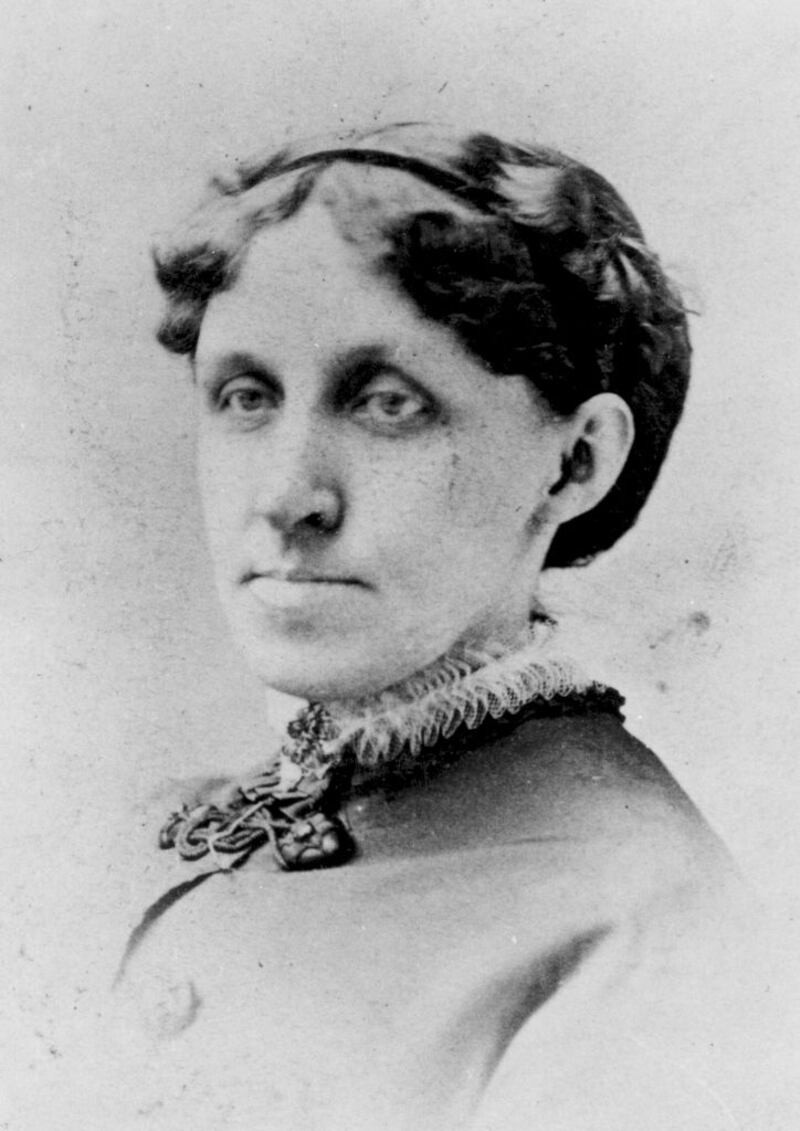
Like many readers of Little Women, I assumed the story was basically true. The March home was, to me, a real house. Jo, Meg, Beth and Amy were thinly disguised versions of the Alcott girls in their teens. Alcott drew on her family for inspiration and allowed her readers to assume that one reflected the other. Alcott had three sisters and one of them died, like Beth, of consumption at a young age. One sister was an artist (May) and the eldest (Anna) married a man named John and had two children. The Alcotts existed in a state of precarious poverty like their fictional counterparts. The Alcott parents had, for their time, enlightened ideas about the abolition of slavery and the education of women. The core text of the March girls’ lives, Pilgrim’s Progress by John Bunyan, was indeed an important text to Bronson Alcott and used in his children’s education.
However, the similarities soon end. There was nothing gentle about the Alcotts’ very real poverty. In Madeleine B Stern’s biography the Alcotts eat apples a lot. Apples are sometimes a central part of breakfast, lunch and dinner. Bronson was a pioneer of vegetarianism and during one particularly zealous period his family were not permitted any animal products including milk. They ate “solar” breakfasts consisting of fruit and water. Neighbours peering through the Alcotts’ windows might have seen children who were too thin being given a slice of bread and an apple for their supper.
[ Amy Pascal: ‘Little Women is a rite of passage book for all of us, even now’Opens in new window ]
Adult Louisa didn’t like Concord all that much. By the late 1860s the town was no longer an exciting hub of transcendental thinking but a sleepy town obsessed with preserving itself as a kind of museum. Neither was her life filled with the “sweet home peace” that is the chorus of Little Women. From a young age, Louisa was contributing financially to the household. Her father tried to make his living off the paid lecturing circuit but he was perpetually broke and often blind to the needs of his own family. Devoted to his ideas and causes, he left most of the practical matters to his wife and children. He often survived on the generosity of others including fellow transcendentalists. Emerson helped the Alcotts to buy Orchard House and many friends and relatives, including Hawthorne, let the family live in their homes during various times of need. In Little Women, Mr March is forgiven for his neglect because he is ministering to soldiers during the civil war and ends up getting sick. In real life, it was Louisa and not Bronson who volunteered in a hospital during the civil war. Louisa, not Bronson, almost died of typhoid fever as a result.
In perhaps the most egregious episode of parental misjudgement, Bronson joined with English evangelical Charles Lane to start a vegetarian “consocial” family at Fruitlands in Harvard, Massachusetts. The group (Lane and his son, the Alcotts and a few others) were to grow their own food and make their own clothes without partaking of animal products or animal labour or the cotton made by slaves. Alcott and Lane spent more time on a preaching circuit and not enough time growing food. The experiment collapsed. As the weather began to get cold and the supplies to dwindle, 11-year-old Louise recorded pathetically in her diary: “I wish I was rich, I was good, and we were all a happy family this day.” What else is the fantasy of the perfect Christmas aside from the fantasy of a happy family?
My parents have lived in Concord for more than 30 years now. I am there often. And yet, in all those years, I never took a tour of Orchard House where Alcott lived. During high school I passed the house several times a week. My mother suggested going on a tour almost every time I visited my family. So she was a little surprised when I suggested it on a recent trip.
The tour began in the barn where Bronson had his school. There was a surprisingly large group of people for a random weekday in the low season. I immediately spotted an Irish woman because she was much better dressed than all the shabby Americans. Another woman stood holding a tiny chihuahua. When my mother tried to pet the dog the woman informed her sharply that the dog was a service animal. We all watched a video. An actress playing Louisa fawned over Bronson. I inwardly scoffed. Still, the video reminded me, Bronson provided his daughter with a desk and plenty of encouragement for her writing.
Once we were inside Orchard House I found nothing to be as I expected. The ceilings were low. The floors were crooked. The rooms were small, dark and cold even on a mild day. There were lovely remnants of May’s artistic hand including a painting of an owl next to Louisa’s bed. There was Louisa’s desk: a tiny half round attached to the window casing. The feeling of the house was shabby and claustrophobic. I could understand why Louisa referred to it as “Apple Slump”.
In the obligatory shop I paused over the replica writing caps and Christmas ornaments and instead I bought a copy of Hospital Sketches in which Alcott details her experience of nursing in a hospital during the civil war. It is self-deprecating and compassionate and in some ways more interesting than Little Women.
And yet it is not so easy to banish the Little Women fantasy version of Christmas. Some months later my parents came to visit us and we all went to stay in a hotel. My mother is allergic to our cats and we tire of cooking large dinners in our small kitchen after a few days. After dinner in the town, we began to climb the hill back to the hotel in Dalkey. That’s when I saw it: the Marches’ sittingroom. The room itself had no one in it. The curtains were parted and the lights of the Christmas tree were enough to illuminate the soft yellow wallpaper and the old-fashioned sofa and arm chairs, the tasteful chandelier, the glass-fronted cabinet containing a library of old books, the mantlepiece softened by greenery. I stopped in the street to stare and, surrounded by my happy and loving family, I felt once again that terrible longing for the picture in the window.
[ Twice upon a time: 10 fictional characters who are given a novel of their ownOpens in new window ]
Juliana Adelman is from Concord, Massachusetts but now lives in Dublin, where she is assistant professor of history at Dublin City University. Her most recent book is The Grateful Water.