

For many people, childhood and teenage years are the most carefree periods of their life. But for Robert Cullen, the reality was very different.
The Dubliner’s formative years were a tumultuous and difficult time that led him to experiment with drugs “to numb the sadness within”.
“As the traumatic experiences mounted, I became more impulsive and reactive, which led me to hurt others,” the 34-year-old says.
“The pain that I inflicted upon them became another layer of pain and guilt that I needed drugs to suppress, and I fell into a spiral of drug addiction that almost took my life.
READ MORE


“I had so many near-death experiences, ranging from medical emergencies to being subjected to violent attacks and multiple injuries.”
[ Hard cell: The entrepreneurial programme for prisonersOpens in new window ]
Things soon unravelled further and Cullen turned to crime, eventually being sentenced to 7½ years in prison for armed robbery.
However, it was during his incarceration that he got clean, faced the issues he had been suppressing and leaned into education, which sparked a transformation of his life.
He says “healing from multiple traumatic incidents, feelings of abandonment, loss, shame and guilt is not an easy feat”.
Cullen’s journey was assisted by courses offered by community education organisations such as the Alternative to Violence Project (AVP). He says this aims to help us “understand our violent tendencies, provide tools to use when triggered, and help us to seek non-violent resolutions to conflict”.
Data from the Central Statistics Office shows that more than half of prisoners released in 2019 reoffended within three years. However, research shows that education in prisons helps to reduce rates of recidivism, with recent international analyses finding that those who engage are significantly less likely to reoffend and have better employment outcomes on release.
Prisoner education in the State is delivered by seven of the 16 Education and Training Boards (ETBs) in partnership with the Irish Prison Service. In 2024, an average of 58.5 per cent of the total prisoner population (6,765 people) participated in such initiatives.
Tony Dalton, director of further education and training with the Laois & Offaly ETB, says the classes, customised to either one-on-one or small group settings, are well received, with many participants saying “it is the first time they enjoyed ‘school’”.
“The approach to education is innovative and person-centred, with exciting new developments taking place all of the time,” he says.
“Statistics show a high level of educational disadvantage among those entering the system, which ETB programmes aim to address.”
‘It’s not just me that benefits from these changes, my healing has impacted upon that of my family, my children, my community and society as a whole’
— Former prisoner Robert Cullen
Cullen says the programmes he completed while serving his sentence helped to open up a new world of opportunity.
“I was released from prison a short time ago, having studied towards a degree in criminology while incarcerated, and am now starting a Masters at University College Cork,” he says.
“Working with the AVP inspired my desire to understand violence and its root causes. This led to me taking part in some wonderful initiatives, none of which would have happened had I not had access to community education while in prison.”
[ ‘Most prisoners are not violent and shouldn’t be there’Opens in new window ]
He adds: “And it’s not just me that benefits from these changes, my healing has impacted upon that of my family, my children, my community and society as a whole.”
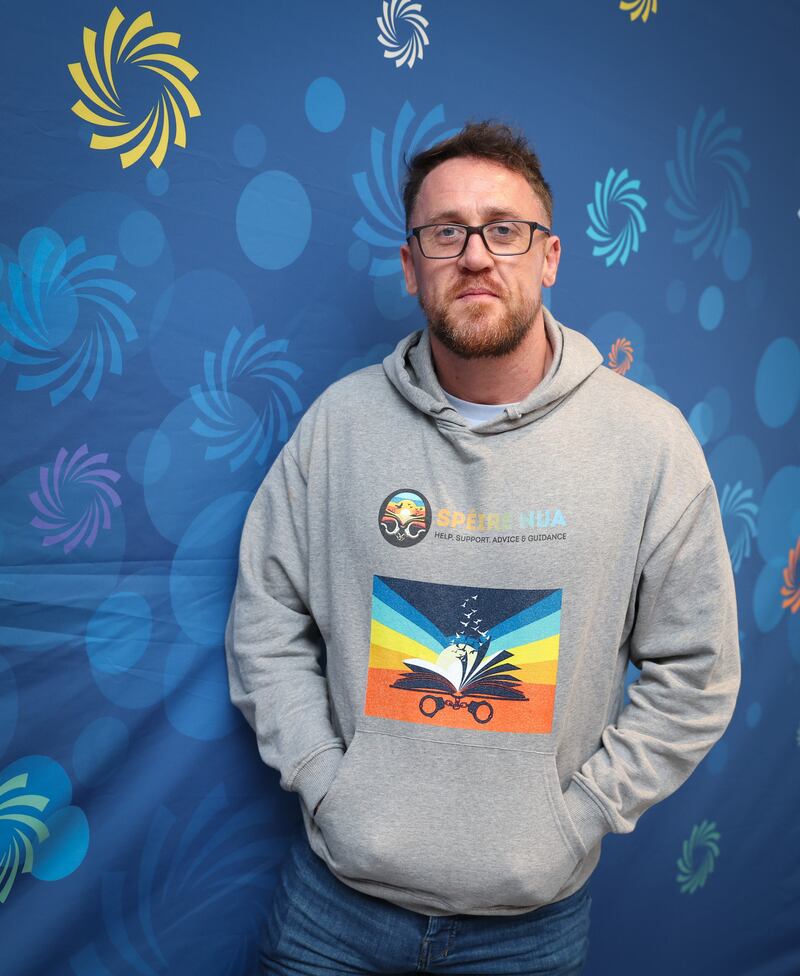
These days, Cullen facilitates workshops with Spéire Nua, a group working to help people start over after spending time in prison.
He says the “profound impact of community education” inspired him to create his own project, which is “centred on masculinity and seeking to open men’s minds to the damaging effects of patriarchal gender norms”. It aims to show men that the “ideology which teaches them that they mustn’t show emotion” prevents them from truly loving their partners and children.
“The workshop also explores the sexual objectification of women and gender violence,” he says. “Based off my experiences, I have high hopes for this workshop to provide the spark needed for a shift in perspective within the men who partake in our discussions.”


