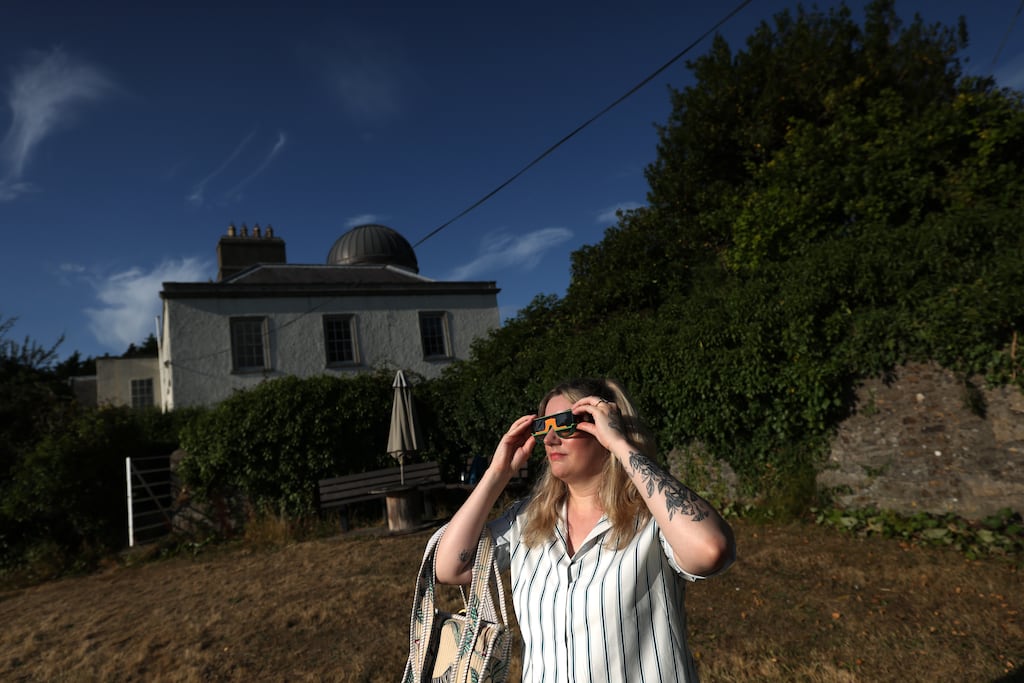
Three historic observatories on the island of Ireland are teaming up in a bid to gain Unesco World Heritage status.
The Birr Scientific and Heritage Foundation in Co Offaly, Armagh Observatory and Planetarium, and Dunsink Observatory, which is part of the Dublin Institute for Advanced Studies, are collectively known as the Historic Astronomical Observatories of Ireland.
Together, they have agreed a formal partnership to advance research, education and outreach, and astronomical heritage recognition.
Achieving Unesco World Heritage status provides legal protection for buildings or sites that are considered to have outstanding universal value.

Armagh, Birr and Dunsink contain a number of preserved historic observatories. They have supporting domestic buildings and grounds, along with several original telescopes fixed within their domes or structures.
The partnership is seeking to appoint a project co-ordinator on a five-year term to take the proposal forward.
The Unesco nomination bid will feature the story of Thomas Romney Robinson, who was director of Armagh Observatory from 1823 until his death in 1882.
Robinson, who invented the cup anemometer for measuring wind speed, was president of the Royal Irish Academy and won a Royal Medal in 1862.
The Leviathan Telescope at Birr will also play a central part in the Unesco bid.
The logo used for Ireland’s presidency of the Council of the European Union is inspired by Birr’s astronomical heritage.
The official logo is based on the spiral structure of the whirlpool nebula, first identified in the 1840s using the Great Telescope at Birr Castle.
Each individual arm of the spiral features 27 discs which symbolise the 27 EU member states.
The space at the centre forms a five-point star, a symbol from the EU flag, while the blue, green and orange colours symbolise both the Irish state and the European Union.
Prof Michael Burton, director of Armagh Observatory and Planetarium, said the bid was a “landmark step”.
He said: “We are delighted to see our Unesco ambitions moving forward and look forward to this exciting bid progressing in the months ahead.
“Being designated as a Unesco World Heritage Site would truly put Armagh Observatory and Planetarium on the map and give it global recognition as a world-class site of outstanding scientific importance.” – PA


