
New coastal defences and “emergency evacuation processes” are needed to prepare Ireland for the worst consequences of climate change, an Irish expert has warned.
Prof Iris Moller, a coastal geomorphologist at Trinity College Dublin, said protections for communities were needed “urgently”.
She was speaking in response to a World Meteorological Organisation (WMO) analysis published on Monday showing Earth’s climate is swinging increasingly out of balance, with the planet taking in heat more quickly than it can shed it.
Oceans absorb most of the excess, but the warming waters are expanding, melting sea ice, fuelling storms and raising sea levels more rapidly than previously recorded.
READ MORE


For island nations such as Ireland and coastal communities globally, the implications are enormous.
“There has been no time in the past when we have built so close to the coast and in such low-lying areas and where so many people have been at risk,” Moller said.
[ Hazards mount for coastal areas as Earth’s climate imbalance worsensOpens in new window ]
She said if Storm Chandra in January had occurred during a high spring tide, “the situation would have been many times worse in coastal towns and cities, including Dublin”.
“The state of the global climate suggests that it is only a matter of time before we see this combination of extreme river and coastal flooding on the Irish east coast,” she said.
“We must urgently implement a range of measures to deal with this risk via nature-based solutions, coastal protection measures and emergency evacuation processes, as well as radically switching away from fossil fuels.”
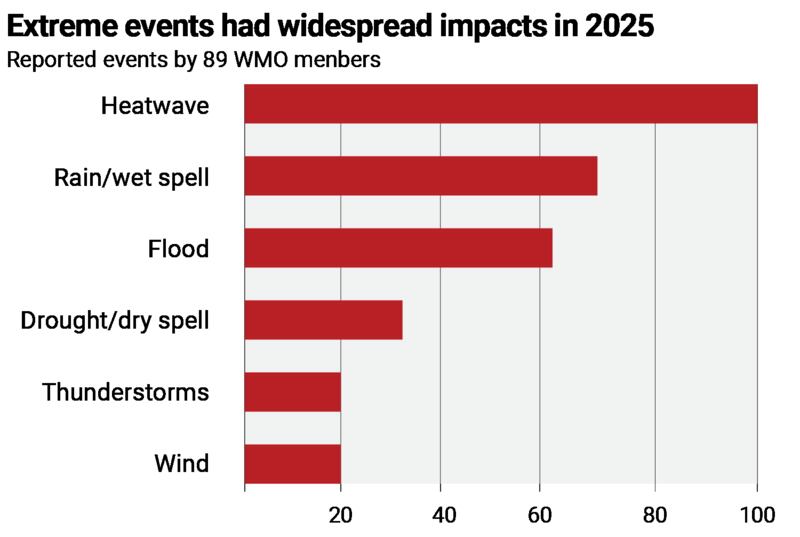
The WMO on Monday publishes its State of the World Climate report for 2025, a year that saw more than 300 extreme weather events including crippling heatwaves, intense rain and deadly floods, droughts and winds.
The report says all indicators of climate change are moving in the wrong direction.
It shows 2015-2025 were the 11 warmest years on record with the past three the hottest of all.
The energy imbalance – the difference between heat absorbed and released – is the highest on record.
There are more heat-trapping greenhouse gases in the atmosphere than at any time in the past 800,000 years and more carbon dioxide, the most common of the gases, than in two million years.
Concentrations continued to rise last year, indicating efforts to slow fossil fuel use are not yet sufficient.
Sea ice in the Arctic was at its lowest or second-lowest extent ever in 2025, while the last four years have been the lowest in the Antarctic.
It was also one of the worst five years for glacier shrinkage, further adding to sea-level rise.
Sea levels are 11cm higher than 30 years ago, and 23cm higher than in 1900, and the rate of increase is accelerating.
“Because warming of the oceans will continue for centuries even if emissions of greenhouse gases cease, sea level will continue to rise on the same timescale,” the report says.
Moller said previous projections of sea-level rise to the end of this century – a further 26cm-77cm – would probably be exceeded.
United Nations secretary general António Guterres said it was clear Earth was being “pushed beyond its limits”.
“These findings are not confined to charts and graphs. They are written into the daily lives of people,” he said.
“In families struggling as droughts and storms drive up food prices; in workers pushed to the brink by extreme heat; in farmers watching crops wither; in communities and homes swept away by floods.
“Humanity has just endured the 11 hottest years on record. When history repeats itself 11 times it is no longer a coincidence. It is a call to act.”


