
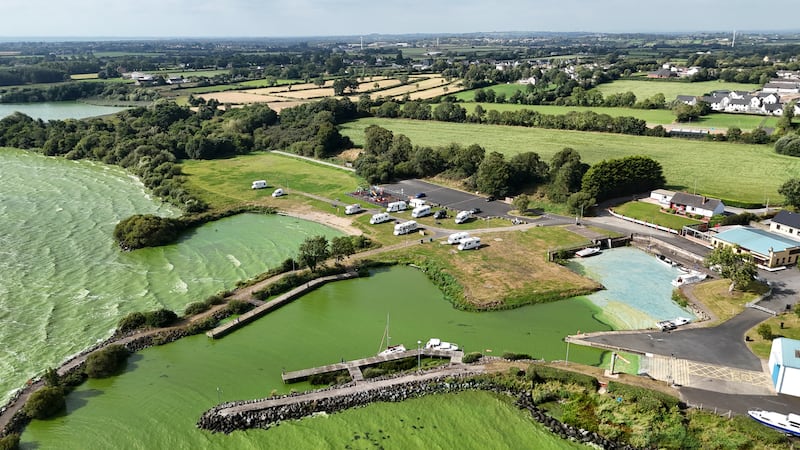
A Tipperary councillor has warned that the condition of Lough Derg is “getting worse” after the council issued an advisory to the public over the presence of a potentially harmful algal bloom on Thursday.
Tipperary County Council warned the public to “exercise caution” at Lough Derg, the third-biggest lake on the island of Ireland, with shores in counties Tipperary, Clare and Galway.
Inspections this week showed “significant blooms” in different areas of the lake, the council said, though local independent councillor Séamie Morris said it had been “building” for weeks.
The blue-green algae bloom can produce harmful toxins, the council said, adding that contact should be avoided as it can cause skin irritation. It can also be fatal to dogs if ingested.
READ MORE


The council, which said it consulted with the HSE on the matter, warned the public to keep “all animals, especially dogs, away from the affected area”.
Algal bloom, which can resemble scum or paint, forms during hot weather, though nutrient pollution, particularly phosphorus and nitrogen, often deriving from agricultural runoff and wastewater discharges, is the main driver.
Morris, who was one of the founders of advocacy group River Shannon Environmental Protection Alliance, said the latest blooms are “not a surprise”, adding that he had been seeing it “building up” in recent weeks.
“It’s bad enough. It was a perfect storm in a way with the lack of water, nitrates and lack of wind,” he said.
[ Ireland’s ‘best rivers’ continue to deteriorate in water qualityOpens in new window ]
He said there had been a “consistent amount” of algal bloom on different areas of the lake “on and off all summer”.
“It’s consistent now. It’s happening every year, and it’s getting worse.
“It’s quite clear that the condition of the lake is getting worse. We’re heading towards Lough Neagh,” he said.
Lough Neagh, Ireland and the UK’s largest freshwater lake by surface area, has been blighted by blooms in recent summers, which has been attributed to excess nutrients from wastewater and agriculture.
Morris believes nitrogen removal should have been incorporated into the recently upgraded wastewater treatment plant at Ballina, Co Tipperary.
“We’re getting more and more algal blooms, and that’s because of the nitrates in the water. There’s no point in consistently blaming farmers over this because that’s what they’re allowed to do.
[ Data centres ‘may have used as much water’ as more than 340,000 homes last yearOpens in new window ]
“But the fact that they’re [Uisce Éireann] actually building new plants, particularly in Ballina, which is an extremely sensitive area, without putting nitrates treatment in is crazy,” he said.
“Our rivers are in serious trouble. Our rivers are dying. I will be calling on the counties to come together in the Midwest to ask Uisce Éireann to put nitrates treatment into all our plants,” he said.
The public advisory issued by the council on Thursday was effective immediately and will last until Monday, September 28th.


