Writing about the Holocaust is always an act of writing about memory: what is remembered, lost, preserved, destroyed, denied, and how we move forward with this memory – or catastrophically, with acts of deliberate forgetting. Natalie Livingstone’s The Nuremberg Women begins with an absence and builds an archive against it, showing how the story of Nuremberg has been shaped by the forgetting of women whose labour, insight and testimony were central to the trials’ intellectual, emotional and political work.
Those women include Laura Knight, who painted the courtroom; journalists Erika Mann, Ursula von Kardorff and Rebecca West; lawyer Harriet Zetterberg; witness house hostess Ingeborg Kálnoky; interpreter Tatiana Stupnikova; and concentration camp survivor Marie-Claude Vaillant-Couturier. Part I follows them through the tribunal itself, situating their lives within the unfolding proceedings. Part II traces what came after, the long shadow of witnessing, and in some cases the quiet erasure of their contributions as postwar gender norms forced them back into constrained roles.
Livingstone’s writing is meticulously detailed, drawing on memoirs, letters, diaries, journalism and official transcripts, building portraits that are deeply absorbing and filled with fascinating detail about both the women and the trials. Her portrait of Harriet Zetterberg, a 36-year-old prosecutor from North Dakota, involves following Zetterberg through the labour of writing the legal brief on Hans Frank, the “Butcher of Poland”.
Zetterberg combs through thousands of documents, sits in on interrogations with defendants, and traces connections between policy and action. Her discovery of Frank’s personal diary becomes vital in securing his conviction, as he noted that a regime of rations condemning 1,200,000 Jewish people to death by starvation “should only be noted marginally”, and wrote that “mincemeat can be made of the Poles and Ukrainians” once the desire for slave labour had expired.
READ MORE


Despite her essential work, Zetterberg’s life narrows after Nuremberg, with postwar gender politics redirecting her into domesticity, her intellectual potential curtailed. Her daughter grows up unaware of her role in the trials, only later assembling her letters and documenting her work – an example of Livingstone’s thesis that women remembering women can become its own form of historical repair.
[ When Nazism went on trial: the Irish journalist in the room at NurembergOpens in new window ]
Another fascinating portrait emerges of journalist Erika Mann, the bold and passionate favourite daughter of Thomas Mann. Erika had already lived a politically charged and scintillating life before arriving in Nuremberg, writing for anti-Nazi cabaret, entering a marriage of convenience with WH Auden, and fleeing Germany when her activism made her position untenable. Her moral clarity led to rifts in many of her relationships including her father over what she saw as his insufficient political clarity. He would later describe her as “a faithful child of turbulent loneliness”.
At Nuremberg, Erika stays at the Faber-Castell press camp, with single shared bathrooms with urinals revealing the gendered assumptions of the space. The details here are brilliantly noted; female journalists remark how even bathroom etiquette revealed broader political fault lines: “While the Soviet women shared the room freely, writers from capitalist countries each sought to claim it as their private domain, even if only for a moment.” Using the words of women, Livingstone shows how intimate and personal moments reflect a wider political texture.
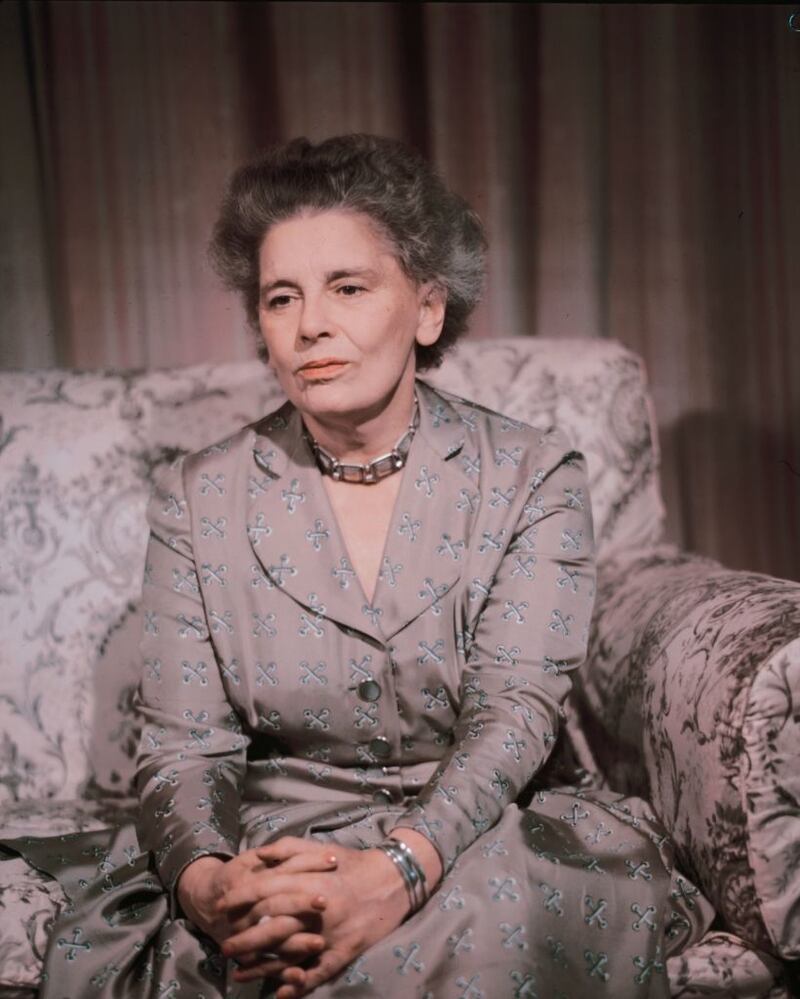
Ingeborg Kálnoky’s story is transfixing account of gendered performance in the face of evil. Originally from Thuringia, she is appointed to run a witness house in Nuremberg, whose shifting population includes Luftwaffe generals, Hitler’s photographer Heinrich Hoffmann, and early Gestapo chief Rudolf Diels. Unthinkably, at times these men were housed with and eating dinner alongside concentration camp survivors awaiting their turn to testify. Livingstone reconstructs these remarkable scenes with unsettling precision: Kálnoky worrying about seating arrangements, and Hoffmann lecturing survivor Herr Herbert about how Hitler “loved children”.
Kálnoky prides herself on being a good hostess, maintaining politeness even as she registers her unease – but Livingstone notes that in Kálnoky’s memoir, the Nazi figures are described in vivid detail, while the survivors remain largely unnamed, “barely sketched”. For Livingstone, the act of remembering is everything. The author constantly names as many women as possible; journalists, memoir writers, victims, survivors.
She was perhaps inspired by survivor Marie-Claude Vaillant-Couturier. Arrested in 1943, the latter spent three years in Auschwitz and Ravensbrück, and became one of the first survivors to testify at Nuremberg. With clarity and control, the 33-year-old described the gas chambers, the killing of babies, medical experiments on twins, and squads sifting through ashes for gold teeth. She distinguishes between Auschwitz, where prisoners were exterminated, and Ravensbrück, where they were worked to death – a distinction that shapes subsequent understandings of the camps.
Vaillant-Couturier also names the dead, as often as possible. “They weren’t just numbers in her telling; each was an individual, vividly recalled.” Her later life continues this work as Holocaust denial spreads in post-war France – a section of the book that feels all too prescient, given the recent rise in anti-Semitism and the resurgence of denialist rhetoric.
[ West German intelligence infiltrated and influenced trial of senior NaziOpens in new window ]
Livingstone’s writing is immersive and compelling, staying close to the archive to etch each portrait, while foregrounding the scale of gendered violence and its marginalisation within the historical record. Citing evidence that millions of women were murdered and millions raped, she frames these figures as an indictment of how such violence has been sidelined even in a moment dedicated to accounting for atrocity.
Livingstone’s brilliant book reminds us, again and again, that memory is always a question of where we choose to look, what harm is acknowledged or forgotten, and who we allow to be seen.
Roe McDermott is an Irish Times columnist