
Frontline gardaí will be permitted to use newly acquired Tasers on children, pregnant women and the elderly if circumstances demand it, the Garda has said.
A pilot programme was launched on Thursday to equip 128 uniformed gardaí with the weapons to evaluate their use in advance of a proposed national roll-out. Previously, only specialised units, such as the Garda Emergency Response Unit, were issued with Tasers.
Launching the project in Store Street Garda station in Dublin, Garda Commissioner Justin Kelly said the weapons were necessary to protect Garda members.
Gardaí “hope and expect that at the end of their shifts they will go home to their family safely. Unfortunately, we have about 300 members of An Garda Síochána who are injured every year,” he said.
READ MORE


He pointed to a number of “extremely concerning” incidents targeting gardaí in recent months, including a unprovoked knife attack on Capel Street in Dublin city centre during the summer.
“Recently in Waterford we had four members from one station injured in one week,” he said.
Tasers would also be used to keep the public safe, he said, pointing to a number of recent violent incidents in urban areas involving knives, swords and axes.
Sgt John Heeney, a Garda firearms trainer, said the device was designed to “de-escalate situations”.
“The last thing we want to do is squeeze the trigger on the Taser. It’ll only be as a last resort,” he said.
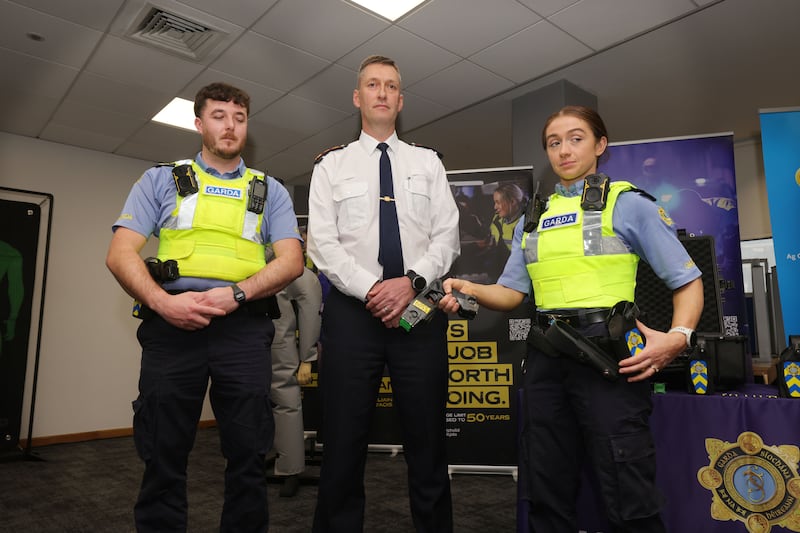
Often unholstering the Taser and pointing it enough to de-escalate a situation, he said.
Gardaí are trained to avoid aiming at the head, chest and groin area. Members are trained to be wary of using the devices on “certain age groups” and people close to water or at a height.
“But you can never say never,” said Heeney.
“For example, you could have a pregnant woman who has a mental health condition and is trying to self-harm. The last thing you want to do is Taser her. But if she’s doing something that could obviously hurt herself, you can Taser.”
Heeney said the Garda could never rule out using Tasers on those under the age of 18. It “depends on the scenario – you never can say no”, he says.
The project is a response to an “an operational reality”, Acting Deputy Commissioner Paul Cleary said.
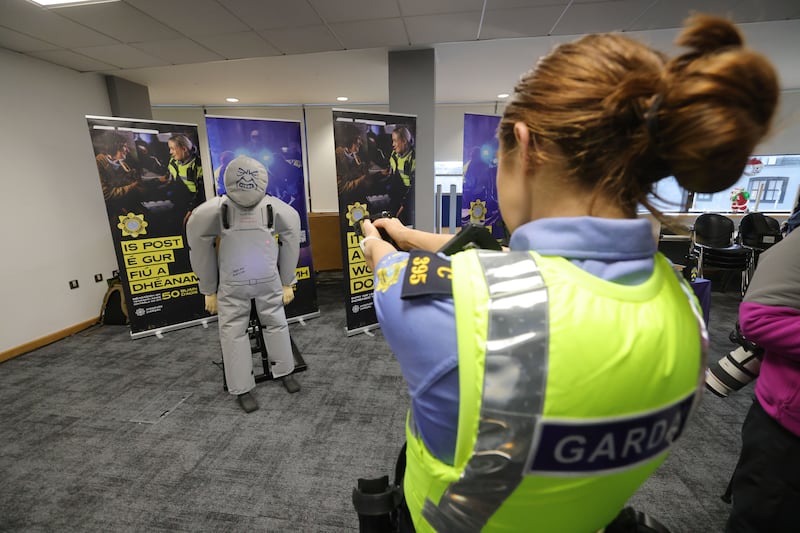
“Every day, our members encounter volatile and unpredictable incidents, including knife crime, public disorder and mental health related incidents.”
Four Garda stations are taking part in the pilot: Kevin Street, Store Street and Pearse Street stations in Dublin and Waterford Garda station.
This means a large proportion of gardaí on foot patrol in Dublin city centre over the Christmas will be armed with Tasers.
The devices, which are termed “less-lethal weapons”, fire two barbed connectors. When these make contact with a person, they complete an electrical circuit and administer a shock for five seconds.
The goal is to neutralise the threat posed by the person without causing lasting harm. However, according to some studies, Tasers can in rare circumstances lead to fatalities and there is data from the UK suggesting they are more likely to be used on minority communities.
The Irish Council for Civil Liberties (ICCL) has criticised the roll-out as “the latest example of an expansion of Garda powers without sufficient evidence demonstrating their need”.
“Members of An Garda Síochána say that Tasers will help to keep them safe, but the number of gardaí assaulted on duty is falling and international evidence and experience suggest that in fact Tasers may exacerbate violent situations,” ICCL executive director Joe O’Brien said.
[ Tasers – the five-second electric shock coming to frontline Irish policingOpens in new window ]
Mr Kelly said no one has approached him with these concerns. He said there are “many, many studies” which come to different conclusions.
He pointed to one study from the College of Policing in the UK which found 80 per cent of potentially violent incidents were de-escalated by the mere presence of a Taser.
He said the results of the pilot would be studied deeply.
“When we get to the end of this pilot, we may certainly say we’re not going to roll out Tasers around the organisation,” he said.
The project is not a step towards arming ordinary garda members with firearms, the commissioner added.
All of those issued with Tasers during the pilot project have already been equipped with body worn cameras as part of a separate project. Members will be obliged to switch on their cameras before using the weapon, gardaí said.


