
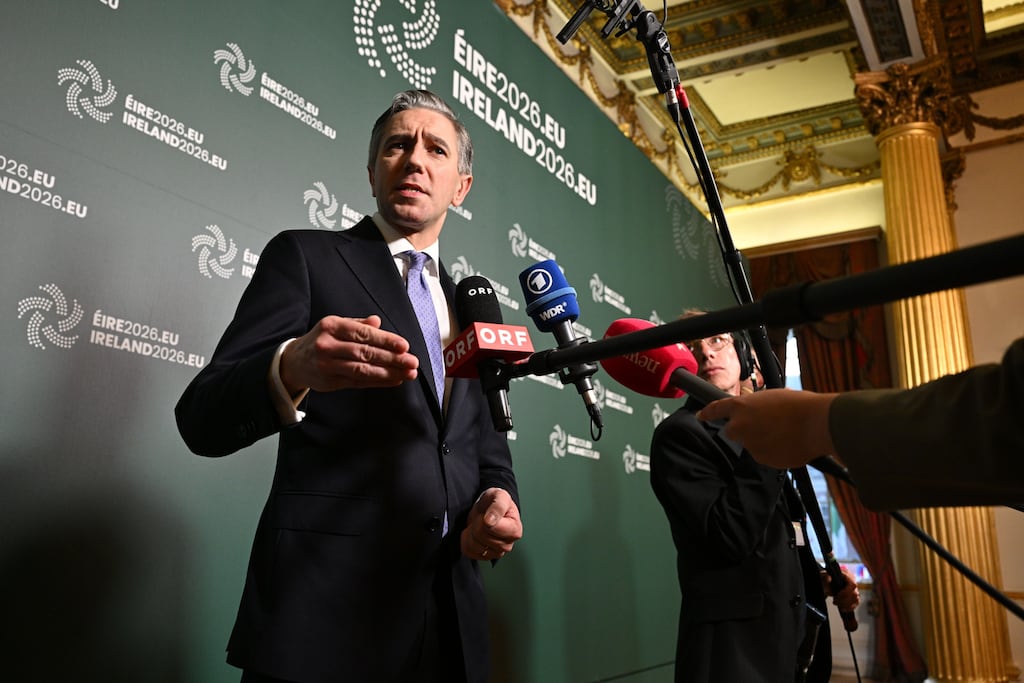
What issue plagues Minister for Finance Simon Harris the most? Donald Trump? The upcoming budget?
“The issue that keeps me awake most at night as finance minister ... is energy,” Harris told an event hosted by the Economic and Social Research Institute (ESRI) on Monday.
He was responding to a question about a seeming contradiction in Ireland’s energy policy.
While the Government is trying to wean consumers and businesses off fossil fuels as part of its energy transition agenda, it is simultaneously subsidising fossil fuels through excise duty cuts in a bid to reduce cost pressures, slowing down the transition to clean energy in the process.
READ MORE


Ireland is just one of many countries caught in this Catch-22. If they cut off fossil fuels too fast before renewables reach a critical mass, they risk creating an economic crisis. If they don’t move quicker they risk a climate crisis.
This year’s El Niño weather phenomenon is being supercharged by climate change with experts predicting another wave of extreme weather events.
In the longer term, the solution to Ireland’s energy trilemma – affordability, sustainability and security – is to get off fossil fuels. But in the short term, sustainability and affordability seem to be in conflict.
Telling households that are struggling to afford their energy bills to retrofit or buy an EV (electric vehicle), both of which involve big upfront costs, is politically tricky, potentially divisive.
Will the Strait of Hormuz (and the second energy price shock in five years) prove to be an inflection point for renewables?
Perhaps, but in the short run Ireland is stuck using fossil fuels and, as a price taker internationally, stuck with the volatility of oil and gas prices.
“This (energy) is a fundamental issue in terms of our wellbeing, our security, our living standards,” Harris said.
But he denied there was a contradiction between pursuing a transition to clean energy and subsidising fossil fuels, insisting Government sometimes had “to do more than one thing at a time”.
“I don’t accept it’s an either/or, except we need to get the balance right ... there is a need in the here and now to help people with the cost of living,” Harris said.
“Because of the very fortunate economic position we’re in, I do believe it’s possible to do some of both ... so I am committed to a carbon tax, there will be a carbon tax next year, we’re not getting rid of the carbon tax,” he said.
Energy economist
The person who asked Harris the question about Ireland’s contradictory energy policy was the ESRI’s Muireann Lynch, an energy economist.
“In the long term, the solution (to energy costs, sustainability and security) is not in conflict, the conflict is all in the short term,” she said.
Lynch acknowledged the Government’s desire to shield households from the current spike in energy prices.
“But as long as the policy response includes an element of price suppression via taxation, that undermines the long-run goal of moving off fossil fuels,” she said.
The Government is sending consumers the wrong price signals. Households respond more readily to an increase in fuel taxes rather than fuel prices, she says. Her solution is to deliver the current suite of supports through the income tax channel.
There’s no easy answer to our energy dilemma which stems, in the main, from the slow roll-out of renewables. We’re a major laggard in Europe.
Harris said he was minded to accept the core thesis in Ezra Klein and Derek Thompson’s recent book Abundance, which argues that well-intentioned liberal policies adopted since the 1970s to stop bad infrastructural development had given individuals too much power to block projects at the expense of the common good.
One of the examples of this regulatory stonewalling documented in the book centres on proposals for a congestion-free, high-speed bullet train network for California.
State authorities began studying the possibility of building the infrastructure more than 40 years ago. It took a decade for planning to begin; another 15 years to get the funding in place; 16 years later, it still doesn’t exist.
Remind you of anything? MetroLink?
ESRI research from 2024 shows that regulatory delays associated with the delivery of energy infrastructure here is having “substantial impacts on electricity prices, system emissions, and system cost” – lifting wholesale electricity prices up by 10 per cent and CO2 emissions by 4 per cent.
The question is whether the planning and regulatory environment here is making good projects – projects for the common good – unduly slow and expensive.
Most people would probably answer in the affirmative.
“I think if you asked people, can you point to an infrastructural project that we need that hasn’t been built – they would be able to point to a lot,” Lynch says.
Conversely, “if you said can you point to an infrastructural project that has been built that shouldn’t have been built, I’m not sure how many people would have one”, she says.


