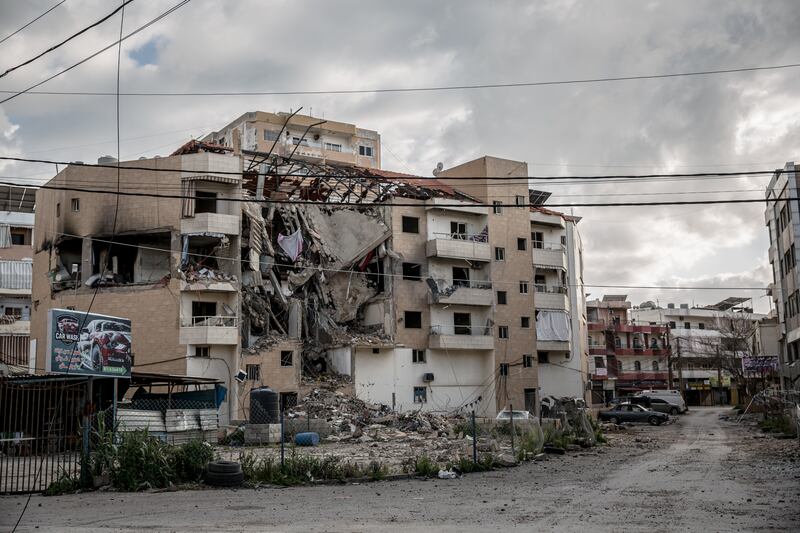
The frame of the building was still smoking, with a potentially toxic smell that clung to the clothing. On the ground were scattered medical supplies – a catheter and inhaler; pills and ointments; books about the human body. This medical centre, in Burj Qalaway, southern Lebanon, was directly hit by a missile on March 13th after it had closed and the medics inside had enjoyed iftar, the evening meal to break the fast during Ramadan. Twelve were killed – including doctors, paramedics and nurses – and one badly wounded. Colleagues recalled finding body parts and charred bodies scattered around the rubble.
Two days later, Abdullah Nour Al Din, a regional civil defence head for the Hizbullah-linked Islamic Health Authority (IHA), stood in front of the building. He said he was messaging one of the murdered men shortly before the air strike hit. “The Israeli enemy’s goal is to terrorise so that we stop providing medical services,” he said.
Israel says its war in Lebanon is against Hizbullah alone. But Hizbullah is a political party and social movement, as well as a militant group. International law says medics cannot be targeted, regardless of their affiliation, unless they take an active role in hostilities. Human rights organisations have said that deliberately targeting civilian sites is a war crime.
An Israeli military spokesperson told The Irish Times that the strike on Burj Qalaway is “under review”. But medics, Lebanese officials, hospital directors and aid agency staff say they see a consistent pattern of Israeli military violations of the rules of war, in which medical workers are no longer protected.
READ MORE


Many referred to Gaza, and the perceived lack of a strong international reaction, which they say has pushed boundaries regarding how healthcare workers are treated. Last year, UN experts said the targeted destruction of Gaza’s healthcare system by Israeli forces amounted to “‘medicide’: a sinister component of the intentional creation of conditions calculated to destroy Palestinians in Gaza which constitutes an act of genocide”.
Since all-out war between Israel and Hizbullah restarted on March 2nd, at least 42 Lebanese healthcare workers and first responders have been killed and 119 wounded by Israeli attacks, Lebanon’s ministry of health says. At least 44 healthcare-related vehicles have been damaged or destroyed and five hospitals forced to close completely.
In response to a detailed list of questions related to allegations raised in this article, an Israeli military spokesperson said that the IDF “respects the special protection granted to medical personnel and facilities” and “categorically rejects allegations of deliberately targeting the healthcare system in Gaza and Lebanon.”
The spokesperson said the IDF has extensive intelligence of Hizbullah’s “systematic use of ambulances and medical facilities for terrorist purposes, including the transfer of weapons and the transportation of operatives, as part of a broader pattern of exploiting civilian infrastructure while deliberately endangering the Lebanese civilian population.” The spokesperson did not present evidence.

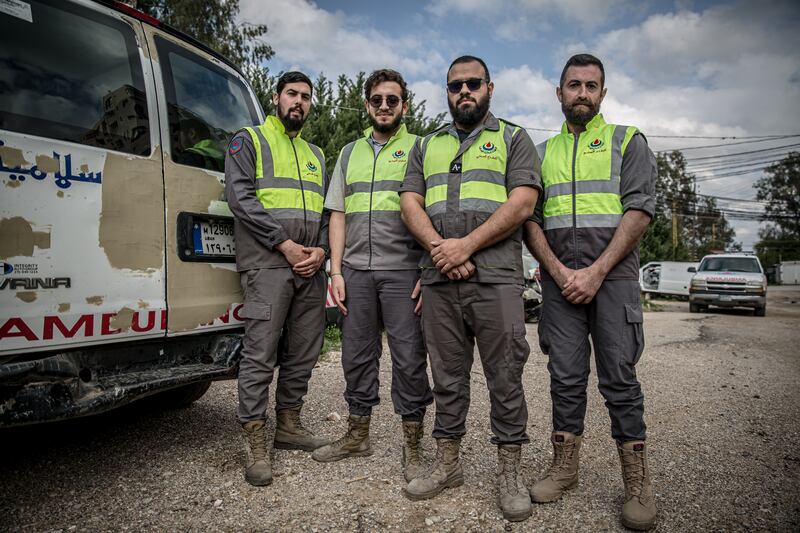
In the southern Lebanese city of Tyre last week, first responders from the IHA stood in front of a line of destroyed ambulances and fire trucks, which they said were casualties of Israeli attacks, both during the 2024 war and now. Some were barely shells, others had been repaired so they could be used again.
“You can open our vehicles. It’s lies that we’re carrying weapons,” said Kassem Arbid. The 33-year-old comes from a family of medics: he said that was what inspired him to follow this path 15 years ago. For him, this was the best way to support his people: “I found this way to resist.”


He leads a team of four. When an air strike hits, they go to the site in an effort to save survivors. Sometimes they sleep in their vehicles in order be ready at any moment. When asked if he is afraid of being targeted, he said: “My other colleagues, they died, and we’ll follow, we’ll go on the same path.” They will stand their ground, he said. “Even if there’s a hundred attacks on us we’ll keep going.”
Firass Abiad, a surgeon at the American University of Beirut and Lebanese minister of health during the last all-out war, said he investigated Israeli claims about medical vehicles being used for military purposes made then too by Israeli forces. This included investigating the IHA as an organisation, because it was “important to see if they have any behaviour that can endanger other healthcare workers”, but he did not find evidence in even a single case. And the burden of proof is on Israeli forces, he emphasised.
In Abiad’s opinion, what he sees as “ambivalence” and the failure of the international community to uphold international humanitarian law means that with each new conflict, the attacks on healthcare workers will intensify. This includes those in power making “generic” statements, which do not make it clear where blame lies.
The targeting of medics and hospitals had been seen in Syria before Gaza, and now it’s also being seen in Sudan and Afghanistan, he added. While in the past someone guilty of breaking the law would at least be forced to explain themselves, now there seems to be total impunity, he suggested.
Fears of ‘double tap’ strikes
Many of the medics being killed are from the Hizbullah-affiliated IHA. A staff member with an international organisation said the IHA’s leadership has gone through respected and credible vetting processes and passed, and the quality of its services have been assessed as good. He is worried that international donors feeling wary over it for political reasons has contributed to a narrative that the organisation’s medics are legitimate targets.
Others, without any Hizbullah affiliation, are being killed too. On Tuesday, 16-year-old volunteer paramedic Joud Suleiman and Ali Jaber from the Nabatieh Emergency Service were allegedly targeted by an Israeli drone. Suleiman’s father is the lead paramedic in the city of Nabatieh: while devastated, he announced he would begin work again directly after the funeral.
Lebanese Red Cross volunteer paramedic Youssef Assaf was killed near Tyre on March 9th. He was helping wounded people, the International Federation of the Red Cross said, describing him as “dedicated ... to serving people in need.”
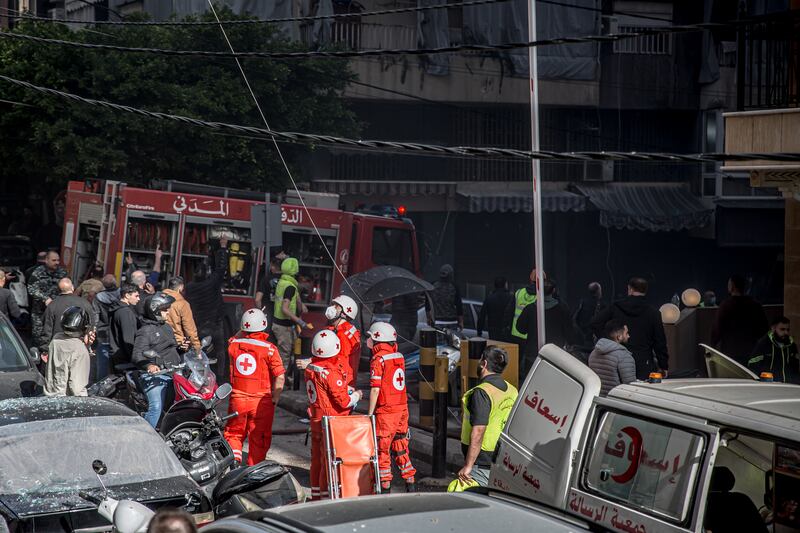
Some rescuers say that they are now forced to delay rescues due to the fear of “double tap” strikes. During the 2024 all-out war, The Irish Times also documented reports of these strikes, which are widely considered illegal under international law, including because they land as first responders, and other civilians, arrive on the scene.
On March 18th, Fahmi al-Chami, a paramedic with the government-affiliated Lebanese Civil Defence, was killed in the city of Saida. The 51-year-old became a civil defence volunteer in 1999, his brother Mohammed al-Chami said, and received a salary from 2023.
Pointing out dents and craters in the ground at the site of the attack, his brother said an Israeli drone fired three times at another target: a man initially in a vehicle, who exited it and ran away, passing a busy central area where civil defence has a base. As the wounded target crouched by a tree, Fahmi – who witnesses said did not know the man and believed the attack was over – approached to treat him. Then there was a fourth strike.


Mahmoud Nagai, another civil defence member, said Fahmi was a “sweetheart” who “loved the civil defence more than his family, he was always here”. Fahmi “was one of the essential members of our team – if there’s a fire, if there’s an accident, a bomb, an earthquake, someone drowning in the sea, Fahmi was the first one to come with me.”
If Israeli forces wanted to target someone they should have done it in a location where there was no one around, Nagai continued. They would have been well aware where the civil defence base was, he said. When asked about the killings, an Israeli military spokesperson said they are “not aware of any strike aligning with these details.”
Israel ‘using Gaza playbook’
On Tuesday, Oxfam – which works in Lebanon – issued a statement saying Israel is using the “Gaza playbook” there, with country director Bachir Ayoub saying this is part of a pattern: “attacking civilians, critical civilian infrastructure, emergency services personnel ... and aid workers. Aiming to maximise disruption and fear among the population, while ignoring international law.”
“Every day ... we’re getting increasingly out of our comfort zone, there is constant negotiation,” said an aid worker with an international organisation in Lebanon, who preferred to remain anonymous. He said a “Gazafication” is taking place.
While Israeli forces make accusations about local medics, another aid worker – who has also worked inside Gaza – said there is a growing concern that the Israeli military could deliberately target international organisations to send a message and prevent outside assistance from reaching certain areas any more.
Across much of Lebanon, there is now a “notification system” managed by the United Nations Office for the Coordination of Humanitarian Affairs (OCHA), through which those making humanitarian journeys can alert all parties to the conflict of their plans. In the current all-out war it was first used on March 10th. But aid workers said this means they are supposed to provide information about their movements 48 hours in advance, which is often not practical. OCHA did not respond to a request for an interview.
South of the Litani river, inside the area under forced Israeli evacuation orders, a spokesperson for the UN Interim Force in Lebanon (UNIFIL) said they facilitate, “within our means, the work of various humanitarian actors,” including by co-ordinating information between the Lebanese and Israeli armies with the aim “to minimise the potential for misunderstanding and therefore minimise the risk of harm.”
But an aid worker said they are concerned about providing these alerts. He pointed to the April 2024 Israeli strikes in Gaza which killed seven World Central Kitchen aid workers – from countries including Australia, the UK and the US/Canada – causing international organisations to temporarily pause operations. Any attack will “slow down the pace of aid going in because not every organisation has a high risk threshold,” the aid worker said.
The Israeli military has been accused not just of targeting medical workers, but of actively impersonating them. In 2024, Israeli soldiers were caught on camera disguised in medical uniforms while carrying out a raid on a hospital in the West Bank, in which they killed three men.
More recently, during a March 6th Israeli raid on Nabi Chit, eastern Lebanon, there were reports – including from the Lebanese army – that Israeli forces travelled in vehicles resembling Islamic Health Authority ambulances. At least 41 people on the Lebanese side were killed, Lebanon’s health ministry said. An Israeli military spokesperson did not respond to a question specifically about this.
‘We have to accept them if they are wounded’
In the governmental hospital in the city of Saida, 45km south of Beirut, there are pictures on a wall of who died in service: known as “martyrs of humanitarian duty.”
Dr Ahmad el Samadi, the hospital’s COO, said various first responder organisations deliver patients to them – including the IHA and Lebanese Civil Defence – and they see no difference in how each one operates: “Just the outfit is different.”
The hospital was not caring for any war injured then, but if necessary he said his staff must also treat anyone in need: “Hizbullah, Hamas, we have to accept them if they are wounded ... They must not be a target either.” International law forbids the targeting of sick or injured militants.
Samadi said the hospital is extremely busy trying to care for displaced civilians: the number of medical operations has tripled per day. The lights flickered on and off as he spoke – a reminder of Lebanon’s electricity shortages.
He was worried about the safety of the hospital, close to the Ein El Hilweh Palestinian camp, which has been targeted before. “The last [strike] was 500m away from the entrance to the emergency [department]. Getting in and out could become difficult.”

In Tyre, which only 20km from the Israeli border and which is under Israel forced displacement orders, an air strike has already hit a residential building around 130m from Jabal Amel Hospital. Wael Mroueh, the hospital’s director, said he personally knows medics killed during this war: “the community here is tight”. He is praying for ambulance drivers and first responders “because they’re on the front line”.
That day, more reports came through about targeted attacks, including that two first responders had been killed a 27km drive away.
Mroueh’s focus is on securing fuel and medical supplies, which come from further north. His fears that supply routes could be cut off are largely coming true: most bridges across the Litani river have been bombed by Israel now. Around 50 per cent of Mroueh’s staff have left, he said, and the others sleep in the hospital with their families.
Two weeks into the war, his hospital had already treated 350 injured people, while 115 had either died or been delivered as bodies. A short drive away is a temporary cemetery, where the dead are buried until there is a ceasefire and their families can come to collect them.

Monday marked the first anniversary of the day when 15 Palestinian emergency workers were killed by Israeli forces, while they were in a convoy of ambulances near Rafah, southern Gaza.
Along with Palestinian Center for Human Rights director Raji Sourani, human rights lawyer Chantal Meloni has been gathering and submitting evidence to the International Criminal Court regarding this case – the same court which has already issued arrest warrants for Israeli prime minister Binyamin Netanyahu and his former defence minister for war crimes and crimes against humanity. She is hopeful that there will be progress.
Yet she said everyone working in international justice is in a state of shock now, watching how political, military and economic support continues to be given to a country she perceives as violating international law in such a blatant way.
She said that when you attack healthcare – in Lebanon, as in Gaza – “you are, of course, going at the very heart of the possibility of the people to resist”. She said these attacks can also be perceived as having the goal of depopulating certain areas, because they force people with healthcare needs to leave.
At the same time, the enforcement mechanisms of international law are very weak, she said. There can be commissions of inquiry and reports by exports or the UN special rapporteur for the area, and cases brought in international courts and tribunals, but getting to the stage where proceedings take place is difficult. Internally, a military may have its own lawyers to rule on legalities in advance of an attack, but they can be “twisted, unlawful legal interpretations of international law principles,” and those outside do not have access to their workings.
States can also take their own actions, when they see violations, but that requires political motivation. In truth, she said, this is “a very difficult moment for those working with international law and that still believe in the international justice system”.
What is at stake “is really the validity of the system in its entirety. While the principles of international law exist, you need political will to translate these into consequences – sanctions and political determinations. And this is what is lacking completely.”