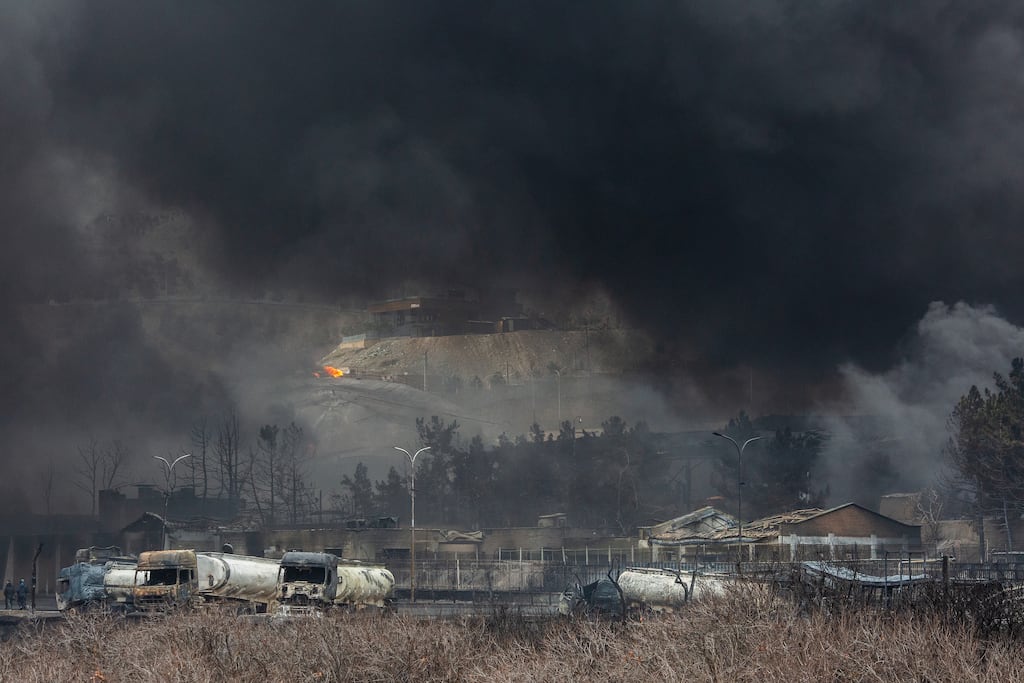
As their war on Iran enters its fourth week, US president Donald Trump and Israeli prime minister Binyamin Netanyahu continue to send out mixed messages about when it will end.
In recent days, Trump has said the United States had “essentially defeated Iran”, that “the war will end when I feel it in my bones” and the war will “end soon”. On Tuesday, he said: “We’re not ready to leave yet, but we will be leaving in the near future.”
At the same time, 2,500 marines are on the way to the Gulf and the White House is seeking an extra $200 billion (€173 billion) to finance the war. The mixed messaging is deliberate: Trump wants to keep all options open.
At a news conference on Thursday night, Netanyahu told the foreign press the war will end “sooner than people think” but minutes earlier, in remarks in Hebrew, he said the war “will go on as long as necessary”.
READ MORE


In three weeks of fighting, the US and Israel have chalked up considerable achievements and significantly degraded the Islamic Republic’s nuclear and conventional capabilities. However, despite the setbacks, the regime continues to function and fight, largely because the Islamic Revolutionary Guard Corps has effectively taken control of the state and is directing the war effort.
Anticipating decapitation of its leadership and damage to command structures, Iran spread out its military assets geographically and empowered local commanders to act based on pre-set directives.
Despite the relentless bombing on Tehran and across the country, there are few signs that regime change is imminent or that the Iranian leadership is willing to compromise to end the war.
For the regime, survival amounts to victory and the tactics have shifted to a prolonged war of attrition.
Tehran hopes by blocking the Strait of Hormuz and attacking Gulf Arab states’ oil and gas facilities, global oil prices will increase, causing stagflation – slowing growth and rising costs. They hope this will lead to pressure on Trump to stop the war to prevent a global recession.
Over time, messaging from the US and Israel has shifted. The focus is now less on toppling the regime and more about degrading Iran’s capabilities and reducing its ability to project power across the region.
This shift, theoretically, makes it easier for Trump to end the conflict at a moment of his choosing, declaring that most of the objectives have been achieved. However, such a scenario is unlikely as long as the Strait of Hormuz remains closed and Iran’s supply of enriched uranium remains buried under the rubble at the Isfahan nuclear facility.
Additional weeks of fighting may lie ahead.
[ Sally Hayden: In a Beirut hotel, families brace for war with no clear endOpens in new window ]