
Most people have never heard of Flora Kerrigan, even though she was one of Ireland’s most innovative and talented film-makers during the late 1950s and early 1960s. Her award-winning animated and live-action films were broadcast on RTÉ and screened at international film festivals, yet she and her work, like that of many other gifted female film-makers of the era, have largely disappeared from Irish film history.
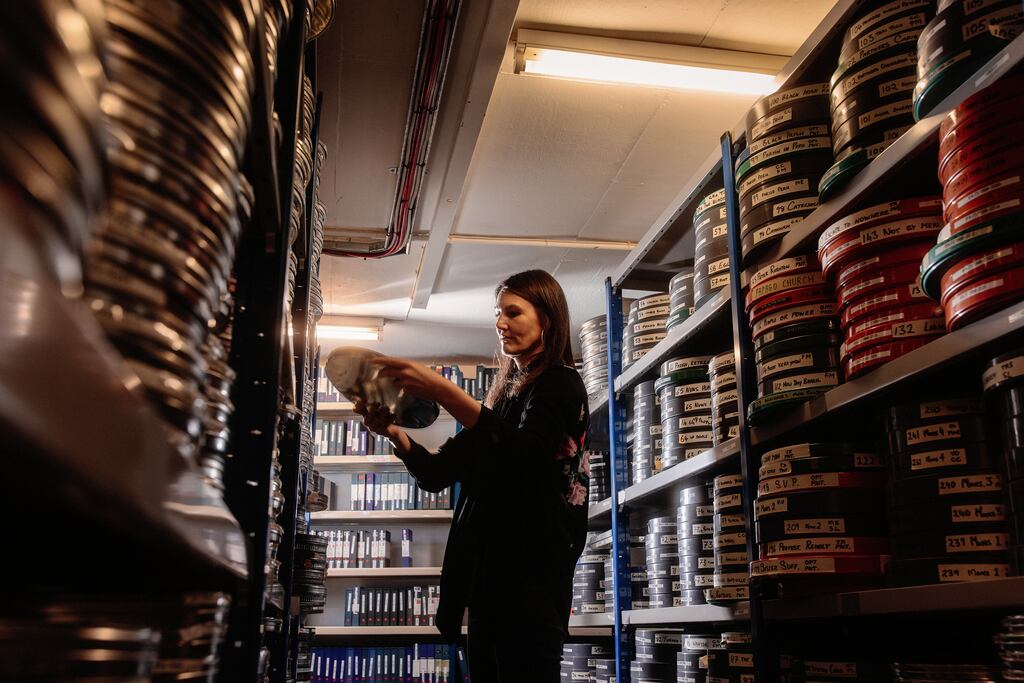
That glaring omission is being rectified thanks to the work of Sarah Arnold, associate professor of media studies at Maynooth University, and Kasandra O’Connell, head of the IFI Irish Film Archive, who have been collaborating on a number of projects examining overlooked women film-makers and developing new approaches to documenting their contribution to Irish film history.
“Women’s creative work has historically been underreported and under-recognised, making it difficult to document and catalogue accurately,” Arnold explains. “This challenge is particularly acute in amateur and non-professional film-making, where records are often incomplete and women film-makers can become effectively invisible within the historical record.”
Through a Research Ireland New Foundations project, Arnold and O’Connell are combining academic research with archival expertise to improve how women’s creative contributions are identified, catalogued and contextualised within local, regional and national archives. The collaboration forms part of wider efforts to ensure women’s film-making history is better represented within Ireland’s cultural record.
READ MORE


“When you read about history of Irish film, it’s mainly about the success of setting up a commercial Irish film industry after the establishment of the Irish Film Board,” says Arnold. “Irish amateur film-making is often not included. It was as if the period from the 1910s until the 1990s was the dark ages. There was lots of interesting activity during that time, but it doesn’t fit the narrative because it wasn’t commercial film-making.”
Part of the reason for this is a certain disdain or snobbery towards amateur film-making. “People think amateur is not very good, but some of it was extremely good,” Arnold says. “Some of these film-makers were doing amazing stuff with Super 8 and so on. The Irish Film Society was cofounded in 1930 by novelist, playwright and critic Mary Manning and its members were making very good films, but they are considered amateur because there wasn’t an industry around it.”
Home movies tend to be derided and undervalued, she adds, but films by people like Margaret Currivan provide a valuable record of life in Ireland at the time. “She was a member of the Dublin Cine Club. Her family owned a chemist, so she had access to materials. Her films are really interesting and quite accomplished. She was interested in storytelling, and she used family and neighbours and local area as props to tell those stories. These films are a rich archive of daily lives.”
The Flora Kerrigan story is even more interesting. “She is so different, she almost upends what we know about film in the 1950s and 1960s,” says Arnold. “We were told that nothing was happening, that there were no amateurs, but we have this really interesting and exceptional film-maker who has somehow disappeared from the record. But people like Flora and Louis Marcus were doing really interesting film-making down in Cork. It wasn’t this stagnant period. We had a really vibrant film culture with really interesting and bold film-making.”
Kerrigan’s film-making star shone brightly but briefly before she left for London in the mid-1960s where she became a highly innovative poet. During her time in Cork, she sent films to festivals in Australia, Yugoslavia and other countries. “They are abstract, surreal and told very interesting stories. One of Flora’s animated films has cutouts of shoes representative of people interacting with controlling and coercive relationships portrayed by different sized feet.”
Another of her films, The Seventh Day, illustrated the concept of time and explored our understanding of it. “In another the Earth is anthropomorphised as a face with rockets and other things coming out of it,” says Arnold. “It illustrates the cold war, among other things. Dream Maker explores sensuality between women. A Hard Day’s Night was inspired by The Beatles movie in some ways. It is film about chess players; the chess players turn into people and a white pawn turns into a queen and the male player gets frustrated because he’s no longer in control of her.”
Kerrigan puts her own introductions in some of the films. “She is quite playful, saying things like ‘you’re never going to see this because of what’s in it’ or ‘if you understand this you must be a psychopath’. Amateur film-makers could do almost anything because the censor was never going to see it. Our aim is for Flora and others to be written back into history and that will transform what we think about that time.”
The films are being put up on the Irish Film Archive player (ifiarchiveplayer.ie). “This is not geo-blocked so anyone from anywhere in the world can look at the Flora Kerrigan collection.”