

Employment in Ireland hit an all-time high earlier this year, with more than 2.8 million people at work.
The country is effectively at full employment and organisations across almost every sector are reporting difficulties attracting and retaining staff.
That makes diversity, equity and inclusion (DEI) programmes more important than ever, not just because they help deepen the talent pool that employers get to draw from, but because it also means more people are more likely to meet their full potential.
It’s also because promoting fairness is the right thing to do.
READ MORE


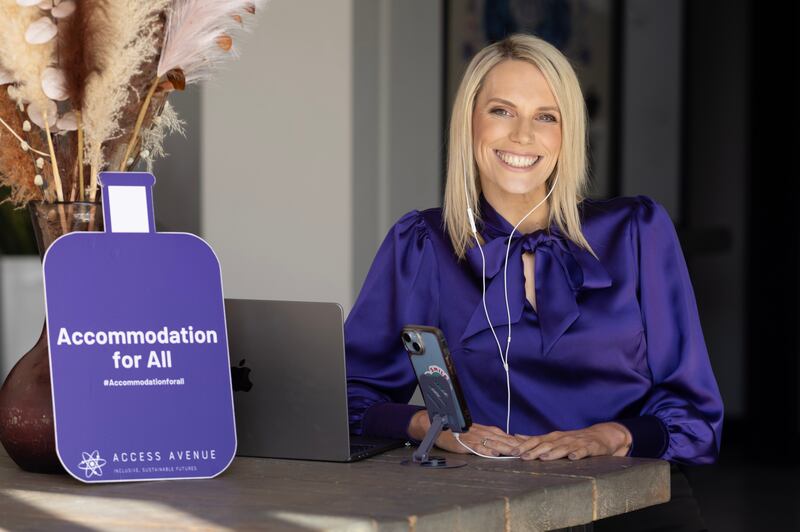
That’s something accessibility advocate Shelly Cowan is passionate about. The entrepreneur, and hugely inspiring keynote speaker, was diagnosed with an illness that, at 15, left her bedbound and almost blind for 12 years, and in a wheelchair for the following decade.
Having made a partial recovery, still today she can see only see light and shade and can only walk with the assistance of a carer.
But when she was finally well enough to return to education, a long-held dream, she faced fresh barriers.
At one adult-education class she says she was asked to leave for fear she posed a distraction to her classmates. When she protested, she went through the humiliation of having to wait outside while the issue of her presence was put to a vote.
All her classmates wanted her to stay but when she rejoined, she was instructed to sit apart from the group. It was only when one student, in a show of solidarity, moved his chair over beside hers – and then sat with her for every class until the course finished – that she felt supported.
It was a rocky start to a back-to-education journey that saw Cowan going on to university and indeed ultimately gain a master’s degree in business administration, the much-coveted MBA.
She went on to set up JustUs, a social network for people with disabilities and their family members, and TravelEase, a start-up aimed at empowering people to tailor travel to their needs.
Through her consultancy Access Avenue International, she now helps organisations of all kinds to ensure they are as accessible and inclusive as possible.
“If I wasn’t so stubborn that could have actually stopped my education, but I pushed on because I had support, and that’s what we need in society. We need people to stand up for people with different needs,” says Cowan.

Lecturer and author Furkan Karayel agrees. Her books, Inclusive Intelligence: How to be a Role Model for Diversity and Inclusion in the Workplace, and DEI Ambassadors’ Workbook arose from her experience coming to Ireland from Turkey and working in the multinational tech sector for 10 years, where she struggled to feel heard.
She could see that managers often had no understanding of how to ensure inclusivity. “I could also see that potential was being missed by large organisations that were not being inclusive, because the talent basically leaves and goes to another company,” she says.
As someone who specialises in DEI, Karayel is well placed to assess shifting trends in the area, including the current pushback from some politicians in the United States.
Yet from her client base in Ireland she sees that work on DEI is continuing apace, often just simply rebadged as, in some cases, “fairness and awareness” training.
She compares it to the trend for “no make-up make-up” on social media.
“It’s where you basically apply products as make-up, but it doesn’t look like you are wearing any. I call this era ‘no DEI, DEI’. So basically, companies keep going but don’t make it look like they are doing anything fancy,” she explains.
But that’s a strategy that risks suggesting that their previous work on DEI was mere lip service. It also risks alienating future staff.
“Gen Z in particular is going to be moving in the direction of those companies who stood up to this. Gen Z is very sensitive to DEI visibility and advocacy,” she says.
She calls out companies pulling back on DEI as having practised “artificial inclusion”. “Now is the time for real inclusion,” says Karayel, a judge at the recent Diversity in Tech Awards.
This year’s awards were supported by a raft of international businesses, including JP Morgan, EY and LinkedIn. They have run for the past eight years and this year’s event was the best yet, says organiser Clare Kilmartin.
“I think there is a recognition that this is an area that should be celebrated, championed and given recognition, which is why it has been going from strength to strength,” says Kilmartin.
She also believes that, regardless of any pushback from across the Atlantic, Ireland is a leader in the area of DEI, pointing to a survey from the Irish Management Institute which found 97 per cent of senior business leaders intend to double down on their DEI efforts, despite US trends in the other direction.
“DEI is not at risk of going away but I do think it will affect those companies that are shown to have been fair-weather friends to DEI,” she says.

One company that is a true friend to diversity and inclusion is Datapac. The managed services firm won the diverse company of the year award. “DEI is something we are very passionate about. It’s part of our DNA in that it goes back to our values – we are a team of equals,” says Datapac general manager Karen O’Connor.
The business currently employs 96 people and offers a full portfolio of ICT solutions.
“We have always described the Datapac difference as our people. We’ve got a very agile, customer-focused team of problem solvers who come up with solutions for our customers. For that to happen, you have to have a diverse team, people who are creative, who think differently. You also have to have people who work well with one another, and diversity has really helped us to leverage all that. We have doubled down on it because it delivers for us,” says O’Connor.


