
When Irish citizen Daniel Tatlow-Devally turned 32 on November 8th, it was just like any other day in the previous two months: locked up for 23 hours.
The Dubliner is on remand in the southern German town of Ulm and faces up to five years in prison for their alleged role in a break-in at a German subsidiary of Israeli arms firm Elbit on September 8th, causing extensive damage.
With four others from Germany, the UK and Spain, Tatlow-Devally, who uses they/them pronouns, is likely to be charged with trespassing, destruction of property and membership of a criminal organisation.
Prosecutors say the group behind the early-morning break-in destroyed office and technical equipment with axes, detonated smoke bombs and sprayed the facade of the building.
READ MORE


The group posted a video of the attack online, waited for police to show up, were detained at the scene and brought to a local prison.
What happened subsequently has infuriated and outraged their family and friends.
They accuse the German authorities of chicanery, intimidatory practices and a politicised approach to the case – charges rejected by the federal prosecutor in Stuttgart.
After the arrest, father Conor Devally said his son was detained for 30 hours in a police cell, “stripped to his fundamentals”.
“He was denied access to a lawyer despite repeated requests,” said Devally.
The federal prosecutor in Stuttgart disputes this, saying Tatlow-Devally was read their rights on September 8th – in English – but “at first relinquished explicitly their right to a public defender”.
One was appointed on September 9th by the examining magistrate, the prosecutor added.
This is not the whole story, says Tatlow-Devally’s lawyer Christina Mucha.
She said Tatlow-Devally declined a court-appointed lawyer, telling police that a lawyer of their choosing – naming Christina Mucha – would be in contact.
Mucha says police blocked several attempts by her to access her client, unusual behaviour that meant she met Tatlow-Devally only directly ahead of the remand trial.
The federal prosecutor disputed this version of the first 30 hours, saying neither the lawyer’s name nor calls were known to authorities before the remand hearing.
Last month about 40 people protested outside the German embassy in Dublin over the refusal of bail and the 23-hour remand lock-in, allowing for just one 30-minute visit every fortnight.
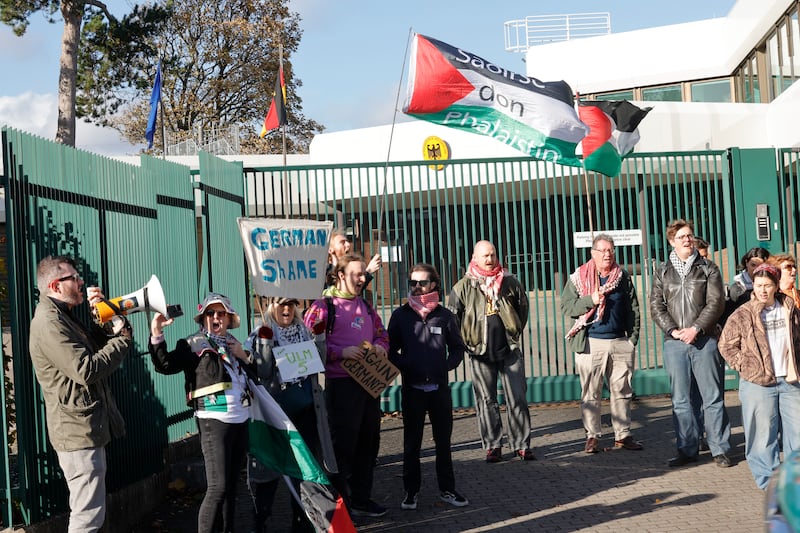
A spokesman for the federal prosecutor in Stuttgart denies that the conditions are “in any way unusual, these are the usual restrictions”.
Mucha confirms that 23-hour lock-in is standard in such remand cases in Ulm and the surrounding state of Baden-Württemberg.
The group’s defence team take issue with the prosecutor drawing on article 129 of the criminal code, pertaining to criminal and terrorist organisations, as it remains unclear which criminal organisation the prosecutor has in mind.
The defence team for the group say the alleged actions of their clients caused damage to property, not persons, and were “clearly aimed at a legitimate goal, namely, to end the killing of civilians in Gaza”.
They accuse Elbit, a major Israeli arms company that supplies drones, of “war crimes, crimes against humanity and genocide in Gaza”.
‘Emergency’
According to Mucha, the defence will draw on German legal provisions allowing for extreme action “in self defence or an emergency, and that committing such an act might prevent bad things happening in Israel”.
In September a Stuttgart judge agreed with prosecutors that there was a real flight risk and ordered all five suspects be detained on remand until trial.
Mucha and other defence lawyers say this is disproportionate given their clients filmed the attack, posted it online, waited for police officers to show up and want the case to come to trial.
Asked have they confessed to carrying out the attacks, she replied: “They have not commented on this, it still has to be proven – even with the video.”
Devally, a senior counsel in Dublin, is anxious not to comment on legal aspects of his son’s case but says it has an “intimidatory feel” with “frightening background noise” from the German state.
Devally said that, on a joint visit with his wife, two prosecutor’s office officials from Stuttgart “spoke in high voices in a very small anteroom of their authority to sit in” on their meeting with their son, along with a translator.
Permission for a later visit was denied at first, Devally was told, because the same translator was not available.
Access to reading material has been limited, says Devally, while letters – forwarded first from Ulm to the prosecutor in Stuttgart for vetting – can take up to three weeks to arrive.
Like the lawyer team, Devally takes issue with what he views as “criminal language” being used by prosecutors in the case.
“They seem to be deploying words that in any other jurisdiction would be reserved for gangs who run profit-motivated scams,” he says.
Devally says his son’s prison is clean and the food is acceptable – “at least from a calorific content point of view”. Daniel is being “looked after physically” and has begun a Calisthenics exercise programme, Devally says, though his son’s complexion now reflects their “limited access to daylight”.
Tatlow-Devally studied philosophy in Trinity College Dublin and has lived in Berlin for the last seven years, at first on a Humboldt University scholarship in philosophy and neuroscience.
Subsequently they studied and worked in the fields of AI, behavioural psychology and ethics and had a job offer they were unable to take up because of their remand in Ulm.
Devally says his son has had an interest in political activism for many years, from the oppression of the Kurdish people to the situation of the Palestinians in Gaza after the Hamas terror attack of October 7th, 2023.
Tatlow-Devally was a regular at Gaza solidarity marches in Berlin and complained to their parents about high police presence at these demonstrations and arbitrary police violence.
Asked if the involvement of an Israel firm was a relevant element in their investigation, a prosecutor spokesman said the attack was on a German-registered firm and “whether any anti-Semitic motivation needs to be considered in sentencing is the subject of the investigation”.
Clashed
Tatlow-Devally is not the only Irish national who has clashed with the German authorities over the Israel-Palestine issue.
Two other Berlin-based Irish nationals were served removal notices last spring and subsequently charged for their alleged role in a demonstration that turned violent at a Berlin university in October 2024.
Charges against one, Bert Murray, were dropped while the second, Shane O’Brien, will go on trial on February 9th accused of trespassing and physically attacking police officers, injuring one, and helping co-accused of evading arrest.
In a separate case, Berlin police have concluded their investigation into a Gaza solidarity demonstration in Berlin last August where an officer was filmed punching Irish-based Kitty O’Brien.
The officer remains in service and a Berlin state prosecutor has opened an investigation of its own.
Facing into a Christmas without his son at the dinner table, Conor Devally says he is deeply disturbed by Germany’s response to protest against Israel’s military actions in Gaza.
“We have spent half a century saying at least the Germans have faced up to what they did, and I can see it must have been a struggle,” said Devally. “But some of the lesson appears to have been washed out. Instead of learning the lessons they are almost applying a rigid rule that is pro-Israel, regardless of rights and wrongs.”