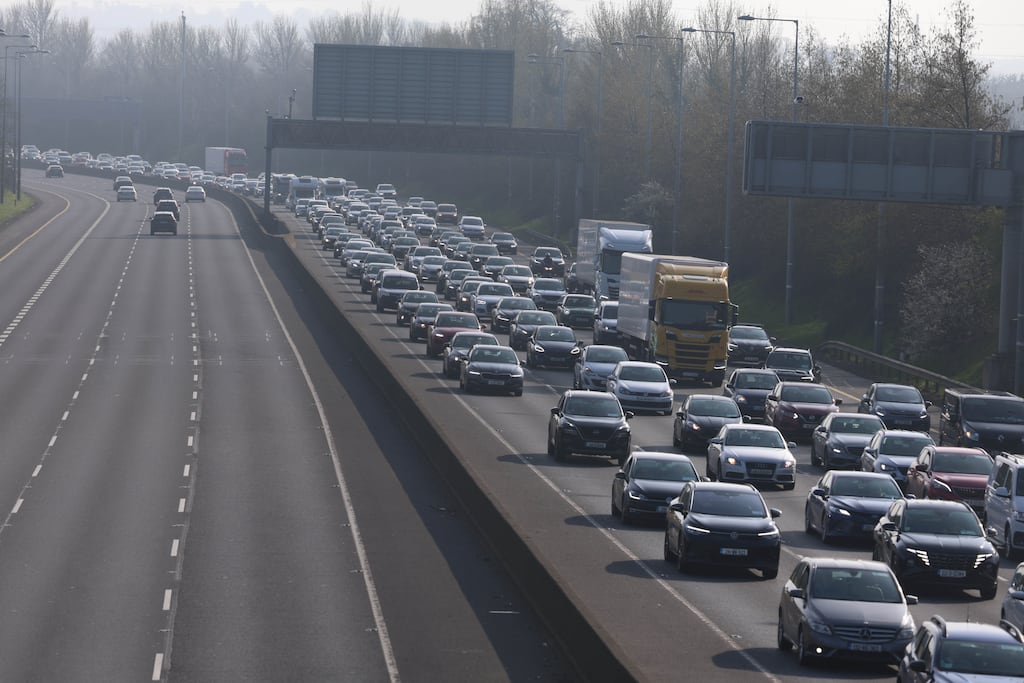
The report which found that Dublin ranked 11th among a list of almost 1,000 international cities for traffic congestion will come as little surprise to the city’s hard-pressed car commuters. According to an analysis by Inrix, a company which specialises in transport data, the city climbed from 15th last year, with commuters losing an estimated 95 hours during the year to congestion. To put this in context, the comparable figure in Istanbul, the world’s most congested city, was 118 hours and Ireland has a similar ranking to major European cities like London and Paris.
The report looked at traffic conditions in 36 countries. While inevitably such rankings are estimates, trying to compare conditions in many diverse countries, the conclusions for Dublin nonetheless ring true.
Since the rare traffic tranquility of the pandemic, the growth of journey volumes has been relentless, reflecting growth in the economy and in Dublin’s population. This is also part of an international trend, with more than six out of ten of the cities studied showing worsening congestion.
In Dublin, the M50 is the centre of this story of disrupted journeys, but it is far from the only problem spot. Major artery roads leading into the capital, or onto the M50, are all heavily congested at rush hour, as are many suburban roads.
READ MORE


Traffic on the M50 now exceeds Celtic Tiger volumes with Transport Infrastructure Ireland saying that it is past peak capacity and that there is little that it can do to ease the pain for motorists. Peak traffic hours are now extending from the previous two to three hours to longer lengths of time. More traffic in turn means more accidents and these can cause huge delays.
Back in the Celtic Tiger days there was talk of a second ring-road to the east of the city, or even one out beyond the M50. Now the focus has turned more to what can be done to boost public transport and get people out of their cars and on to buses, trains or the Luas.
The slow rate of progress in developing these networks is one reason why traffic is now so bad. Dublin has not brought any new piece of fixed rail service into place since the cross-city Luas in 2017 and the BusConnects project has been slow to come on stream. Meanwhile the resilience of existing public transport networks is in question, with a recent power outage on the Luas causing huge delays and regular problems on train lines.
The latest transport plans produced by the Government, while promising extra spending overall, raise doubts over the timing of vital expansions in the Luas and Dart networks, even if progress is promised in some areas. The Metrolink will take years to build. Delivering new public transport options for motorists remains vital – investing to make current train, Luas and bus services more reliable would help in the meantime.


