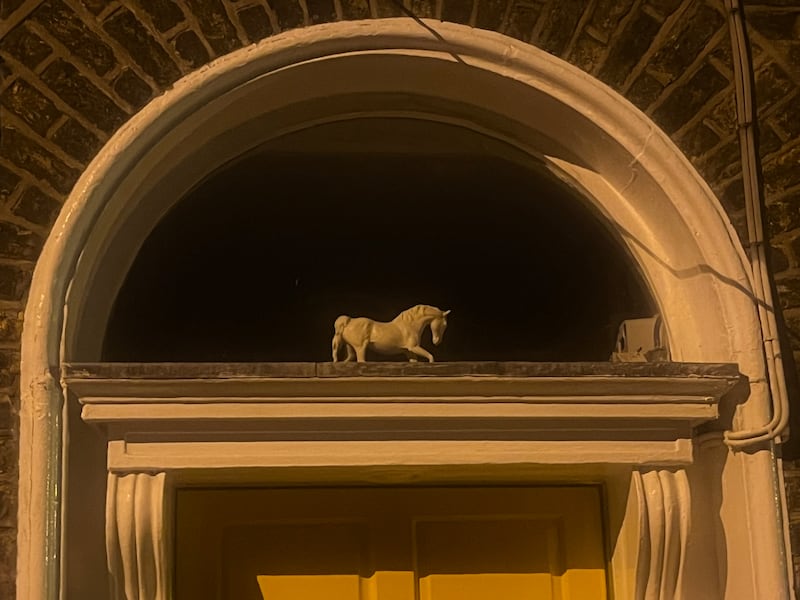
Iam delighted to report the sighting, thanks to another eagle-eyed reader, of a second surviving Dublin fanlight horse. As Brian Galvin emailed to let me know, this one is on Hendrick Street, near Smithfield. And it looks in even better shape than the specimen previously identified, at Erne Street.
Whereas that seemed a bit downcast, this one has its head up, and is in full prancing mode. In any case, although the once-prolific species must still be considered endangered, the fact that there are at least two horses still out there may open the possibility that they could breed again.
The location of the latest discovery is unquestionably apt. It was a talk by city historian Cathy Scuffil on how horses have left their mark on Dublin that first alerted me to the subject of these formerly ubiquitous fanlight figurines.
But the stamp of equine history is obvious even on a map of the Smithfield area. Just opposite Hendrick Street, for example, is a place still called Haymarket. Nearby also is a Stable Lane. And then of course there is Smithfield itself, long synonymous with the horse fair.
READ MORE


Other vestiges of the animal’s former dominance are “cobblestones and jostlestones”, to quote part of the title of Scuffil’s talk, also still prevalent around there.
Cobblestones were first used as a hard-wearing, drainage-friendly street surface for horses pulling heavy loads.
Jostlestones, now devoid of context but still standing in many places, were short, stumpy stone pillars designed to protect gate piers and other vulnerable building parts from cartwheels cutting corners.
Hendrick Street itself is somewhat nondescript these days, although it merits a sizeable entry in an excellent blog I found called historyeye.ie. Even that begins by acknowledging the street’s limitations, including its failure to be mentioned in Ulysses, a stigma hard to live down.
“It was never a fashionable place,” says the blog: “a short street slotted between the city’s hay, corn and cattle markets to the east and the enormous Royal Barracks to the west. A street that might be used on the way to or from somewhere else: so overlooked that it never made it once into the huge canon of Joyce’s Dublin.”
Back in the 1700s, apparently, it was dominated by “Dutch Billies”, the gable-to-the-road style of architecture that was the city’s defining look before the Georgian era.
But today, says the blog, the last remnant of the 18th century is an old house, now two-storey but once taller and perhaps gabled, occupied by Bourke’s Funeral Directors, on the corner with Queen Street.
That, as it happens, is where the fanlight horse resides. So perhaps in keeping with one of the theories about how the statuettes originated, this one is itself is a relic of a time when King Billy’s memory was still revered.
Short as Hendrick Street is, it has had its share of well-known residents, none more famous than Willie the “Toucher” Doyle (1880-1933).
He too was associated with horses: by some accounts he was a professional gambler. But he can’t have been that good because what he was more noted for, and earned his nickname from, was asking people for loans.
He was painted by Harry Kernoff (from whom he sought “ten bob” while posing) as one of a pair of drinkers in a picture called A Bird Never Flew on One Wing, which hung for years in a Dublin Pub, O’Brien’s of Leeson Street.

And as previously mentioned here, this may have had far-reaching consequences.
The story goes that a Hollywood designer visited the pub once and was struck by Doyle’s pointy noise and almost alien ears. The designer later worked on Star Trek and so, according to legend, the Toucher lent his features to Mr Spock.
Whether that’s truth or imaginative fiction, Hendrick Street’s claims to cinematic history do not end there.
Just as Smithfield posed as postwar Berlin in the 1965 film version of The Spy Who Came in From the Cold, it seems the old house on Hendrick Street’s corner featured in a 1960 thriller, set in London half a century earlier, called The Siege of Sidney Street.
I can’t find it mentioned in Irish newspaper archive reports of the film scenes shot here. But describing another of the locations, Donore Avenue, the Cork Examiner’s Dublin correspondent noted (a little defensively): “Take it whichever way you will ... one of the reasons for making this film in Dublin is that we still have streets here which are like those of London’s East End fifty years ago.”
Today there is at least one conspicuously modern building on Hendrick Street: the eponymous Hendrick, a hotel billing itself as the first in Ireland devoted to “street art”.
It also, however, trades on the area’s past, including “the city’s darker side”. Thus, the hotel website boasts that Hendrick Street “has long carried whispers of hauntings” and “tales of restless spirits”. These are not specified, but perhaps the horse in the fanlight nearby can now be added to the list.