

When British soldiers opened fire on civilians at Bachelors Walk, Dublin, in July 1914, after the Irish Volunteers landed guns at Howth and marched them into the city, one of the many people injured was a man named Sylvester Pidgeon.
A print tradesman aged 40, he died two months later, becoming the fourth fatality of the attack and leaving behind a wife and five children, the youngest a baby. In November that year, at the Mansion House, the Dublin Typographical Provident Society held a “Grand Concert” in aid of the widow and her orphans.
One of those orphans was John Joseph (aka “Johnny”) Pidgeon, who might have fought in the 1916 Rising that followed except he was too young. Instead, he joined the IRA in 1917 and served with the A Company 3rd Battalion between then and the end of the Civil War.
After that he emigrated to England, joined the RAF and, befitting his surname, took to the air.
READ MORE


Like Jim O’Dwyer, whom we mentioned here last week (Diary, March 20th), he was both diminutive – 5ft 3in or 4in – and intrepid. So like O’Dwyer, too, he became a “tail-end Charlie”: squeezed into a perspex bubble at the back of aircraft to defend them against fighter planes.
But by the time Seán Creaney, who wrote to me about him, first encountered Pidgeon, the latter was back on the ground again. It was the 1970s, in London, where Seán had just joined Córas Tráchtála, the Irish Export Board, one of many promotional bodies headquartered at Ireland House in New Bond Street.
Pidgeon, the former rear-gunner, now had a front-end job there, as doorman, and performed it with great warmth and personality. First impressions were important in that business, Creaney recalls, and the ebullient Johnny “was the ideal doorman – we were already five steps ahead when a foreign buyer met him”.
There was a tradition in Britain, going back to the Crimean War, of ex-servicemen getting jobs as uniformed “commissionaires” (as upmarket doormen were known). And being full of luxury shops, New Bond Street was one of the most prestigious places to play that role.
Creaney recalls seeing a newspaper cutting from 1966 (he thinks it was the Daily Mirror), in which the street’s then newest commissionaire was profiled.
It noted that whereas uniformed doormen elsewhere were known for wearing the military decorations they had earned fighting for Britain, this one “wore only one medal, won fighting against the British in 1916-23”.
Pidgeon remained a doorman until the late 1970s, retiring at 75. Not long after that, in January 1979, he died. And it was while talking to his widow, an English lady, that Creaney realised Pidgeon had always wanted to be buried back home in Dublin.
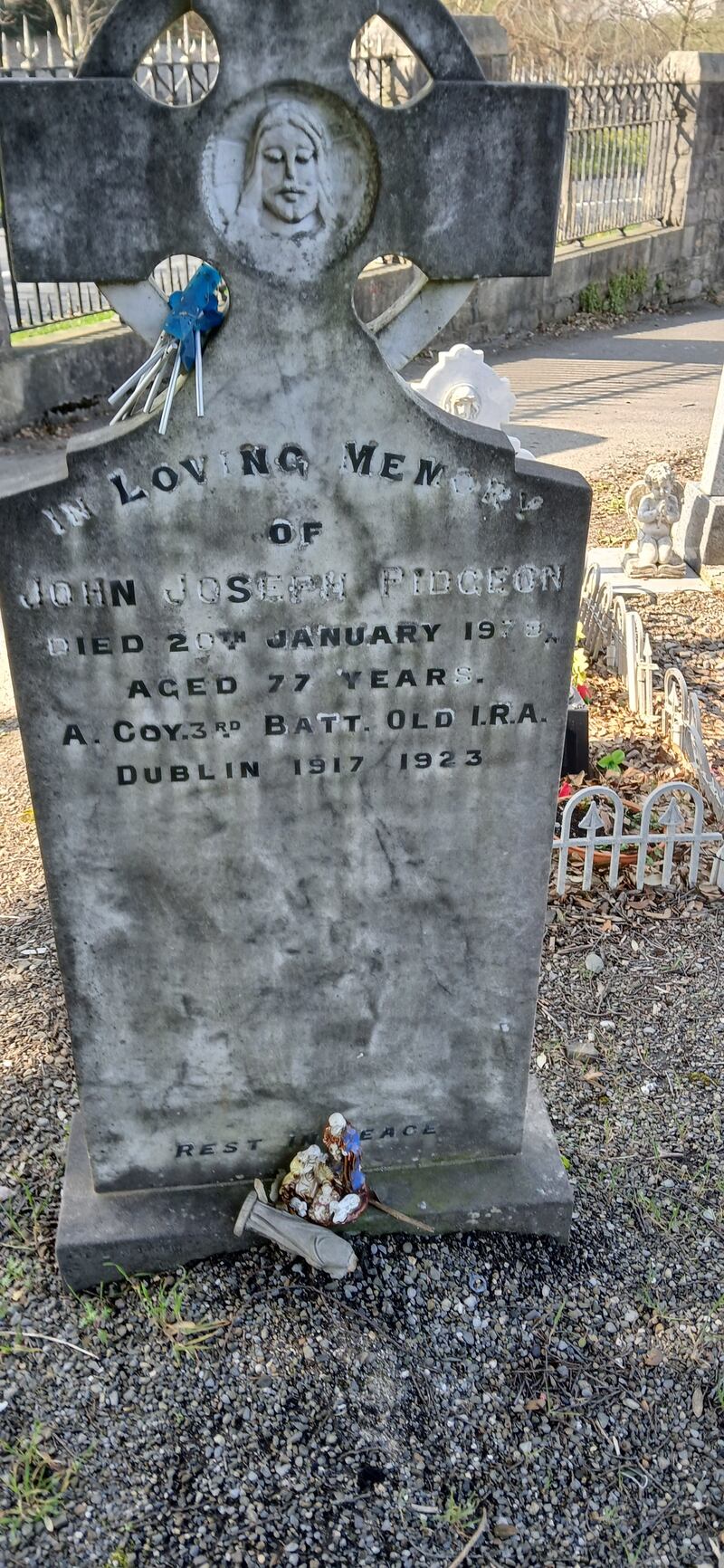
So after looking up the costs of the funeral and repatriation – £750 including two airfares, for widow and daughter to accompany the remains – Creaney did the rounds of Ireland House to raise the money.
The various bodies contributed between £50 and £100 each, but he was still £100 short until An Bord Bainne weighed in with £200 and saved the day.
A necessary condition of the whole exercise was discretion. Unlike the peaceful 1960s when English newspapers could be indulgent about Pidgeon’s republican past, this was the height of the Troubles. There was a lot of anti-Irish feeling in London. The funeral was politically sensitive.
Even so, at the service in Streatham, two Old IRA men who had sat quietly at the back of the church came forward, placed a medal on the coffin and saluted it before resuming their seats.
Later, on arrival in Dublin (to which Creaney paid his own fare), the coffin was met by a party who placed a Tricolour on it for the journey to Glasnevin. Where, at the end of the ceremony, a group of veterans stepped forward and fired the traditional salute.
By now, the potential for causing controversy in Britain had passed. Or so Creaney thought. But as the spent cartridges fell to the ground in Glasnevin, he noticed some of the relatives picking up shells as souvenirs, so decided to do likewise. On request from Mrs Pidgeon, he got her some too.
It was only when in mid-air, en route back to London, that he realised this historical baggage might be a problem. “Oh my God, I had forgotten about the tight security at Heathrow,” he recalls. “I suddenly saw the headline ‘[Irish Export Board] man arrested with spent-ammunition on him’.”
When he broached the subject of their imminent detention to Pidgeon’s English widow, however, she just laughed at the thought of how funny he would have found that prospect. In the event, as Creaney recalls with some regret, it didn’t happen: “Alas, we walked through unquestioned.”


