
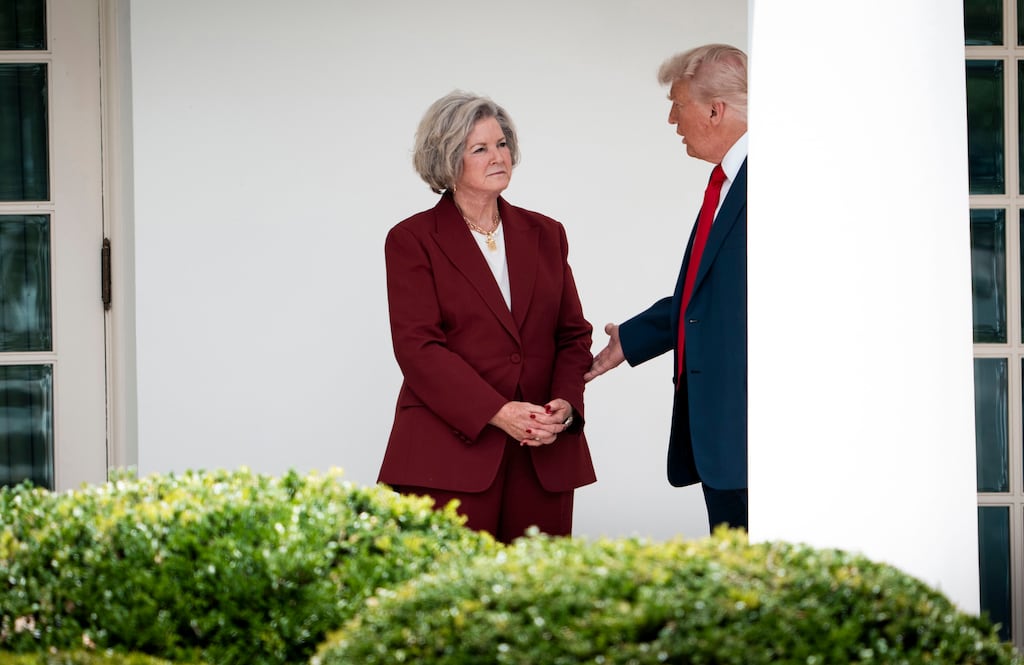
Earlier this week, Vanity Fair magazine published a long article by the reporter Chris Whipple about the Trump White House. For a glossy liberal publication – known for its generally unsympathetic reporting on the US president and whose previous editor, Graydon Carter, had a very public feud with Donald Trump going back to the 1980s – the piece benefitted from surprisingly robust access.
It’s largely based around a series of conversations with White House Chief of Staff Susie Wiles over the course of the last year or so, amid the Trump administration’s many moments of crisis. It also features secondary interviews with vice-president JD Vance and secretary of state Marco Rubio.
The article immediately provoked controversy, largely for Wiles’s apparent portrayal of her White House colleagues, arguably including her boss, in an unflattering light. She describes the president as having “an alcoholic’s personality”. (To be clear, she is not implying that the famously teetotaling Trump has a secret fondness for the sauce, but rather that he operates with “a view that there’s nothing he can’t do. Nothing, zero, nothing.”) She describes Elon Musk as a ketamine user (which he very much is), and also a genius (which he very much is not). She refers to JD Vance as an inveterate conspiracy theorist.
The whole thing is sort of fascinating, not because it tells us anything we don’t already know about Trump and the people around him, but because it seems like such an act of recklessness for a person so central to the administration to say these things publicly. Who knows what her reasons were: perhaps she’s anticipating the fall of the House of Trump, and attempting to smooth her path to a post-White House acceptance in polite Washington society. Perhaps she just didn’t think any of these remarks portrayed anyone in a particularly bad light.
READ MORE


The reaction to the Vanity Fair piece had less to do with the article itself, in any case, or with anything Wiles said, than with the photographs accompanying it. These portraits, by Christopher Anderson, are an extraordinary illustration of the enduring power of the photographic image, and of the continued relevance of magazines. Several White House figures who presumably declined to be interviewed for the article agreed to be photographed by Anderson.
Looking at the photographs, you find yourself wondering what they were thinking. Well, presumably they were thinking “Vanity Fair”, and therefore gauzy Annie Liebowitz photoshoots, the glamour of the magazine’s annual post-Oscars party, and so on. Trump himself is famously preoccupied with image, with the gleaming surfaces by which power and prestige are reflected, and is well known, in choosing appointees, to be guided by whether they look the part. (One of Trump’s great compliments is to speak of a person as being “straight from central casting”.)
But this was not that. The photographs that have provoked the largest reaction are Anderson’s tight close-ups of the faces of the administration’s main supporting characters. As a technique, it’s utterly pitiless; depending on where you are on the political spectrum, it’s either a prime example of mainstream media bias against the current US presidency, or a ruthless short-circuiting of the normal political business of image-curation and stage management.
There’s a portrait of JD Vance that is so close that you can see his actual pores; if you have the stomach to really look closely, you can in fact see individual nose hairs. The photograph of Karoline Leavitt, the notoriously combative 28-year-old White House Press secretary, is particularly brutal and unsparing. The first thing your eye is drawn to is an orange-coloured smear of make-up along the dorsal ridge of her nose, but then you notice a pointillist pattern of scars, apparently injection sites for lip filler.
There is a discomfort in looking at these portraits. However awful these people might be, whatever cruelty and damage they have inflicted or helped to inflict while in power, you can’t help wince at the harshness of the images, and perhaps at the thought of what you yourself might look like in such a tight close-up, spread across the pages of a glossy magazine.
In an interview in the Washington Post the day after the photos went viral, Anderson was asked what he would say to people who thought the images unfair – the close-up portrait of Leavitt in particular. “I didn’t put the injection sites on her,” he replied. “People seem to be shocked that I didn’t use Photoshop to retouch out blemishes and her injection marks. I find it shocking that someone would expect me to retouch out those things ... Because if I had, that would be a lie. I would be hiding the truth of what I saw there.”
Stephen Miller, who serves as deputy chief of staff for policy and homeland security adviser, is one of the more extreme right-wing ideologues in Trump’s presidential orbit; he is generally regarded as the prime architect of the administration’s immigration policy, with its street abductions by masked Ice agents and its detention of Venezuelan migrants in black-hole El Salvador mega-prisons. In terms of his portrait for the article, Miller got off relatively lightly, in that his one was at least shot in monochrome. He looks like Pee-Wee Herman disastrously miscast in a Mussolini biopic, and his suit seems to be at least a size too small for him, but that has little to do with Anderson’s photographic composition; it’s just what he looks like.
There’s an interesting moment in that Washington Post interview, where Anderson mentions that, of all the people he photographed for the feature, Miller was the most concerned about the shoot, with how he would be depicted. After the shoot was finished, Anderson says, Miller came up to him to shake his hand, and said “You know, you have a lot of power in the discretion you use to be kind to people.” If Miller has any self-awareness at all, Anderson’s reply must have given him a sense of how things would turn out: “You know, you do, too.”
The value of these portraits is, I think, precisely in their mercilessness. In submitting themselves to Anderson’s lens, these people were made vulnerable by the very phenomenon from which so much of their power derives: the image. And it is always useful to be reminded of the human vulnerability of those who wield extraordinary power.


