
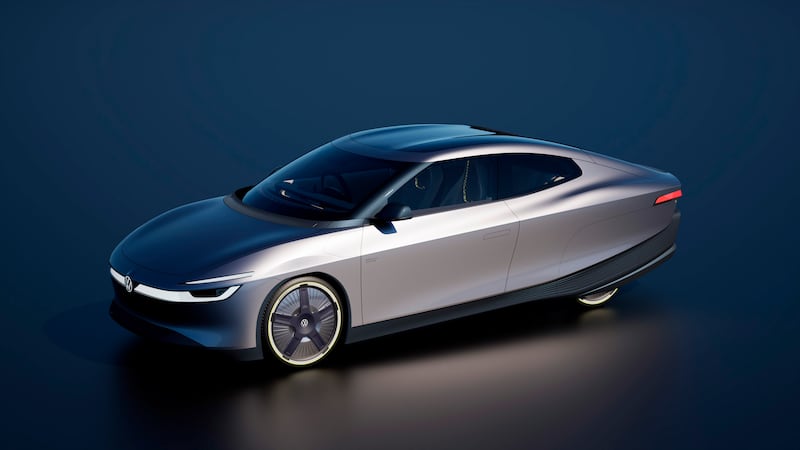
Volkswagen might be in crisis right now – shedding jobs and with even some ancillary brands potentially in the cost-cutting crosshairs – but the German firm is determined to prove that it’s still at the cutting edge of electric car technology with this, the Mission Efficiency concept car.
Those with long memories might remember the Volkswagen XL1, which wasn’t so much a concept as an incredibly limited-edition production car. It sought to squeeze as much mileage out of a litre of diesel as was possible.
It was, for a time, the most fuel-efficient car in the world, and we drove one around Dublin with its 1.0 litre per 100km (300mpg or thereabouts) economy. The XL1 was hand-built and so dedicated to efficiency that it was hardly easy, nor even especially pleasant, to drive but at least VW had the chutzpah to actually put some on sale.
No such luck this time around. The Mission Efficiency concept owes a clear and obvious debt in stylistic terms to the XL1, but it won’t be copying that car’s path to production.
READ MORE


Underneath the Star Trek bodywork – draped as tightly over the mechanical package as possible and pulled backwards into a classical teardrop, almost like a 1950s Land Speed Record car – there are actually the mechanical bones of the new Volkswagen ID Polo electric hatchback. That car uses a 52kWh battery to claim a WLTP one-charge range of up to 454km. The Mission Efficiency goes further.
Although perhaps not quite so far as some have claimed. VW has publicised the Mission Efficiency by taking it on an economy run of no less than 1,278.36km from Volkswagen’s German development centre in Wolfsburg via Poznań in Poland and Olmütz in the Czech Republic to the Austrian capital, Vienna.
However, contrary to some reports, the Mission Efficiency didn’t cover that 1,200km or so on one charge. It did, in fact, stop off for a quick top-up en route, but the claim of a 7.51kWh/100km energy consumption figure is striking – the best and most efficient EVs generally hover around the 14kWh/100km mark in real-world usage, while many will drift closer to 18kWh/100km if you introduce some motorway driving.

The range on one charge hovers at around the 800km mark – there are production cars which offer a similar range right now, but they require twice the battery capacity (which also means twice the size and weight, near enough).
That wasn’t even getting to the bottom of the Mission Efficiency’s battery, either. The car’s route was completed with an average speed of 67.72km/h; while the top speed achieved was 138km/h. The 54.9 kWh battery (actually slightly larger than that of the ID Polo) was only charged once during the journey. On arrival in Vienna, it had a remaining range of 164km.

Thomas Schäfer, chief executive of the VW brand said: “Rather than using specialist technology, the vehicle set its three world records using affordable production technology from the ID Polo and ID Cross, based on the MEB+ platform with front-wheel drive. This shows how much potential efficiency we can add to the latest generation of our electric cars.”
A big part of the Mission Efficiency’s efficiency is that aero body, which is so slippery that it has a measured coefficient of drag of just 0.158Cd (the best production cars generally have a Cd starting with a 0.2 number) and a frontal area of just over 2sq m. VW claims the aero efforts mean the Mission Efficiency is 30 per cent better off at speeds above 80km/h than the ID Polo, which is itself hardly a porky SUV. In fact, at 140km/h, the Mission Efficiency requires about as much energy as does the ID Polo at 100km/h.
It’s not just aero, though. The Mission Efficiency also boasts some other tricks, such as a solar panel roof, that can add a claimed 30km of “free” range per day according to VW’s numbers.

It also boasts special tyres from Continental and wheels that are specifically designed to smooth out the airflow down the sides of the car.
There’s also a clever electromechanical braking system, which is fully brake-by-wire, and which does away with the weight and complication of hydraulic pressure lines between the brake pedal and the calipers. Even the cabin has been designed for efficiency, with a Dacia-style dashboard clamp allowing you to use your phone as the car’s touchscreen, saving a little bit of helpful weight.
Production, though? Nope, not this time. VW is shrinking its model line-up right now, as it seeks dramatic cuts in costs and employment to allow it to better compete with Chinese car makers. There’s no room in that for another high-cost moonshot car like the XL1. More’s the pity.


