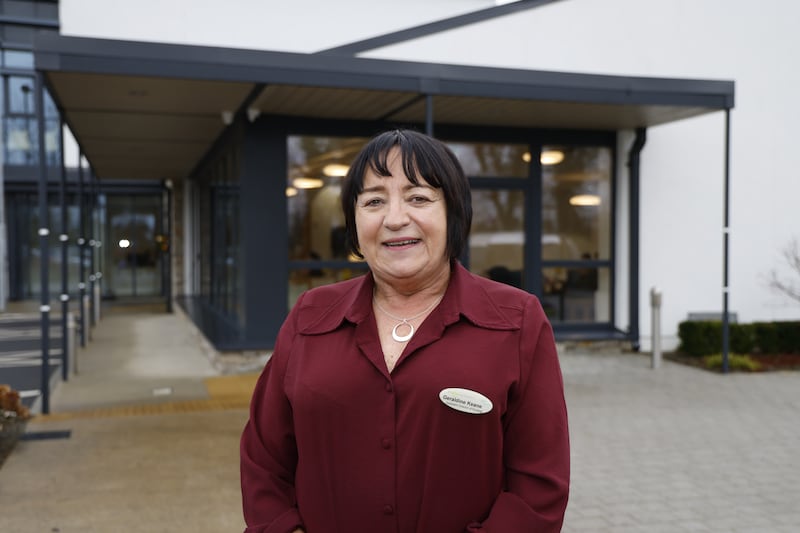
In the lobby of Roscommon Hospice there’s a Christmas tree and a kind woman with a visitors’ book.
Margaret Coakley’s daughter-in-law died three years ago in a hospice in Westmeath and she started volunteering here soon after. She thinks it’s important that families are greeted by someone who knows what they’re going through.
“You can see on people’s faces they’re scared to come in the door,” she says. “I’ve been there. Once they get to meet everyone they relax. There’s a lovely atmosphere here.”
The Roscommon Hospice opened in 2023. It’s the only hospice governed by a hospital.
READ MORE



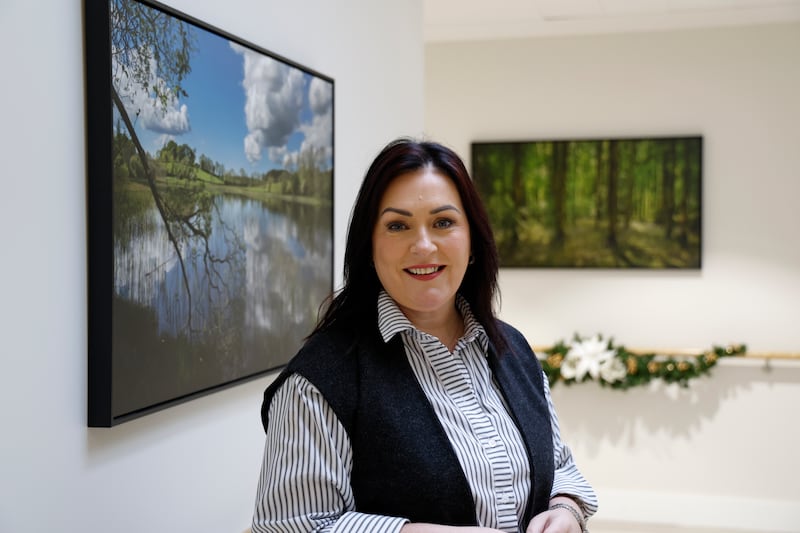
You can see Roscommon University Hospital from the door. “The original plan was to build it in the grounds,” says the chief executive of the Mayo Roscommon Hospice Foundation Martina Jennings. “One day I was walking across and saw an overgrown gateway at the top of the road. And I thought ‘that site is perfect’. So I walked from the door of the hospital to here and then the door of the hospital to the original site and it was the exact same distance.”
It was entirely financed by fundraising. “People with buckets,” says Jennings.
“The first thing we do now is tell people it’s free,” says Geraldine Keane, the manager of Roscommon Hospice.
“It’s amazing how they worry. I saw a woman one time and her husband was here eight days and when she was leaving, she said, ‘I’ll be here to fix up the bill tomorrow’. It was just missed, she wasn’t told. Imagine the worry she had for eight days.”
[ A day in a hospice: ‘Will I last until Christmas?’Opens in new window ]
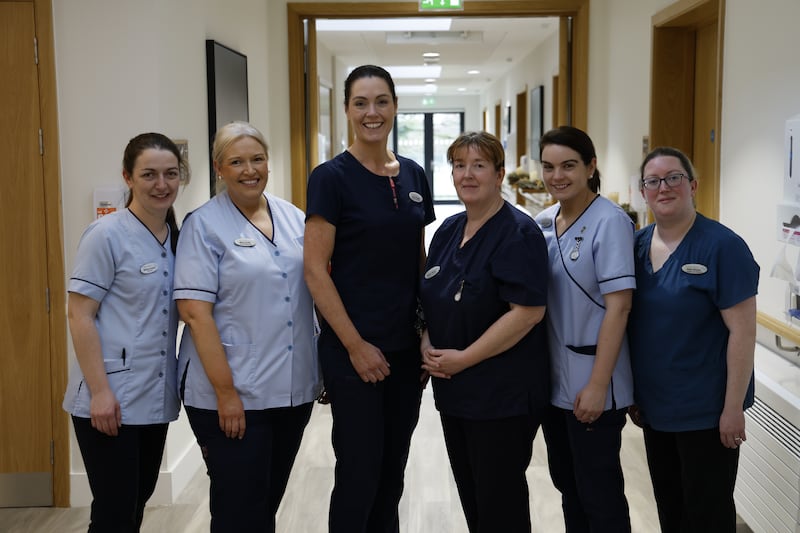
Keane gives me a tour. We pass the social worker’s office, the physical therapy room, a playroom for children or grandchildren of patients (a play therapist works with them to help them understand what’s happening), the canteen, the complementary therapy room, the nicely laid out visitor’s room, the mortuary.
In an equipment room she shows me a “cuddle bed”, a medical bed with a section that can be pulled out if a family member wants to lie with their loved one. “We’ve had kids lie on it, and people’s sons and daughters lie on it.”
There’s a beautiful garden with a stone water feeder and bird feeder created by Mark Feeley, a local stonemason. A 53-year-old man came to terms with his own death while planting the garden’s first sunflowers, Jennings tells me. “Through that [the occupational therapist] got him to talk to his family, his wife ... It was out in the open.”
Patients have very different attitudes to what they do and don’t want to know. Some don’t ask direct questions. Keane makes sure to regularly ask: “Is there anything worrying you?”
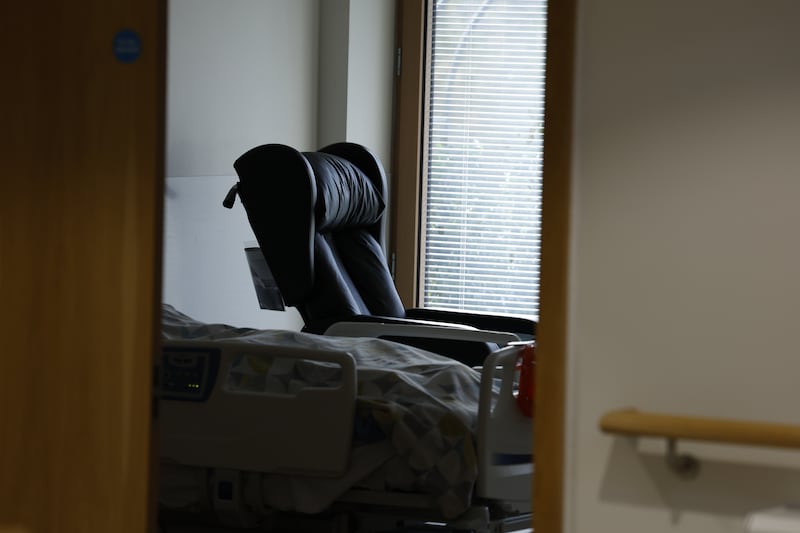
They try to make it feel as unlike a hospital as possible. Keane wants to show me how they have pleasant ordinary duvets, not hospital bedding, so we go to a patient’s room. The door is open. “Padraig, I’m just going to show Patrick the room is that okay?”
“Work away,” says Padraig, who’s sitting in an armchair.
Padraig once drove tractors and diggers and his nickname is “Benjy” after Benjy from The Riordans. He was born and bred in Roscommon and is now dying here at the age of 73. He has a large tumour on his neck.
“Is it going to kill me?” he says. “It is. What can I do only keep going? Isn’t that all.”
He was frightened of coming here at first. “I kept thinking of people being sent to the county home.”
“A lot of older people think of that,” says Keane. “When they first told you about coming here, what did you think?”
“I thought I was going to die soon,” he says. “I didn’t know it was going to be like this. It’s beautiful in here. Better than a hotel. I go up and down and out for a smoke and the staff are lovely. Talking to me. People come to see me in the evening. My sister, my nieces and nephews. The white doggy came in.”
“Beau,” says Keane. He’s a therapy dog who visits on Fridays.
Benjy nods. “He hopped up on top of me. I have a dogeen at home.”
“I was telling him he could bring him in,” says Keane. (Many patients have had their pets brought in. One woman had a visit from her horse.)
Padraig shakes his head. “My nephew will look after him.”
He’s less frightened here, he says. “Being on your own at home, the long nights looking out the window talking to no one, it’s fierce. One time I’d go to the pub but I’m not able now. I sit at home talking to myself. I could be dizzy on the feet and worried I’d fall. Jaysus, if I was at home now, I’d fall in the kitchen and no one would see me.”
Jennings says: “The hospice doesn’t just look at the patient that comes through the door, they look at the whole family. If people don’t have a family they find out who’s important to that person. Who are their neighbours? Their friends? The peace and the safety that brings to the patient you can’t put a price on it.”
“Some patients may not get a lot of visitors or their families might be a little bit further away,” says volunteer co-ordinator Michelle Brehon. “So a patient might like somebody to come in and sit and chat or just be there. [One volunteer] lives around the corner and she worked in a nursing home her whole life. She said, ‘I’m quite happy to sit at night with a patient, if they don’t have somebody to sit with them’.”
Keane remembers a time before palliative care was widely available. “My father died in ’91 and I remember being handed two ampoules of morphine by the GP who said, ‘give him those if he needs them’,” she says. “Ten years later my mother died at home with palliative care and I just saw the difference, how vital the service is.”
People are increasingly more comfortable talking about death, she says. She shows me some hospice tote bags with the triple spiral end of life symbol on it. “I’ve seen them in Tesco.”
[ Biden hopes new Roscommon hospice will bring ‘comfort’Opens in new window ]
She tells me about the Think Ahead programme where people fill out forms about their final wishes well before illness or death is an issue. She’s a big advocate of this. Has she done it herself?
She laughs. “No!”
Many of the people who work here say they’re less afraid of death than they once were. “People fear palliative care because of the lack of knowledge around it,” says clinical nurse manager Carol Duggan. “Even though it must very hard to face your own death, having that time to be with your family, to say the things you need to say and you want to say, or to plan for what you’re leaving behind, that can be a good thing.”
“If I had a euro for every time someone said, ‘I really wish I engaged with the service sooner’,” says Jennings. “It helps them live as well as they can for as long as they can.”
Everyone I speak to talks about what a privilege it is to do this work. Two patients died here over the weekend. When the body is making its journey from the building, the staff all line up in the lobby.
“It’s out of respect but as closure for the staff as well,” says Keane.
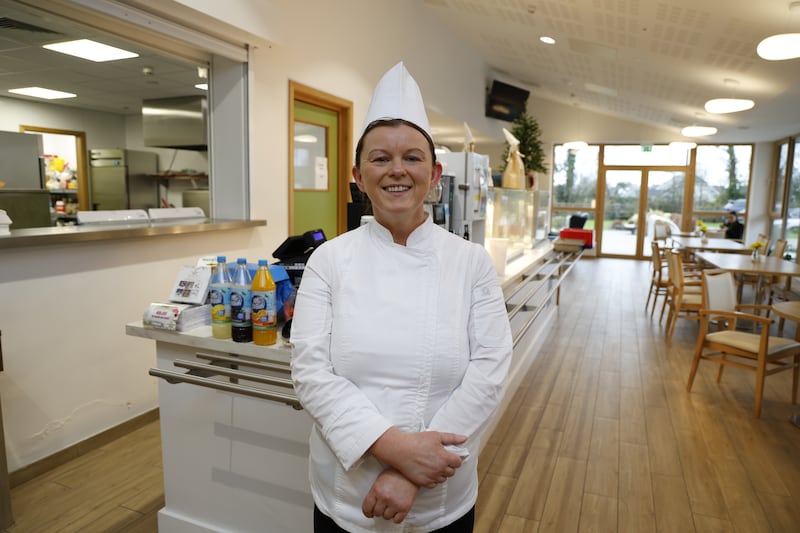
Chef Caroline McCormack loves her job. People also want to talk about their lives and what they’re going through and she’s happy to listen.
One woman wasn’t eating and when McCormack told her she’d cook whatever she wanted she asked for sausage and mash with onion gravy. “I made it and she was delighted and had it the few days after.” Foreign born people often want something from home. Sometimes she has to google it. “People have longings. You do it because it might be their last meal.”
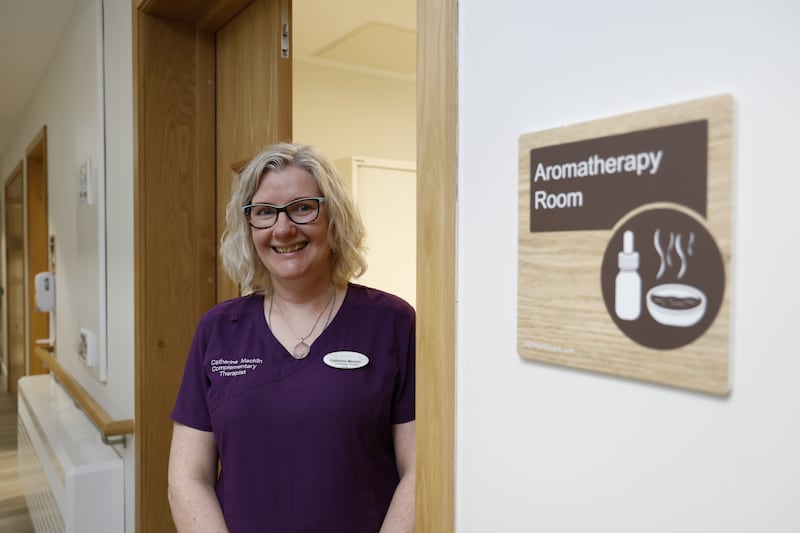
Complementary therapist Catherine Macklin was once an accountant, but she now specialises in sound therapy, aromatherapy and reflexology. “When you’re in a place of turmoil you don’t expect that there’s a space anywhere to feel peace or calm,” she says. “But there always is ... It’s very beautiful and really humbling work.”
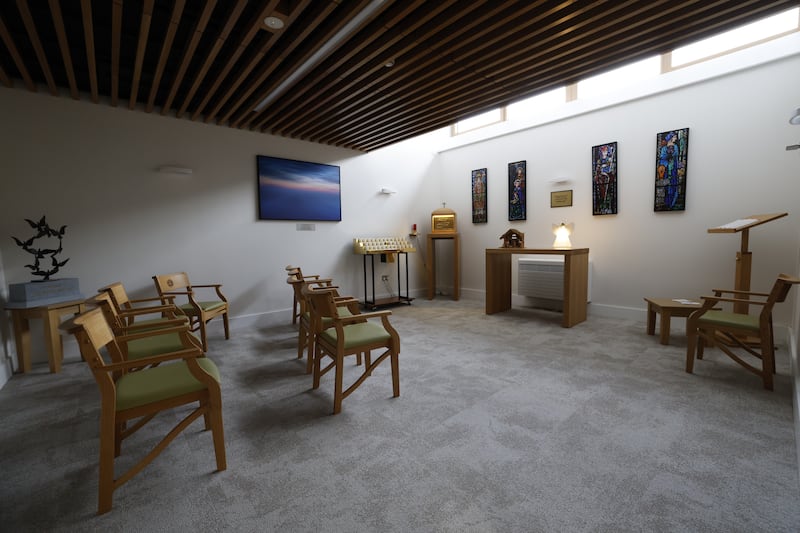
As Keane is showing me the non-denominational reflection room, we pass a man pushing a walker with two nurses on either side in case he stumbles. Keane greets him warmly.
[ How to survive Christmas when you are grieving for a loved oneOpens in new window ]
She’s surprised to see him up and about. In the cosy family room she introduces me to his wife, Rosemary, a teacher.
Keane gives her a big hug. Rosemary is staying here in the visitors’ bedroom and they’ve got to know each other. Owen is 59 and was diagnosed with pancreatic biliary cancer in June. He came here 11 days ago.
“We would have found it very sad that day,” says Rosemary. “You’re always thinking that maybe you’ll be the lucky one and that the treatment will do something. And Owen has great fight in him. It’s a big change, the realisation that this is where you’re at. But it’s been such a comforting experience here. Everyone is so kind.”
It’s been very difficult for them, she says. “To reconcile all of it in your head and your heart is hard. Owen is very independent and always has been. He’s always been hard-working, a great work ethic. And to go from that to being so sick, so quickly. In the beginning you think you’re going to beat it and then comes to the realisation you have to just accept the way it’s going to be. I work in a profession where you’re always fixing things, and you just can’t fix this. It’s out of your control. You just have to accept it.”
“He is also very worried about you and concerned we are minding you,” says Keane.
“He says to his family and mine, ‘Make sure Rosemary’s looked after’. There’s only the two of us. That makes it harder in a way. But we have a great support network. [Our families] have been absolutely wonderful.”
Right now, Owen’s hope is that he lives until his 60th birthday, shortly after I visit. “That would be his wish,” says Rosemary.
The staff here have hosted all sorts of celebrations here – birthdays, holy communions, date nights, anniversaries and one wedding. They sometimes bring a celebration forward. Rosemary is hopeful Owen will make his birthday. “Today is the first day he’s been out of the bed walking since he came,” she says. “He was sitting up having two boiled eggs. Then he said, ‘I’m going to go for a walk.’ He’s a very determined man.”
In January 1998, Rosemary was staying in Longford with family when they met a group of acquaintances in the pub. She gave Owen a lift home. “As I was crossing the street I thought, ‘These are the stories you hear about people who disappear’.” She laughs. “Two weeks passed and I bumped into him. He said, ‘I was looking for you’ ... He’s County Louth and proud. His greatest fear was he’d meet a woman from Longford.”
What’s he like? “He’s very, very loyal and kind. The sort of person you always feel safe with. A person of great integrity. That’s what I love about him. He’s a man of few words but you always know he’s there and has your back and is a very good person.”
Nobody expects this when they’re younger, she says. “I thought myself and Owen would see each other into old age. His fabulous consultant, Dr Silvie Blazkova, said, ‘I’ll give you treatment. I can’t cure you, but I can give you time.’ My 91-year-old mother, she said recently, ‘That was your wish, that Owen would be comfortable and you’d get time’.”
She can’t praise the medical and palliative care staff enough. She thinks she might volunteer here in future. The couple have also had huge support from family and friends.
“It’s very inspiring that people are so kind,” she says. “It’s about giving the person comfort and knowing that there are people around who love you and care for you and want you to be well within the context of where you are.” There are tears in her eyes now and her voice cracks. “He’s surrounded by love.”