
“The tipping point has been reached,” says Noeleen Smyth, head of horticulture at UCD, referring to non-native plant species now outnumbering native ones growing in Ireland. It raises profound questions about the true condition of ecosystems and what the future holds for them.
Ecologists in Ireland have traditionally held on to the importance of native species as the lodestar for conservation action, native being used to describe species of plants or animals that gained a toehold here without human help. Not all of these species become a problem – the majority of them are not – but those that do are referred to as alien invasive and this category of plants and animals are among the leading drivers of biodiversity loss globally.
In Ireland, Smyth asserts that collectively “they are a huge threat” noting, for instance, the damage that giant rhubarb has done on Achill island or the rhododendron in Killarney and Connemara National Parks.
These are species that have been an established problem for some time but Smyth worries “there are many more waiting in the wings”.
READ MORE


“We should be focusing on species that we know are really invasive but only have small populations in Ireland so far, such as the Japanese rose, which can become established on sand dune systems. We’d save ourselves a lot of trouble if we weeded them out now.”
Cotoneaster, a very common garden plant with small white flowers and red berries on sprawling stems, is another plant of concern for Smyth. However, identifying which of the many thousands of plants that may arrive in our country – or which of those that are already here but in small populations – will become invasive is not an easy task.
[ Ireland’s sika deer may face cull following ‘invasive species’ classificationOpens in new window ]
And it’s not just plants. The arrival of breeding colonies of the Asian hornet in 2025 gained wide media attention and a rapid response from authorities. But the number of new species arriving on our shores is remarkable. The autumn 2025 newsletter from the National Biodiversity Data Centre gives a taste, listing new sightings of freshwater turtles, short-tailed field voles (a common European rodent), roe deer and even a variated squirrel (a native of the Americas) as well as several exotic plants.
While the centre provides an early warning system for the arrival of invasive – or potentially invasive – species, the system for managing the response to these species is confused. Definitions for what actually constitutes an invasive species vary, but typically emphasise the potential harm that they can do native biodiversity and/or the economy. But therein lies a fatal tension.
Whole industries – not only garden centres and pet shops, but agriculture and forestry – rely on plants and animals that are exotic to our native ecosystems. Some of these cause tremendous ecological harm, such as sheep, goats or Sitka spruce, but are rarely thought of as invasive species.
In fact the Sitka spruce was identified by the Botanical Society of Britain and Ireland, in their monumental Plant Atlas 2020, as the plant with the greatest increase in distribution of any plant over the past 100 years. The authors pointed to the plant’s “invasive tendency”, noting that “it regenerates freely from seed, often on heathland and bog some distance away from plantations”. Yet the National Biodiversity Data Centre classifies it as “low risk of impact”.
Cherry laurel, which is a very frequent hedging plant, and distinctive with its shiny green leaves, is a native of Turkey’s Black Sea region and has infested swathes of broadleaved woodland in Ireland, particularly in the east and south. The centre labels it “invasive – risk of high impact” while the Citizens’ Assembly on biodiversity loss in 2023 recommended that the state should “act immediately” in banning its sale.
Yet it is not listed in legislation for this purpose and remains widely available in garden centres. “There’s no buy-in from the horticulture industry for this move,” says Smyth. “There’s so much of it being grown and supplied.”
The wild boar is considered by many ecologists to be as native a species as any, although proving this is difficult (as it is for many animals where debates rage as to their origins). In a risk assessment led by the biodiversity centre in 2014 it was acknowledged that this archaeological history was “complicated”.
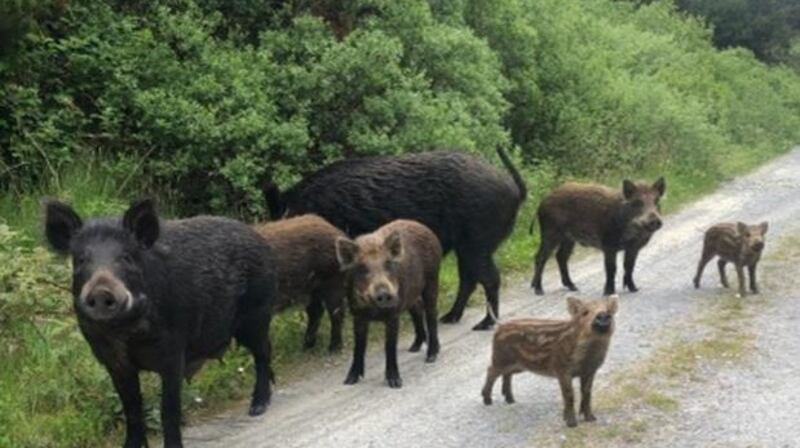
Wild boar are important components of forest ecosystems in Europe and Asia and have been shown to be beneficial to biodiversity. However, the risk assessment noted the potential for “major” economic losses due to crop damage and the potential for disease transmission. The animal has been listed as an invasive species in law since 2011.
There are many other exotic plants and animals that worry ecologists due to the impacts that are seen to native vegetation or wildlife. Pheasants, which originated in Asia, will wipe out local lizard populations and compete with ground-nesting birds such as corncrakes.
Pacific oysters could proliferate and supplant areas of sea floor that were traditionally composed of native flat oysters. Fuchsia and montbretia (also called Crocosmia) will take over whole roadsides where once there were native hedgerows. But all of these species have been assessed by the National Biodiversity Data Centre as “low risk” or have not been assessed at all.
Smyth says Ireland reacts more to edicts from the EU rather than developing its own system of assessment and management. In 2024 new legislation was passed to align with EU regulations “on the prevention and management of the introduction and spread of invasive alien species”. As well as many well-established weeds such as rhododendron and Japanese knotgrass, this law, for the first time, lists two of our most common deer species: fallow deer (well known from the Phoenix Park in Dublin) and Sika deer (an Asian introduction) but, confusingly, both remain protected species in the Wildlife Act.
[ ‘I think I see Japanese knotweed growing next door. What should I do?’Opens in new window ]
Identifying alien invasive species is one thing, and while the biodiversity centre performs a valuable task in monitoring and alerting authorities, it is not always clear whose job it is to enforce regulations or to carry out what might be difficult or expensive eradication programmes. The regulation says that it will be an offence to keep a species listed in law but it is hard to know the meaning of this given the number of invasive species, even on public lands such as parks or Coillte forests.
The new law is roundly welcomed in providing the tools necessary to prevent the sale and transport of proscribed species but, as of November 2025, there have been no enforcement actions by the responsible department – the Department of Heritage.
Collette O’Flynn, the invasive species officer with the National Biodiversity Data Centre, says their role is to receive and verify sightings and to make that information available as well as to assess whether non-native species are at risk of causing an impact, and determining what that impact is.
Many of the assessments are more than a decade old but now a review of risk assessments and methodologies is under way on an all-island basis, with greater resources from the government’s Shared Island Initiative.
While she welcomes that Irish law is now compliant with the EU regulation, she does not believe that we have the infrastructure in place to implement it. She also notes that an assessment by the centre of a species as “high risk” brings no legal ramification where it is not listed in law. “It’s not clear what is the process for having species listed in regulations as invasive,” she says.
As for who is responsible for removing or eradicating species from land, she says “it doesn’t clearly set out in the regulations that landowners are responsible for managing alien invasive species”.
“There is a piece of work that is badly needed on clarifying roles and responsibilities and looking at governance across Ireland, and that’s both from central government and state agencies,” she says.
“The National Biodiversity Action Plan tells us we’re looking at a whole-of-government and whole-of-society approach, and, certainly with alien invasive species, that’s where we need to start looking. But there is clarity that is needed and then looking at the supports that people need.
“But we don’t have a plan. We don’t have a strategy.”


