As the war on Iran enters its second month, reports from state media and residents in the Islamic Republic indicate mounting attacks on civilian infrastructure including homes, factories and electricity facilities.
Hospitals and homes
Iran’s Red Crescent Society, part of the international humanitarian network, said on March 30th that US-Israeli air strikes had damaged or destroyed more than 300 hospitals or medical facilities and more than 90,000 homes, about half of them in Tehran.
Some residents say they’ve seen increasing numbers of strikes on residential buildings. They include those on the capital’s north, a more affluent area where more secular Iranians live alongside regime elites. The pummelling of urban areas is also shifting the mood among some Iranians who might have initially supported the action, two people said.
“It’s not like they hit one block for one person, they hit three or five blocks expecting that the person will be in one of them,” a woman in her mid-50s who lives near the leafy Fereshteh neighbourhood said in voice notes sent on WhatsApp. On March 22nd, the strikes on her immediate surrounding area increased significantly, she said. “That’s how it’s been recently.”
READ MORE


Medical research
On Thursday, Iranian officials said the country’s landmark Pasteur Institute, a century-old medical research centre, was targeted in an air strike. Photographs published by the Iranian foreign ministry showed extensive damage.
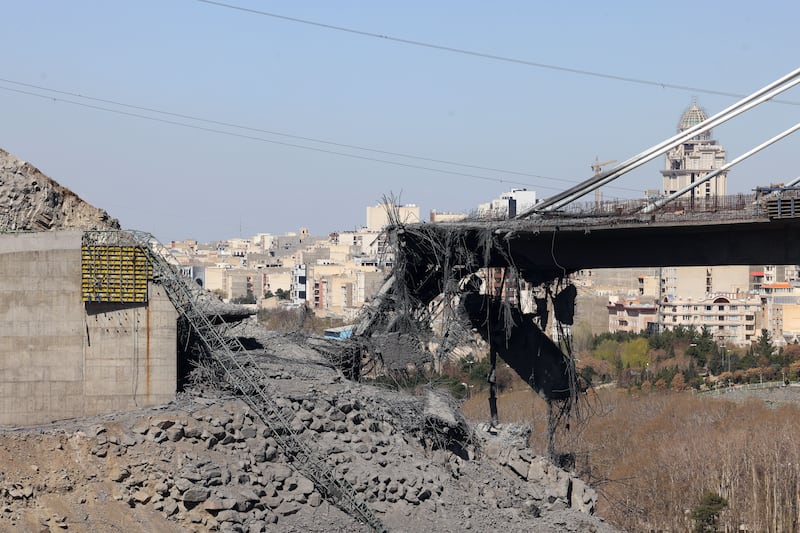
Bridge
On Thursday, US president Donald Trump posted footage on social media showing dust and smoke billowing up as US strikes hit the newly constructed B1 bridge between Tehran and nearby Karaj, which was due to open to traffic this year.
“Our Military, the greatest and most powerful (by far!) anywhere in the World, hasn’t even started destroying what’s left in Iran. Bridges next, then Electric Power Plants!” he wrote in a subsequent post.
Electrical facilities
Away from Tehran, Iranian state media reported that an air strike on the town of Mahallat in central Markazi province killed 11 civilians including two women and three children. Earlier the same day, strikes on electrical facilities in the provinces of Tehran and Alborz had caused temporary blackouts. Neither report could be independently verified.
Pharmaceutical companies
Missiles also struck one of Iran’s biggest state-run pharmaceutical companies, Tofigh Darou, destroying its production and research and development units, state media said on Tuesday, blaming the strike on Israel. The company is a big producer of anti-cancer drugs and anaesthetic in Iran, according to the Social Security Investment Co, whose subsidiary owns the company.
Restrictions
Assessing the impact on Iran is difficult. Following a deadly crackdown on protests in January, Iranians are facing continuing pressure through arrests and judicial executions as the regime battles to keep its grip on power after initial signs that some people supported the strikes.
State-imposed restrictions on internet access and telephones mean that only state media and accredited photographers are able to publish footage and photos. Unverified social media clips of apparent damage and attacks are also limited because of the government’s internet blackout.
Iranian response
While Trump has signalled he is preparing to end the conflict, the US and Israel have pressed on with their bombardment of Iran. Trump said on Wednesday that he plans to hit the country “extremely hard” in coming weeks. The Islamic Republic, meanwhile, is firing missiles at Israel and Gulf states and is keeping the Strait of Hormuz largely closed to marine traffic.
The US and Israel say they are only hitting targets used for military purposes or by security services. Neither the US military nor Israel Defense Forces (IDF) have published a list of what exactly what they have struck.
“The IDF conducts precise operational planning and takes feasible precautions in both the planning and execution of strikes in order to mitigate harm to civilians and civilian infrastructure to the greatest extent possible,” the IDF said in a response to questions. A spokesperson for the US military was not immediately available for comment on specific incidents. – Bloomberg