A team of assistant referees walks into the Twelve Pins in Finsbury Park carrying linesmen’s flags and whistles. It’s 3pm on a Thursday, you think, they’ve probably just been reffing a local game. Then, you think, there isn’t a football pitch around here. And why haven’t they changed and showered? Then more referees walk in, more linesmen, one of them in a comedy wig. And eventually the penny drops.
Yes, “the Darts” is back: an indispensable festive trimming that – much like Christmas itself – always seems to roll around a little sooner every year. Fire up all the old cliches: “the beauty of set play”, “bent the wire”, “pressure the shot”. Wheel John Part out of the attic. Fingers poised on the 180 zoom. You know it’s serious, because it’s two hours before his match and Luke Littler is already on the practice board.
Littler won on opening night, of course he did. Nobody will be too fussed about dwelling on the finer details of his 3-0 win over Darius Labanauskas, least of all Littler himself. But the Lithuanian can certainly be proud of the way he pushed the defending champion, averaging 95 and taking the first two sets to deciding legs.
Certainly there was little here to disabuse anyone of the notion that Littler is the overwhelming favourite to claim the sport’s first ever £1 million prize. It took 23 years for Phil Taylor – a 16-time winner – to accumulate that sum in world championship prize money. This year’s winner could do it in the space of a few weeks. Even Labanauskas walked away with £15,000 for his first-round defeat.
READ MORE


And in a way there has always been a kind of paradox at the heart of this championship: an event that somehow keeps getting bigger while also managing to stay exactly the same. This is the first year in which the field has expanded from 96 players to 128. Next year’s tournament will move from the Ally Pally’s West Hall to the larger Great Hall in an attempt to meet the voracious demand that led to all the tickets selling out in 12 minutes in July.
By any barometer the sums of money at stake here are genuinely life-changing, sums that have gently warped the gravity of the sport. The prize money on the lower rungs of the tour – the weekly tournaments in regional leisure centres where most pros spend most of their existence – is handy, but still not quite enough to make a viable living.
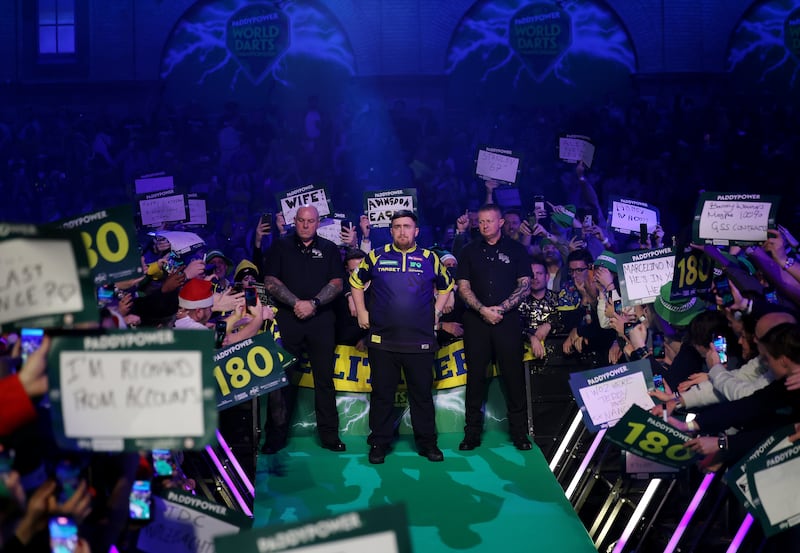
By contrast, a single run at Alexandra Palace can make or break an entire year, an entire career. Take the delighted Arno Merk, an amateur from Germany who has barely played on television before, whose first-night win over Kim Huybrechts netted him a cheque of at least £25,000. “It’s a hefty sum of money,” he said. “I’m definitely going to use it as a springboard and go full-throttle to become a professional. I’m not going to buy a car or anything.”
And so in a sport still defined by fine margins, these few weeks take on a more feverish, desperate hue than ever before. The highs can be supreme; the lows crushing. In the first week of 2023 Michael Smith sat atop the world, having tasted perfection in the greatest leg of darts ever seen. Two years later he lost his first match, at which point all the 2023 money also dropped off his ranking, instantly dumping him out of the top 16.
Now, after a nightmarish few years in which his body has fallen apart and his ranking has collapsed, Smith is back. He comfortably saw off Lisa Ashton, the women’s world matchplay champion, 3-0 on opening night, offering hope of a happy coda to a year blighted by ankle injuries, shoulder injuries and chronic arthritis in a wrist that left him barely able to practise for more than half an hour. “The butterflies was bad this morning,” Smith admitted. “It’s hard coming the first night, especially if you get beat.”
Michael van Gerwen is just one of the many pros who have been grumbling at the potential for outsized world championship prize money to distort the sport. “I don’t think the distribution is fair,” he said recently. “The world champion soon hardly needs to play any other tournament.” All of which raises an interesting counter-question: in a 12-month sport, has this show now become too big?
One to chew on for the darts hard-core and the tour stalwarts. But for all the strides this sport has made over the decades, this remains its one genuine showpiece, its one cut-through event, and to an extent its rewards are simply a reflection of its status. And from the happy costumed throngs making their annual pilgrimage up the hill, you will hear few complaints.
After all, if darts has taught us anything, it’s the value of giving people exactly what they want. – Guardian