

Pharmacists have long brought a unique blend of clinical expertise, medicines knowledge and patient-centred care to the healthcare system. In recent years, the profession has evolved significantly, with some of the most transformative developments taking place this year. This enables pharmacists to play an even greater role in improving patient care.
Shane Cullinan is programme director of the MPharm course at RCSI. He says that with recent developments such as the Common Conditions Service – where pharmacists can now prescribe medicines for a number of specific conditions – pharmacists can finally begin to use more of the tools in their toolbelt. It also means that training for pharmacists at the university’s state-of-the-art St Stephen’s Green campus is strategically evolving to keep pace with these big shifts.
“When I started college, there was talk of the role changing and expanding responsibilities, but it has only been in the last few years that we’ve seen the fastest rate of change and the most impact,” Cullinan says. “It’s really satisfying for us now as educators to stand up in front of a class and explain why this is such an exciting time to become a pharmacist given how the role has changed.”

Pharmacists, Cullinan says, have always been trained to “do more than perhaps legislation allowed them to do”. The difference now is that training is finally being put to use in the workplace. “There is now the opportunity for more direct, targeted patient care and for patients to benefit more from these accessible and highly trained healthcare professionals.”
READ MORE


The relatively rapid evolution of pharmacy necessitates an agile training ground. Cullinan says a big focus for RCSI has been to adapt its programme to ensure that their graduates are more than able for these changing demands.
“The university curriculum for any program is really a byproduct of the landscape at that time but we have always tried to be future focused in the school of pharmacy and biomolecular sciences, and particularly with all the developments in the last few years,” he says.
For example, in the years preceding the introduction of the Common Conditions Service, and in anticipation of legislative changes, the school had already introduced prescribing for its undergraduates. This has now been stepped up even further, Cullinan says.
“Our students actually sit the Prescribing Safety Assessment, which is a mandatory assessment for junior doctors in the UK, and they’re the only pharmacy students in the country who do it. They do phenomenally well in it, which is really heartening and encouraging to see. It sets them up extremely well, not just for the recently expanded role, but for even more changes we hope we’ll see in the future.”
And as healthcare becomes increasingly digitalised, the school has also incorporated a specifically designed artificial intelligence (AI) curriculum into the pharmacy programme, which will be rolled out this coming year. “The objective is to prepare students for entering a workplace where AI is commonplace and help them understand its potential as well as its limitations,” says Cullinan. “We are also very lucky to have a state-of-the-art simulation suite in the university where students can really hone their clinical skills. We also leverage technology in other areas as part of our teaching, such as virtual dispensing software, to provide students with additional opportunities to practise fundamental skills”.

Opportunities for new graduates are myriad and offer attractive careers in a range of settings including community pharmacy, hospital pharmacy, pharmaceutical industry, regulation, academia, research and development.
“Every year, when the new group of first years come in, I am amazed at the breadth and the variety of personalities in the room,” Cullinan says. “It’s fantastic to see, because there are many different paths and roles in pharmacy which cater to a wide range of people.”
The traditional community pharmacist is very much a patient-facing role. This may suit some people more than others, but Cullinan says communication skills are an inherent focus of the pharmacy degree course. “Empathy is a big one,” he adds. “Some people are naturally empathetic, some people have to work on it a little bit, but everything can be worked on and developed. And it can be very rewarding for us, actually, to see a student’s journey from day one to the time they leave and how they have honed these different traits that they need.”

RCSI pharmacists also benefit from a human touch, as students begin to interact with real patients from the very beginning of the course; RCSI’s strong hospital links mean they receive invaluable bedside training. The university also employs a number of teacher practitioners, who alternate between their busy pharmacies and hospital wards for the lecture halls of the university.
“They are an invaluable resource for us in bringing the day-to-day reality of the workplace into the classroom,” Cullinan says. “What’s changing, what’s evolving, what does the future look like?”
One of the unique aspects of studying pharmacy within RCSI, Cullinan says, it is a healthcare university solely focused on training healthcare professionals. “Our students are learning alongside the people they’re ultimately going to be working beside. It creates a vibe and a culture on campus that everything is geared towards providing care for the patient. And we obviously work very closely with our colleagues in medicine, physiotherapy and dentistry through shared teaching and educational events.”
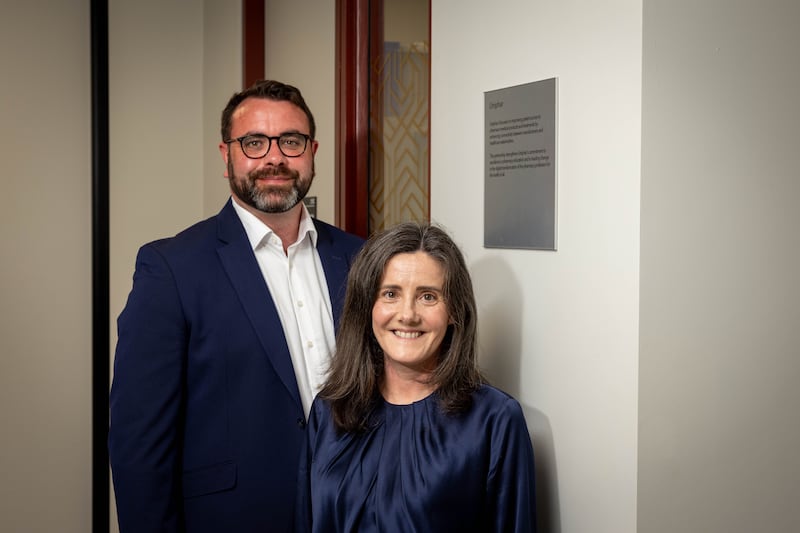
RCSI has recently announced a unique partnership with Uniphar to support excellence and innovation in pharmacy education and training. Uniphar are also sponsoring RCSI’s celebration of World Pharmacists Day which take place today. Shane O’Neill, director of pharmacy with the Irish pharmaceutical group, says that as the role of the pharmacist has expanded, so too have expectations for the profession.
“We’ve branched into prescribing in common conditions,” he says. “We have the same ability on pneumonia vaccinations as a GP, and we’re now starting to venture into the bowel screening initiative as well, where pharmacists are going to actually be referring to a screening pathway, whereas before we were just health promotion.”
Under the partnership, RCSI pharmacy undergraduates have the opportunity to undertake placements and internships at Uniphar pharmacies. This allows them to gain exposure to the diverse role of the pharmacist and identify what their future pharmacy career might look like.
“We get them involved in the organising and delivery of vaccination clinics before they even qualify,” O’Neill says. “The partnership allows us a far more deep-rooted connection with the university, as well as being able to provide real-time support in shaping pharmacists’ understanding of the role as it’s developing throughout their programme.”
The breadth of this offering will be explored as part of the RCSI school of pharmacy’s first open day for potential pharmacy students, on Saturday, October 17th.
“It’s a three-hour session where they’ll get to participate in a number of workshops and hear all about the pharmacy course,” Cullinan says. “It will be quite an immersive experience where you’ll get to feel what it’s like to be a RCSI student. We would love to lift the curtain and show people the potential and possibilities for someone with a pharmacy degree.”
RCSI Pharmacy Open Day will be held at RCSI, 26 York Street, on October 17th, 2026 at 12pm. Register at rcsi.com


